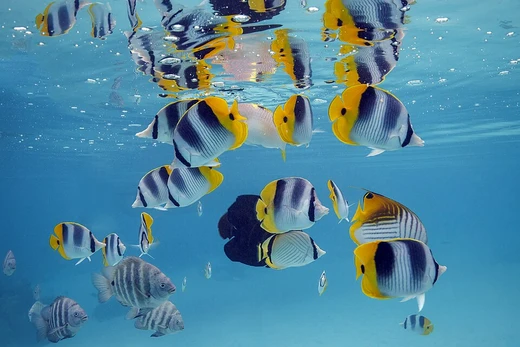
West Australian butterflyfish
Endemic butterflyfish of Western Australia's rocky reefs.

The West Australian butterflyfish (Chaetodon assarius), also called the Western or assarius butterflyfish, is a marine ray-finned fish in the family Chaetodontidae. It is found only along the west coast of Australia.
This fish has a pale silvery-brown body with a vertical dark stripe through the eye. On the upper two-thirds of the body, there are five vertical lines made of closely spaced dots. A wide brown to blackish band runs across the tail stalk and continues horizontally along the anal fin. Young fish have a black spot with white edges near the rear of the dorsal fin’s soft-rayed section; this spot remains in young adults but fades with age. The spiny part of the dorsal fin has 12 to 13 spines, the soft-rayed part has 21 to 22 rays, and the anal fin has 3 spines and 18 to 19 soft rays. The maximum total length is 15 centimeters (5.9 inches).
The species is endemic to Western Australia, ranging along the southern and western coasts from southeast of Israelite Bay to Exmouth Gulf and the North West Shelf. A report of it in deep, cold upwelling areas off Bali is thought to be based on misidentified Chaetodon guentheri.
It lives on rocky reefs and sandy flats with weed growth, often in groups. Its diet includes algae and zooplankton. It is oviparous and forms pairs for spawning.
The species was first formally described in 1905 by Australian ichthyologist Edgar Ravenswood Waite, with the type locality between Fremantle and Houtman Abrolhos. The name assarius means "browned," referring to its color and griddle-like markings. Some authorities consider it incertae sedis within the genus Chaetodon, while others place it in the subgenus Exornator.
Quick Facts
- Taxon
- Chaetodon assarius
Facts from the source article.
Lore & Background
The West Australian butterflyfish has a pale silvery-brown body with a vertical dark band through the eye. The upper two-thirds of the body are marked with five vertical lines of close-set dots. A wide brown to blackish vertical band runs across the caudal peduncle and then horizontally along the anal fin. Juveniles have an obvious black ocellus with white margins at the corner of the soft-rayed part of the dorsal fin, which is retained in young adults but lost as they age.
This species is endemic to Western Australia, found along the southern and western coast from southeast of Israelite Bay to Exmouth Gulf and the North West Shelf. A recent claim of its presence in deep water off Bali is thought to be based on misidentified Chaetodon guentheri. It inhabits rocky reefs and sandy flats with growth of weed, occurring in aggregations and feeding on algae and zooplankton. It is oviparous and forms pairs to spawn.
The species was first formally described in 1905 by Australian ichthyologist Edgar Ravenswood Waite, with the type locality given as between Fremantle and Houtman Abrolhos. The specific name assarius means 'browned', a reference to the colour and the griddle-like markings. Some authorities make this species incertae sedis within the genus Chaetodon, while others place it in the subgenus Exornator.
Reader's Guide
The West Australian butterflyfish is a species of marine ray-finned fish in the family Chaetodontidae, native to the west coast of Australia. Its significance lies in its restricted endemic range along the southern and western coast of Western Australia, from southeast of Israelite Bay to Exmouth Gulf and the North West Shelf. The article notes a disputed claim of its occurrence in deep water off Bali, which is thought to be based on misidentified Chaetodon guentheri, underscoring the importance of accurate species identification. Its description by Edgar Ravenswood Waite in 1905, with the type locality between Fremantle and Houtman Abrolhos, provides a historical anchor. The species' biology—occurring in aggregations, feeding on algae and zooplankton, and forming pairs to spawn—reflects its ecological role on rocky reefs and sandy flats. The taxonomic uncertainty, with some authorities placing it as incertae sedis and others in the subgenus Exornator, highlights ongoing scientific debate. Its maximum total length of 15 cm and distinctive markings, including a juvenile ocellus lost with age, contribute to its identification and life history understanding.
Did You Know?
- The West Australian butterflyfish is endemic to Western Australia, found from southeast of Israelite Bay to Exmouth Gulf.
- Juveniles have a black ocellus with white margins on the dorsal fin, which is lost as they age.
- The specific name assarius means 'browned', referring to its colour and griddle-like markings.
Physical Appearance and Morphology
The scrawled butterflyfish presents a striking visual profile against the backdrop of coral reefs. Its body is predominantly whitish or bluish-white, serving as a canvas for a series of bold black markings. These bars run diagonally across the flanks, each curving toward the posterior end of the fish, giving the species its evocative common name. A distinctive yellow-edged black stripe passes directly through the eye, while a similar dark band encircles the snout and mouth region. In terms of fin structure, the dorsal fin carries between twelve and thirteen spines followed by twenty-three to twenty-five soft rays, while the anal fin bears three spines and eighteen to twenty soft rays. The fish reaches a maximum total length of roughly twenty centimetres, making it a moderately sized member of the butterflyfish family. As a marine ray-finned fish within the family Chaetodontidae, it shares the general body plan of its relatives while maintaining these unique markings that distinguish it at a glance.
Indo-Pacific Geographic Range
The scrawled butterflyfish enjoys one of the broadest distributions among its coral-reef relatives, spanning the entirety of the Indo-Pacific region. Along the eastern African coastline, its range stretches from Somalia southward to Durban. From there, the species extends across both the Indian and Pacific Oceans, reaching as far east as the Line Islands and the Hawaiian archipelago. To the north, populations are documented around the Ryukyu Islands off the coast of Japan, while to the south the range encompasses the Great Barrier Reef, New Caledonia, and Tonga. Remarkably, this predominantly Indo-Pacific species has also turned up as a vagrant in the eastern Pacific, with records from the Galapagos Islands off Ecuador and the Revillagigedo Islands near Mexico. These isolated occurrences suggest that individuals can occasionally be carried far beyond their normal habitat by ocean currents or other dispersal mechanisms, though they do not establish permanent populations in those distant waters. The sheer breadth of this distribution underscores the species' adaptability across diverse tropical reef environments.
Habitat, Social Behaviour, and Feeding Ecology
In its natural environment, the scrawled butterflyfish occupies a relatively shallow marine zone, typically ranging from just two metres down to about twenty-five metres in depth. It favours areas abundant with living coral, whether in sheltered clear lagoons or on the more exposed seaward reef slopes. The species displays a notable shift in social behaviour as it matures. Young fish tend to be solitary, weaving through the intricate branches of stony corals where they find both shelter and food. As they reach adulthood, their social structure changes: they typically form pairs and establish a defined home range within the reef. Reproduction follows a paired strategy, with the species being oviparous and breeding as couples. Perhaps most ecologically significant is its feeding specialisation. The scrawled butterflyfish is an obligate corallivore, meaning coral is its sole food source. However, researchers believe it primarily consumes the mucus secreted by coral polyps rather than the hard tissue itself, a subtle but important distinction in reef ecology.
Taxonomic History and Classification
The formal scientific description of the scrawled butterflyfish dates back to 1801, when the German naturalists Marcus Elieser Bloch and Johann Gottlob Theaenus Schneider published their account. They designated Ambon Island in Indonesia as the type locality. The specific epithet 'meyer' honours an individual whose identity the original authors did not explicitly state. The type specimen resided in the Museo Meyeri Lugduni Batavorum, commonly known as Meyer's Museum, located in Leiden, Netherlands. One plausible candidate for this 'Meyer' is Johan Frederik Meijer, a bookkeeper stationed at Ambon Island who maintained a small natural-history collection in the Netherlands during the eighteenth century. Taxonomically, the species sits close to the mailed butterflyfish and the ornate butterflyfish, and all three were once grouped under the subgenus name 'Citharoedus.' However, that name is invalid because it had already been applied to a mollusc genus. The group may also be closely related to the subgenus Corallochaetodon, which includes the melon butterflyfish. Should the large genus Chaetodon be subdivided, these species could potentially be reclassified under the name Megaprotodon.
Frequently Asked Questions
What is the West Australian butterflyfish?
It is a small marine ray-finned fish belonging to the butterflyfish family Chaetodontidae, with the scientific name Chaetodon assarius. The species is also commonly known as the Western butterflyfish or the assarius butterflyfish.
Where can the West Australian butterflyfish be found?
This fish is restricted to rocky reefs along the west coast of Australia and does not occur in any other ocean or coastline. Its strictly local range makes it a true endemic of that region.
What does the West Australian butterflyfish look like?
Adults show a pale silvery-brown body marked by a bold vertical dark stripe through the eye, five dotted vertical lines on the upper two-thirds of the flank, and a wide dark band sweeping across the tail stalk and anal fin. Young individuals additionally bear a black spot edged in white near the rear of the soft-rayed dorsal fin.
How big does the West Australian butterflyfish grow?
It reaches a maximum total length of roughly 15 centimetres (about 6 inches), placing it among the smaller members of its family. Its fin formula includes 12–13 dorsal spines, 21–22 dorsal soft rays, and 3 anal spines.
Why is the West Australian butterflyfish considered significant?
Because it is endemic to Western Australia's rocky reefs, it exists nowhere else on the planet, giving it a unique biogeographic profile. That narrow distribution also makes it a useful indicator of the condition of those specific reef habitats.
More in Butterflyfish, Part 3 1-24
Spotted an error? Know more?
Reader corrections go straight into our review queue. Suggest an edit · How this site is sourced