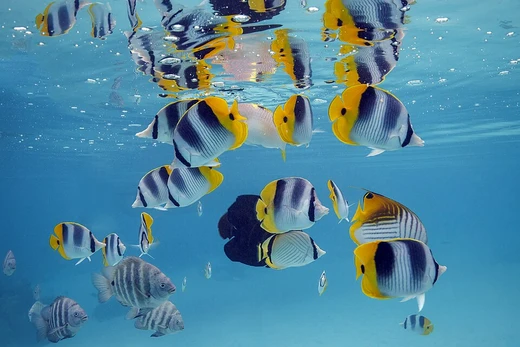
Chaetodon ulietensis
Pacific double-saddle butterflyfish, a coral-reef omnivore with distinctive saddles.

Chaetodon ulietensis, commonly known as the Pacific double-saddle butterflyfish or false falcula butterflyfish, is a species of butterflyfish in the family Chaetodontidae. It flourishes in coral-rich environments in the central Indo-Pacific region, with a range extending from the Cocos-Keeling Islands to the Tuamotu Islands and north to Japan. It is notable for its distinctive coloration and its beneficial role in controlling nuisance sea anemones in aquariums.
Quick Facts
- Genus
- Chaetodon
- Parent
- Chaetodon (Rabdophorus)
- Species
- ulietensis
Facts from the source article.
Lore & Background
Chaetodon ulietensis is white with vertical thin black lines down the body and two dark saddles on the fore and hind back, which softly grade into the background caudal gradient. Immediately after the hind quarter saddle, the body and tail is bright yellow with a black spot on the caudal peduncle. The dorsal fin has a streak of yellow from the crown of the head to the tail. Like most of its relatives, this species displays a black eye band like a mask. As in most butterflyfish, it is prone to blanching at night and when startled.
C. ulietensis belongs to the large subgenus Rabdophorus, which might warrant recognition as a distinct genus. In this group, it is sister to the similar-looking black-wedged butterflyfish, C. falcula. Other fairly close relatives are the lined (C. lineolatus) and spot-naped butterflyfishes (C. oxycephalus), while the blue-cheeked butterflyfish (C. semilarvatus) is the sister species to all of these. Vertical lines are present in all of these species, while a white body with yellow behind and black on back and caudal peduncle are shared by all but C. semilarvatus.
Ecologically, Chaetodon ulietensis is often found singly or in pairs on coral-rich reef systems, foraging on sessile invertebrates and algae. It is not a territorial species that freely grazes throughout a wide range within reefs, lagoons and harbors, and every now and then large groups congregate at rich feeding spots. It is rarely ever observed in a deep reef environment or the open sea; juveniles are typically reared in shallow lagoons, estuaries or harbors. As a measure of defense, they typically wedge themselves in tight crevasses to escape predators.
Reader's Guide
Chaetodon ulietensis is significant in both wild and aquarium contexts. In the wild, it is common in coral-rich environments of the central Indo-Pacific, typically found from the surface to 20 m depths in shallow channels with high current. It is an opportunistic omnivore, feeding mainly on microscopic algae, other plankton, and small sessile invertebrates. It is not territorial and freely grazes across reefs, lagoons, and harbors, occasionally forming large groups at rich feeding spots.
In the aquarium trade, although common in the wild, it is rarely imported. It is considered a hardy Chaetodon and beneficial for the control of nuisance pests. Notably, it has been observed as a beneficial predator of Aiptasia and Majano sea anemones, eliminating them within a 2- to 6-week period depending on the anemone population and tank size. Unlike most raccoon butterflyfish, this species rarely feeds on ornamental corals. It readily accepts most prepared frozen and dry foods, making the transition to aquarium life easier than less hardy species like the Copperband Butterflyfish. Its legacy lies in its dual role as a resilient reef fish and a practical biological control agent in captivity.
A Study in Contrasting Colours
The blackwedged butterflyfish presents a striking visual palette that immediately distinguishes it among reef dwellers. Its base colouration is a clean white canvas, overlaid with a series of slender vertical stripes in a muted dark grey that run from the upper body downward. Two prominent black saddle-shaped markings sit along the dorsal region, while a bold vertical band of black crosses the eye area, and the narrow caudal peduncle is likewise painted solid black. Against this monochrome scheme, the dorsal, anal, and caudal fins blaze in a vivid yellow, a hue that spills slightly onto the flanks immediately adjacent to those fins. Structurally, the species carries twelve to thirteen spines paired with twenty-three to twenty-five soft rays in its dorsal fin, while the anal fin holds three spines alongside twenty to twenty-one soft rays. Adults reach a maximum total length of roughly twenty centimetres, making them a moderate-sized member of the butterflyfish family.
A Vast Indian Ocean Footprint
This butterflyfish enjoys one of the broadest distributions among its reef-dwelling relatives, spanning a remarkable arc of the Indian Ocean. Along the eastern African shoreline, its range stretches from Kenyan waters all the way south to the coast of South Africa. It is also a regular presence around Madagascar and the scattered western and central Indian Ocean island chains. Moving eastward, populations inhabit the waters off Sri Lanka and southern India, extending into the Andaman and Nicobar archipelagos. The species' eastern boundary reaches from the western Thai coast as far as the waters surrounding Java. Perhaps most notably, it has been recorded in the Cocos (Keeling) Islands, a territory administered by Australia, underscoring just how widely this single species threads through the ocean's island communities.
Life on the Reef Edge
The blackwedged butterflyfish favours the energetic boundary where the reef crest meets the upper slope, typically at depths between one and fifteen metres. These are zones where strong currents sweep across the substrate, and the adults appear well adapted to such conditions. Juveniles, by contrast, seek the shelter of branching corals, tucking themselves into crevices to avoid the force of the water. Socially, the species is neither solitary nor highly gregarious; it is most often encountered in tight pairs or in loose aggregations numbering up to twenty individuals. Its foraging diet is impressively varied, encompassing coral polyps, small worms, sea anemones, crustaceans, sponges, the fleshy feet of sea urchins, and a range of other invertebrates. When it comes to reproduction, the fish forms a dedicated breeding pair, and the resulting pelagic eggs are released and dispersed into the open water column, entrusting the current to carry them onward.
A Name Born of a Sickle and a Century-Old Description
The species received its formal scientific description in 1795 from the German physician and naturalist Marcus Elieser Bloch, who based his account on specimens from Tharangambadi on the Indian coast. He chose the specific epithet falcula, a diminutive derived from the Latin falx or falcis, meaning a small sickle or scythe. Bloch had sketched the two dorsal saddle blotches as distinctly sickle-shaped, though modern photography reveals they are more wedge-like than curved. Taxonomically, the blackwedged butterflyfish sits as the sister species to the Pacific double-saddle butterflyfish, Chaetodon ulietensis, and both are members of the large subgenus Rabdophorus, a grouping some researchers feel might justify elevation to full genus rank. Their closest relatives include the lined and spot-naped butterflyfishes, while the blue-cheeked butterflyfish branches off as the sister to that entire cluster. Vertical striping is a shared trait across all of these, and the combination of a white body, yellow posterior fins, and black dorsal and caudal markings unites every member except the blue-cheeked form.
More in Butterflyfish, Part 3 1-24
Spotted an error? Know more?
Reader corrections go straight into our review queue. Suggest an edit · How this site is sourced