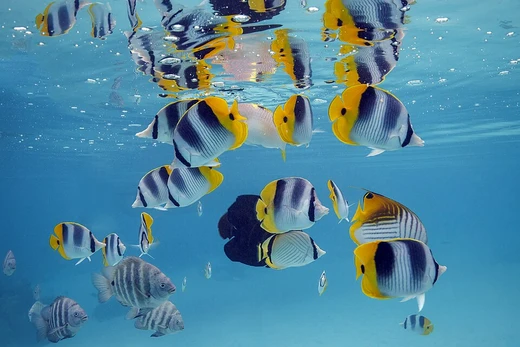
Yellow teardrop butterflyfish
A yellow butterflyfish with a teardrop-shaped black spot.

The yellow teardrop butterflyfish, also called the Indian teardrop butterflyfish, is a marine ray-finned fish belonging to the butterflyfish family Chaetodontidae. Its range covers the Indian Ocean, stretching from East Africa—south to Port Alfred, South Africa—eastward to Sumatra, Indonesia.
This fish has a disc-shaped, laterally compressed body colored bright yellow. A large black spot sits on the upper flank, and a black vertical bar passes through the eye. Another black vertical bar runs along the rear margin, from the back part of the dorsal fin’s soft rays down to the anal fin. The tail is white, and the tail fin is transparent. Paler chevron-like markings run vertically down the sides. In smaller juveniles, the black flank blotch has a white ring around it; this ring is rounder and less teardrop-shaped than in adults, and the black is tinted with blue. As the fish grows, the white outer ring turns yellow, and the blotch becomes teardrop-shaped. The dorsal fin contains 12 to 13 spines and 21 to 23 soft rays, while the anal fin has 3 spines and 18 to 20 soft rays. Maximum total length reaches 20 centimeters (7.9 inches).
The species occurs along the East African coast from Somalia and Socotra south to South Africa, east to Sumatra and western Thailand, and includes most Indian Ocean islands and southern India. It lives in habitats ranging from coral reef flats to deep slopes. Adults are usually seen in pairs, though they sometimes forage in small schools. This fish is oviparous, with males and females forming pairs to breed. It is omnivorous, feeding on hard and soft coral fragments, sponges, polychaetes, and filamentous algae.
First formally described in 1923 from Mauritius by German zoologist Ernst Ahl (1898–1945), it was originally classified as a subspecies of the Indo-Pacific teardrop butterflyfish (*Chaetodon unimaculatus*). Some authorities still consider it a subspecies. The yellow teardrop butterflyfish appears infrequently in the aquarium trade and is regarded as moderately difficult to keep.
Quick Facts
- Parent
- Chaetodon (Lepidochaetodon)
- Genus
- Chaetodon
- Species
- interruptus
Facts from the source article.
Lore & Background
The yellow teardrop butterflyfish was first formally described from Mauritius in 1923 by the German zoologist Ernst Ahl as a subspecies of the Indo-Pacific teardrop butterflyfish (Chaetodon unimaculatus). Some authorities still consider it to be so. It is found in the Indian Ocean from East Africa (south to Port Alfred, South Africa) to Sumatra, Indonesia, including most Indian Ocean islands and southern India.
Its body is disc shaped and laterally compressed, bright yellow, with a large black spot on the upper flank and black vertical bars through the eye and at the rear margin. The tail is white and the tail fin transparent. Juveniles have a white ring around the blotch, which is rounder and tinted with blue; as they grow, the ring turns yellow and the mark becomes teardrop shaped.
Adults are normally encountered in pairs but occasionally forage in small schools. They are oviparous, forming pairs to breed. Their diet includes hard and soft coral fragments, sponges, polychaetes, and filamentous algae.
Reader's Guide
The yellow teardrop butterflyfish is infrequently found in the aquarium trade and is considered of medium difficulty for keeping within this hobby. Its habitat ranges from coral reef flats to deep slopes in the Indian Ocean. The species is omnivorous, feeding on a variety of organisms including coral fragments, sponges, polychaetes, and algae. Adults typically occur in pairs, though they may form small foraging groups. The fish is oviparous, with males and females pairing to breed. Its taxonomic status remains uncertain, as it was originally described as a subspecies of Chaetodon unimaculatus and is still regarded as such by some authorities. The species attains a maximum total length of 20 centimetres. Its distinctive teardrop-shaped marking, which develops from a rounder blue-tinted blotch in juveniles, is a key identifying feature. The yellow teardrop butterflyfish is not widely traded, but its moderate difficulty in captivity means it is of interest to experienced aquarists.
Did You Know?
- The yellow teardrop butterflyfish was first described from Mauritius in 1923 by Ernst Ahl as a subspecies of Chaetodon unimaculatus.
- Juveniles have a white ring around the flank blotch, which turns yellow and becomes teardrop-shaped in adults.
- It has 12–13 spines in its dorsal fin and 3 spines in its anal fin.
- This species is found from East Africa to Sumatra, including most Indian Ocean islands.
Striking Coloration and Growth Transformation
The yellow teardrop butterflyfish presents one of the most visually arresting profiles among marine ray-finned fish. Its body is a vivid, saturated yellow, shaped into a broad disc that is strongly compressed from side to side, giving it a flat, plate-like silhouette. A prominent black blotch sits on the upper flank, while a bold vertical stripe passes through the eye and a second dark bar anchors the rear of the body, stretching from the back edge of the soft-rayed portion of the dorsal fin down to the anal fin. The caudal region contrasts sharply: the tail itself is white and the fin membrane is nearly transparent. Fainter chevron patterns trace vertically along the flanks. The most fascinating aspect is the developmental shift. Young fish display a rounded, blue-tinted dark spot encircled by a white ring. As the individual matures, that outer ring gradually shifts to yellow and the central mark elongates into the distinctive teardrop shape that gives the species its common name. Adults reach a maximum total length of twenty centimetres, with dorsal fin counts of twelve to thirteen spines and twenty-one to twenty-three soft rays, while the anal fin carries three spines and eighteen to twenty soft rays.
Indian Ocean Range and Reef Habitat
The yellow teardrop butterflyfish is a species confined to the warm waters of the Indian Ocean, where its range stretches across a remarkably broad arc. Along the African coast, it occurs from the waters off Somalia and the Socotra archipelago southward all the way to Port Alfred in South Africa. Eastward, its distribution extends to the western shores of Sumatra in Indonesia and the coast of western Thailand. The species also inhabits the majority of Indian Ocean island groups and the southern Indian coastline. Within this vast geographic span, the fish occupies a wide vertical and structural range of reef environments, from shallow coral reef flats to the steeper, deeper slopes that drop away from the reef crest. This flexibility in habitat use suggests a tolerance for varying light levels, current strengths, and substrate compositions across the Indian Ocean basin. The broad but regionally restricted distribution—present throughout the Indian Ocean yet absent from the Pacific—makes it a useful marker of Indian Ocean biogeographic boundaries among butterflyfish species.
Pair Bonding and Omnivorous Foraging
In the social structure of the yellow teardrop butterflyfish, the adult pair is the fundamental unit. Males and females form lasting breeding partnerships, and these bonded couples are the configuration most commonly observed in the wild. On occasion, however, the species will abandon its typical paired existence and forage in small, loose schools, suggesting a degree of social flexibility that is not the norm. Reproduction follows an oviparous pattern, with mated pairs coordinating their breeding activities together. At the dietary level, the fish is a true omnivore with a notably varied menu drawn from the reef ecosystem. Its feeding repertoire includes fragments of both hard and soft coral, sponges, polychaete worms, and filamentous algae. This broad diet allows the species to exploit multiple trophic levels and food sources across the diverse habitats it inhabits, from sunlit reef flats to the dimmer slopes below. The combination of pair bonding, occasional schooling, and dietary versatility paints a picture of a flexible, socially structured reef dweller well adapted to the resource mosaic of the Indian Ocean.
Taxonomic History and Aquarium Presence
The formal scientific recognition of the yellow teardrop butterflyfish traces back to 1923, when the German zoologist Ernst Ahl (1898–1945) described the species from specimens collected in Mauritius. Ahl originally placed it as the subspecies interruptus within the broader Indo-Pacific teardrop butterflyfish, Chaetodon unimaculatus. Even more than a century later, a number of taxonomic authorities continue to treat it in that subspecific capacity rather than as a fully independent species, reflecting an ongoing debate about the degree of differentiation between the Indian Ocean and wider Indo-Pacific populations. The alternative common name, Indian teardrop butterflyfish, further underscores its regional identity. In the realm of the marine aquarium hobby, the species remains a relatively uncommon sight. When it does appear in the trade, keepers rate it as a medium-difficulty fish to maintain, placing it above the easiest reef species in terms of husbandry demands. Its infrequent availability in the aquarium market, combined with the taxonomic uncertainty surrounding its status, keeps it on the periphery of the hobbyist's awareness despite its striking coloration.
Frequently Asked Questions
What is the yellow teardrop butterflyfish?
It is a small marine ray-finned fish in the butterflyfish family Chaetodontidae, more formally known as Chaetodon interruptus. The species is also commonly called the Indian teardrop butterflyfish.
Where does the yellow teardrop butterflyfish live?
Its natural range spans the Indian Ocean, stretching from the East African coast south to Port Alfred in South Africa and eastward as far as Sumatra, Indonesia.
What does the yellow teardrop butterflyfish look like?
It has a bright yellow, disc-shaped body that is strongly compressed from side to side. A large teardrop-shaped black spot sits on the upper flank, a vertical black bar crosses the eye, and a second vertical black bar runs along the rear margin from the soft dorsal rays down to the anal fin.
How big does the yellow teardrop butterflyfish get?
Adults reach a maximum total length of about 20 centimetres (roughly 8 inches). Fin counts include 12 to 13 dorsal spines, 21 to 23 soft dorsal rays, and 3 anal spines.
What makes the yellow teardrop butterflyfish easy to identify?
The combination of its vivid yellow body, the prominent teardrop-shaped black spot on the flank, and the two vertical black bars (one through the eye and one at the rear) sets it apart from other Indian Ocean butterflyfish. These markings are consistent across the species and give it both common names.
More in Butterflyfish, Part 3 1-24
Spotted an error? Know more?
Reader corrections go straight into our review queue. Suggest an edit · How this site is sourced