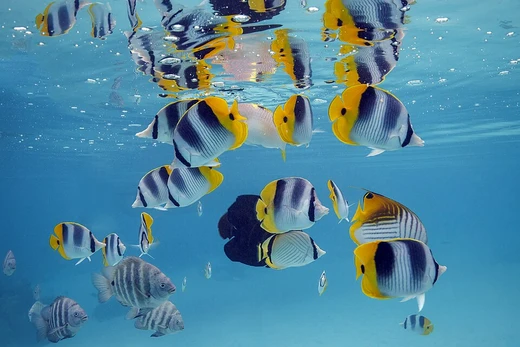
Chaetodon wiebeli
A yellow butterflyfish with a black forehead blotch and eye band.

The Hong Kong butterflyfish, also known as Wiebel's butterflyfish or the blackcap butterflyfish, is a marine ray-finned fish in the family Chaetodontidae. This species lives in the Western Pacific Ocean.
Its body is oval, deep, and strongly compressed, with a head as tall as it is wide. A short snout holds a small, protractile mouth lined with bristle-like teeth—the source of the genus name *Chaetodon*, meaning "bristle tooth." The preopercle is smooth and lacks obvious spines. The fish is mainly yellow with oblique brown lines. A vertical black band runs through the eye, with a white bar behind it, and a black blotch sits on the forehead. The dorsal, anal, pelvic, and caudal fins are yellow, though the caudal fin has a black margin. The dorsal fin has 12–13 spines and 22–25 soft rays; the anal fin has 3 spines and 18–20 soft rays. Maximum total length is 19 cm (7.5 in).
This butterflyfish ranges across the western Pacific, from southern Japan and South Korea down to northern Java, and into the Gulf of Thailand.
It inhabits both rocky and coral reefs, usually in pairs or small shoals, though it can be solitary. Its diet includes coral polyps, benthic invertebrates, and algae, and it often grazes algae off rocks. It is oviparous, forming pairs during breeding. Depth range is 4 to 25 metres (13 to 82 ft).
First formally described in 1863 by German ichthyologist Johann Jakob Kaup, the type locality is Canton, China. The specific name honors Kaup’s friend, naturalist and co-founder of the Zoological Museum in Hamburg, Karl Maximilian Wiebel (1808–1888). It belongs to the large subgenus *Rabdophorus*, which may warrant recognition as a distinct genus.
Quick Facts
- Genus
- Chaetodon
- Parent
- Chaetodon (Rabdophorus)
- Species
- wiebeli
Facts from the source article.
Lore & Background
Chaetodon wiebeli has an oval shaped, deep and strongly compressed body with a head which is the same height as its width and a short snout with a small protractile mouth equipped with setiform teeth in its jaws. These teeth are referred to in the genus name Chaetodon which means 'bristle tooth'. It has a smooth preopercle which does not have any obvious spines. The colouration is mainly yellow marked with oblique brown lines. There is a vertical black band running through the eye, with a white bar to its rear, and a black blotch on the forehead. The dorsal, anal, pelvic and caudal fins are yellow, although the caudal fin has a black margin.
Chaetodon wiebeli was first formally described in 1863 by the German ichthyologist Johann Jakob Kaup with the type locality given as Canton in China. The specific name honours Kaup's friend, the naturalist and one of the founders of the Zoological Museum in Hamburg, Karl Maximilian Wiebel. It belongs to the large subgenus Rabdophorus which might warrant recognition as a distinct genus.
Reader's Guide
Chaetodon wiebeli is found in the western Pacific Ocean from southern Japan and South Korea to northern Java, extending into the Gulf of Thailand. It inhabits both rocky and coral reefs, where they are normally encountered in pairs and small shoals. They feed on coral polyps, benthic invertebrates and algae. This is an oviparous species which forms pairs during breeding. They may be solitary and their main feeding technique is grazing algae off rocks. They can be found at depths of 4 to 25 metres. The species attains a maximum total length of 19 centimetres. Its distinctive black forehead blotch and eye band, along with its yellow fins and oblique brown lines, make it recognizable among butterflyfish. The species is part of the subgenus Rabdophorus, which some authorities consider possibly warranting recognition as a distinct genus, though this remains unresolved.
Did You Know?
- The specific name honours Karl Maximilian Wiebel, a naturalist and co-founder of the Zoological Museum in Hamburg.
- It has a black blotch on the forehead and a vertical black band through the eye with a white bar behind it.
- The dorsal fin contains 12–13 spines and 22–25 soft rays.
Physical Form and Coloration
The Hong Kong butterflyfish presents a strikingly compact silhouette, its body oval, deep, and strongly laterally compressed — a body plan that lets it dart between reef structures with ease. The head is roughly as tall as it is wide, tapering into a short snout that houses a small, protractile mouth. Inside those jaws sit setiform teeth, a bristle-like arrangement that gives the entire genus Chaetodon its name, literally meaning "bristle tooth." The preopercle is smooth, lacking any prominent spines. Coloration is dominated by a warm yellow base overlaid with oblique brown lines. A bold vertical black band slashes through the eye, followed immediately by a white bar, while a distinct black blotch sits on the forehead — features that earn it the common name "blackcap butterflyfish." All fins are yellow, though the caudal fin carries a contrasting black margin. The dorsal fin bears 12 to 13 spines alongside 22 to 25 soft rays, and the anal fin has 3 spines with 18 to 20 soft rays. Adults reach a maximum total length of 19 centimetres.
Geographic Range and Depth
The geographic footprint of this butterflyfish spans a considerable stretch of the western Pacific. Its known range stretches from the waters off southern Japan and the coast of South Korea southward all the way to northern Java, and it also extends into the Gulf of Thailand. This makes it a species of the Western Pacific Ocean, encountered across a broad latitudinal band that includes both temperate-adjacent and tropical reef environments. The type locality recorded at the time of its original 1863 description was Canton in China, anchoring the species' known presence in that region over a century and a half ago. The common name "Hong Kong butterflyfish" reflects its association with the waters around that territory, which falls squarely within the described range. Across this entire distribution, the fish inhabits depths between 4 and 25 metres, a range that places it firmly within the photic zone where light-dependent reef ecosystems thrive.
Habitat, Feeding, and Social Life
In the wild, Wiebel's butterflyfish is a creature of both rocky outcrops and living coral reefs, showing flexibility in the specific substrate it favors. Socially, it is not a lone wanderer; individuals are typically encountered in pairs or in small shoals, suggesting a mild gregarious tendency. Yet the species can also be found solitary, indicating that group size is flexible rather than fixed. Its diet is varied: it consumes coral polyps, benthic invertebrates, and algae, with its primary feeding strategy described as grazing algae directly off rock surfaces. This mixed trophic approach means it interacts with multiple reef components. Reproductively, it is oviparous, laying free-spawned eggs, and it forms dedicated pairs during the breeding period. The depth window of 4 to 25 metres, roughly 13 to 82 feet, defines the vertical habitat band in which all of these behaviors — foraging, socializing, and mating — take place, keeping the fish within the well-lit upper reef zone.
Taxonomic History and Naming
The formal scientific description of this species dates to 1863, when the German ichthyologist Johann Jakob Kaup, who lived from 1803 to 1873, gave it its binomial name. Kaup designated the type locality as Canton in China, a detail that grounds the species in a specific historical and geographic context. The specific epithet "wiebeli" was chosen to honor Kaup's friend Karl Maximilian Wiebel (1808–1888), a naturalist who played a foundational role in establishing the Zoological Museum in Hamburg. This personal connection between the describer and the namesake is a common thread in 19th-century taxonomy, where friendships and professional networks shaped how new species were commemorated. Within the broader classification, the fish sits in the large subgenus Rabdophorus, a grouping so extensive that some taxonomists have suggested it may warrant elevation to a fully recognized genus. The species carries several common names — Hong Kong butterflyfish, Wiebel's butterflyfish, and blackcap butterflyfish — each highlighting a different facet of its identity, whether geographic, eponymous, or morphological.
Frequently Asked Questions
What is Chaetodon wiebeli?
Chaetodon wiebeli is a small marine butterflyfish in the family Chaetodontidae, commonly called the Hong Kong butterflyfish, Wiebel's butterflyfish, or the blackcap butterflyfish. It is native to the Western Pacific Ocean and is recognized by its yellow body, diagonal brown stripes, and a bold black band running through the eye.
What does Chaetodon wiebeli look like?
The body is deep, oval, and strongly laterally compressed, with a head roughly as tall as it is wide. The base coloration is yellow overlaid with oblique brown lines, a vertical black eye-band, a black forehead blotch, and a white bar just behind the eye. The mouth is small and protractile, lined with tiny bristle-like teeth that give the genus its name.
Where and how deep does Chaetodon wiebeli live?
This species is a reef-associated fish of the Western Pacific Ocean, typically encountered between roughly 4 and 25 metres (about 13 to 82 feet) below the surface. Its oval, compressed body shape is well suited to maneuvering among coral structures within that depth band.
How big does Chaetodon wiebeli get?
The maximum total length recorded for the species is around 19 centimetres (7.5 inches), placing it firmly in the small-butterflyfish category. Its fin formula includes 12–13 dorsal spines paired with 22–25 soft dorsal rays, and 3 anal spines with 18–20 soft anal rays.
What does the name Chaetodon wiebeli actually mean?
The genus name Chaetodon derives from Greek words meaning 'bristle tooth,' a direct nod to the fine, bristle-like teeth lining the fish's protractile jaw. The specific epithet wiebeli was assigned to honor the person associated with the original description of this Western Pacific species.
More in Butterflyfish, Part 3 1-24
Spotted an error? Know more?
Reader corrections go straight into our review queue. Suggest an edit · How this site is sourced