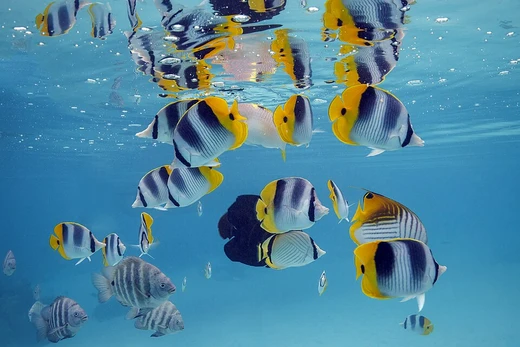
Chaetodon triangulum
A territorial corallivore of Indian Ocean reefs, associated with Acropora corals.

Chaetodon triangulum, the triangle or herringbone butterflyfish, is a marine fish from the family Chaetodontidae. Its body is flat and triangular, a shape made more obvious when its fins are fully spread, and it has a long snout. The fish is mostly whitish with many broad, vertical grey chevron bands along its sides. Its mouth is orange, and a brownish-orange vertical band runs through the eye, becoming brighter orange near the top of the head; in adults, this band widens as it extends rearward along the base of the dorsal fin. The caudal peduncle and caudal fin are black, with yellow margins on the tail. The dorsal fin has 11 to 12 spines and 23 to 26 soft rays, while the anal fin has 3 spines and 20 to 21 soft rays. It reaches a maximum total length of 16 centimetres.
This species is found across the tropical Indian Ocean, from the coast of East Africa east to the Andaman Sea, and along the Indian Ocean coasts of Sumatra and Java. It also occurs in the Seribu Islands and has been reported near Bali. It lives in lagoon and seaward reefs, strongly associated with corals of the genus *Acropora*, especially staghorn corals. The triangle butterflyfish is territorial and lives in pairs, though solitary juveniles hide among coral branches. It is an obligate corallivore, feeding mainly on *Acropora* corals, and defends patches of these corals, chasing away other butterflyfish from its territory and food supply.
The species was first formally described in 1831 by the French anatomist Georges Cuvier, with the type locality given as Jakarta.
Quick Facts
- Genus
- Chaetodon
- Parent
- Chaetodon (Gonochaetodon)
- Species
- triangulum
Facts from the source article.
Lore & Background
Chaetodon triangulum was first formally described in 1831 by the French anatomist Georges Cuvier, with the type locality given as Jakarta. Its body is predominantly whitish with many broad, vertical grey chevron-shaped bands along the sides. The mouth is orange, and there is a brownish orange vertical band through the eye, which grows brighter orange closer to the top of the head, widening as it extends rearward on the base of the dorsal fin in adults. The caudal peduncle is black, as is the caudal fin, but its margins are yellow. The dorsal fin has 11-12 spines and 23-26 soft rays, while the anal fin contains 3 spines and 20-21 soft rays. This species attains a maximum total length of 16 centimetres (6.3 in).
Reader's Guide
Chaetodon triangulum has a wide distribution in the Indian Ocean, from the coast of tropical East Africa east to the Andaman Sea and along the Indian Ocean coastlines of Sumatra and Java. It also appears at the Seribu Islands and has been reported near Bali. It is found in lagoon and seaward reefs, where it is strongly associated with corals in the genus Acropora, especially staghorn corals. This is a territorial species that lives in pairs, although solitary juveniles hide among coral branches. Triangle butterflyfish are obligate corallivores that feed primarily on Acropora corals. They defend patches of these corals and actively chase other butterflyfishes from these territories and the food supply it contains. Its significance lies in its specialized ecological role as a coral-dependent species, highlighting the importance of Acropora habitats in the Indian Ocean.
Did You Know?
- Chaetodon triangulum has a flat triangular shaped body, emphasized when the fins are fully spread.
- It is an obligate corallivore that feeds primarily on Acropora corals.
- Its caudal fin is black with yellow margins.
Frequently Asked Questions
What is Chaetodon triangulum?
Chaetodon triangulum is a small marine butterflyfish in the family Chaetodontidae, commonly known as the triangle or herringbone butterflyfish. It was first formally described by Georges Cuvier and is native to coral reef environments in the Indian Ocean.
What does Chaetodon triangulum look like?
The fish has a notably flat, triangular body with a long snout, and its whitish flanks are marked by broad vertical grey chevron bands. Its mouth is orange, a vertical band passes through the eye, and the tail is black edged with yellow.
How big does Chaetodon triangulum get?
Adults reach a maximum total length of roughly 16 cm (about 6.3 inches). Its fin formula includes 11 to 12 dorsal spines with 23 to 26 soft dorsal rays, plus 3 anal spines and 20 to 21 anal soft rays.
What does Chaetodon triangulum eat and where does it live?
It is a territorial corallivore that feeds specifically on Acropora corals. Its range is restricted to reef habitats across the Indian Ocean, where it defends a small patch of live coral.
How can I tell Chaetodon triangulum apart from similar butterflyfish?
Its triangular silhouette becomes especially obvious when the fins are fully spread, and the chevron banding gives it a distinctive herringbone pattern. In adults the orange eye-band widens as it trails rearward along the base of the dorsal fin, a feature that sets it apart from look-alike species.
More in Butterflyfish, Part 3 1-24
Spotted an error? Know more?
Reader corrections go straight into our review queue. Suggest an edit · How this site is sourced