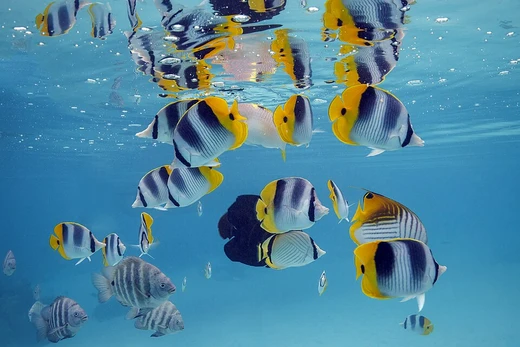
Threadfin butterflyfish
A wide-ranging butterflyfish with a trailing dorsal filament.

The threadfin butterflyfish (Chaetodon auriga) is a tropical marine ray-finned fish in the family Chaetodontidae. It has a broad range across the Indo-Pacific region.
This species lives from the Red Sea and eastern Africa, south to Mossel Bay in South Africa, east to the Hawaiian, Marquesas, and Ducie islands, north to southern Japan, and south to Lord Howe Island and Rapa Iti. It is found at depths between 1 and 35 meters. In 2015, a single individual was reported in the western Mediterranean Sea off Italy, likely from an aquarium release.
The fish grows up to 23 centimeters long. Its body is white with chevron markings on the sides. A black spot with a trailing filament sits on the rear edge of the dorsal fin, and a black vertical band runs through the eye. The belly has descending oblique dark lines, and the fins are bright yellow. Two subspecies are sometimes recognized: *Chaetodon auriga auriga* from the Red Sea, which lacks the dorsal eyespot, and *Chaetodon auriga setifer*, the spotted population found elsewhere.
Taxonomically, it belongs to the large subgenus *Rabdophorus*, which may deserve recognition as a distinct genus. Within this group, it is closely related to the vagabond butterflyfish (*C. vagabundus*) and the Indian vagabond butterflyfish (*C. decussatus*). The *C. auriga* species group shares a pattern of two areas of ascending and descending oblique lines, but the species differ noticeably in the coloration of the hindpart.
Quick Facts
- Genus
- Chaetodon
- Parent
- Chaetodon (Rabdophorus)
- Species
- auriga
Facts from the source article.
Lore & Background
Chaetodon auriga is found in the Indo-Pacific region, from the Red Sea and eastern Africa (south to Mossel Bay, South Africa) to the Hawaiian, Marquesas and Ducie islands, north to southern Japan, south to Lord Howe Island and Rapa Iti, at depths of 1–35 metres. A single specimen was reported in 2015 in the western Mediterranean Sea off Italy, a likely result of aquarium release. Its body is white with chevron markings on the side, and the rear edge of the dorsal fin has a prominent black spot with a trailing filament behind it. A black vertical band runs through the eye, and the fish also has a belly patch of descending oblique dark lines and bright yellow fins. Two subspecies are sometimes recognised: Chaetodon auriga auriga occurs in the Red Sea and lacks the dorsal eyespot; Chaetodon auriga setifer is the spotted population occurring outside the Red Sea.
Reader's Guide
The threadfin butterflyfish belongs to the large subgenus Rabdophorus, which might warrant recognition as a distinct genus. Within this group, it is almost certainly a rather close relative of the vagabond butterflyfish (C. vagabundus) and the Indian vagabond butterflyfish (C. decussatus). The C. auriga species group shares the characteristic pattern of two areas of ascending and descending oblique lines, but they differ conspicuously in hindpart coloration. Its wide distribution across the Indo-Pacific, from eastern Africa to the Hawaiian and Ducie islands, underscores its adaptability to various reef habitats. The 2015 report of a single specimen in the western Mediterranean off Italy, likely from aquarium release, highlights the potential for human-mediated range expansion. The taxonomic uncertainty regarding the subgenus Rabdophorus and the subspecies distinction based on the presence or absence of a dorsal eyespot reflect ongoing scientific discussion about its classification.
Did You Know?
- The threadfin butterflyfish can reach up to 23 cm (9 in) in length.
- Two subspecies are sometimes recognised: Chaetodon auriga auriga (lacks dorsal eyespot) and Chaetodon auriga setifer (has dorsal eyespot).
Visual Identity and Body Design
Butterflyfish are among the most visually arresting residents of tropical coral reefs. Most species measure between 12 and 22 centimeters, though the lined butterflyfish and the saddle butterflyfish (C. ephippium) can reach 30 centimeters. Their common name is well earned: many display vivid combinations of black, white, blue, red, orange, and yellow, with eyespots on the flanks and dark bands running across the eyes—patterns that echo the wings of terrestrial butterflies. Their bodies are deep and laterally compressed, making them stand out against the dense backdrop of reef life. All possess an uninterrupted dorsal fin and tail fins that are either rounded or truncated, never forked. While some species are boldly colored, others are comparatively drab. The conspicuous coloration may function as a form of interspecies communication, helping individuals signal across the visual noise of a busy reef. Their overall silhouette resembles a smaller angelfish, though they lack the preopercle spines found on angelfish gill covers.
Daily Rhythms and Territorial Life
Butterflyfish are generally diurnal, spending daylight hours in waters shallower than 18 meters, though certain species venture down to 180 meters. They maintain strict home ranges and exhibit strong territorial instincts, particularly the corallivorous species that form pairs and defend a specific coral head. In contrast, those that feed on zooplankton tend to gather in large groups of their own kind. At night, the behavior shifts: individuals retreat into reef crevices and their coloration changes noticeably, a marked departure from their daytime appearance. Their diet is a key ecological factor—most species consume coral polyps and sea anemones, making them important participants in reef community dynamics. This dietary specialization also complicates their keeping in home aquariums, where hobbyists must carefully balance predator and prey populations and typically focus on the few generalist or zooplankton-feeding species that are more manageable in captivity.
Pelagic Spawning and the Armored Fry
Butterflyfish reproduce as pelagic spawners, releasing vast numbers of buoyant eggs directly into the open water. These eggs drift with ocean currents as part of the plankton community until they hatch. What makes their early development particularly remarkable is the tholichthys stage: postlarval fry are encased in large bony plates that extend from the head, giving them a heavily armored appearance. These plates are shed as the fish matures into its adult form. This bony-plate larval stage is extraordinarily rare in the fish world—only one other family, the scats (Scatophagidae), exhibits a comparable armored phase. The pelagic spawning strategy means that butterflyfish larvae are dispersed widely by currents, potentially connecting distant reef populations. This reproductive mode, combined with their later territorial settlement behavior, creates a life cycle that spans both open-ocean and reef environments, a duality that shapes their evolutionary history and biogeographic distribution across the Atlantic, Indian, and Pacific Oceans.
Taxonomic Tangles and a Thin Fossil Record
The classification of butterflyfish has long been tangled. The family Chaetodontidae, described by Rafinesque in 1815, encompasses roughly 129 species across 12 genera, split into two broad lineages: the typical butterflyfish centered on the massive genus Chaetodon, and the bannerfish-coralfish group. Before DNA sequencing, distinguishing species from subspecies was notoriously difficult, and numerous subgenera have been proposed to subdivide Chaetodon. Molecular analyses now suggest that Chaetodontidae shared a common ancestor with the scats and angelfish during the Early Eocene, roughly 54 million years ago. The fossil record, however, is frustratingly thin. Coral-reef habitats make preservation unlikely—carcasses are scavenged, overgrown, or eroded away. The earliest confirmed fossils are an indeterminate larva from Germany, two tholichthys specimens from Poland, and the extinct Chaetodon (Blumchaetodon) wattsi from Italy, all dating to the Early Oligocene. Eocene fish like Pygaeus have been tentatively assigned to the family, but these links remain unverified, leaving the deep evolutionary history of butterflyfish largely unresolved.
Frequently Asked Questions
What is the threadfin butterflyfish?
The threadfin butterflyfish (Chaetodon auriga) is a tropical marine ray-finned fish in the family Chaetodontidae, best known for the long trailing filament that extends from its dorsal fin. It is one of the most widely distributed butterflyfish species in the world.
Where does the threadfin butterflyfish live?
Its range spans nearly the entire Indo-Pacific, from the Red Sea and East African coast eastward to the Hawaiian, Marquesas, and Ducie islands, and north to southern Japan. It typically inhabits depths between 1 and 35 meters, and populations extend as far south as Lord Howe Island and Rapa Iti.
How big does a threadfin butterflyfish get?
Adults reach a maximum total length of roughly 23 centimeters (about 9 inches), placing them in the mid-size category among butterflyfish.
What subspecies of threadfin butterflyfish are recognized?
Two subspecies exist: Chaetodon auriga auriga, the Red Sea form that lacks the dark dorsal eyespot, and Chaetodon auriga setifer, the spotted population found throughout the remainder of the species' range.
Has the threadfin butterflyfish ever been found outside the Indo-Pacific?
A single individual was reported in the western Mediterranean off Italy in 2015, but this is almost certainly the result of an aquarium release. No naturally established populations exist beyond the species' native tropical waters.
More in Butterflyfish, Part 3 1-24
Spotted an error? Know more?
Reader corrections go straight into our review queue. Suggest an edit · How this site is sourced