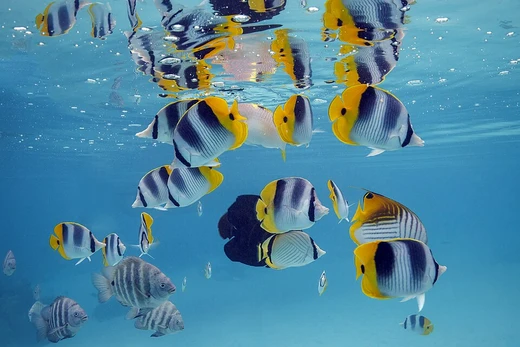
Vagabond butterflyfish
A chevron-patterned butterflyfish of Indo-Pacific reefs.

The vagabond butterflyfish (Chaetodon vagabundus), also called the crisscross butterflyfish, is a marine ray-finned fish in the family Chaetodontidae. Its whitish body is marked by two sets of thin, dark diagonal lines that run perpendicular to each other, creating a chevron pattern. A wide black vertical band crosses the eye, another runs through the caudal peduncle, and a third sits in the center of the caudal fin. Very thin orange horizontal lines appear across the forehead. Juveniles have a black dot near the rear of the soft-rayed part of the dorsal fin. The dorsal fin has 13 spines and 23–25 soft rays, while the anal fin has 3 spines and 19–22 soft rays. This species reaches a maximum total length of 23 centimeters (9.1 inches), though 15 centimeters (5.9 inches) is more typical.
The vagabond butterflyfish lives in the Indian and Pacific Oceans, from the eastern coast of Africa—ranging from Socotra to KwaZulu-Natal in South Africa—across the Indian Ocean east to the Line and Gambier Islands in Polynesia, north to southern Japan, and south to New South Wales and Rapa Iti.
It inhabits reef areas such as coastal reef flats, lagoons, and exposed outer reef slopes. It tolerates varied conditions, including turbid waters and freshwater plumes near stream mouths. An omnivore, it feeds on algae, coral polyps, crustaceans, and worms. These oviparous, monogamous fish form stable pairs that jointly defend a feeding territory against other pairs, though they often accompany other species without aggression. Compared to other butterflyfish, they are relatively easy to keep in tanks.
First formally described by Carl Linnaeus in 1758 in the 10th edition of *Systema Naturae*, it belongs to the large subgenus *Rabdophorus*, which might warrant recognition as a distinct genus. Within this group, it is likely a close relative of the threadfin butterflyfish (*C. auriga*) and the Indian vagabond butterflyfish (*C. decussatus*). The latter may be closer to the threadfin butterflyfish, but because *C. vagabundus* has yielded abnormal mtDNA 12S rRNA sequence data, this is hard to determine. The *C. auriga* species group shares the pattern of two areas of ascending and descending oblique lines, with species differing mainly in hindpart coloration.
Quick Facts
- Genus
- Chaetodon
- Parent
- Chaetodon (Rabdophorus)
- Species
- vagabundus
Facts from the source article.
Lore & Background
The vagabond butterflyfish has a whitish body marked with two series of thin dark diagonal lines perpendicular to each other, forming a chevron pattern. It also has a wide black vertical band through the eye, a second band through the caudal peduncle, and a third on the centre of the caudal fin. Very thin orange horizontal lines appear over the forehead. Juveniles have a black dot on the soft-rayed part of the dorsal fin near the posterior end. The species grows to a maximum total length of 23 centimetres, though a more typical length is 15 centimetres.
It is found in the Indian and Pacific Oceans, from the eastern coast of Africa (Socotra to KwaZulu-Natal in South Africa) across the Indian Ocean east to the Line and Gambier Islands in Polynesia, north to southern Japan, and south to New South Wales and Rapa Iti. Its habitat includes reef areas such as coastal reef flats, lagoons, and exposed outer reef slopes, and it can tolerate turbid waters and freshwater plumes near stream mouths.
The vagabond butterflyfish is omnivorous, feeding on algae, coral polyps, crustaceans, and worms. It is oviparous and monogamous, forming stable pairs that jointly defend a feeding territory against other pairs, though it often accompanies other species without aggression. By the standards of its genus, it is easily maintained in tanks.
Reader's Guide
The vagabond butterflyfish was first formally described in 1758 by Carl Linnaeus in the 10th edition of his Systema Naturae. It belongs to the large subgenus Rabdophorus, which might warrant recognition as a distinct genus. Within this group, it is almost certainly a rather close relative of the threadfin butterflyfish (Chaetodon auriga) and the Indian vagabond butterflyfish (Chaetodon decussatus). However, the latter might be closer to the threadfin butterflyfish; because C. vagabundus has yielded abnormal mtDNA 12S rRNA sequence data, this relationship is hard to determine. The C. auriga species group shares the characteristic pattern of two areas of ascending and descending oblique lines, with species differing conspicuously in hindpart coloration. The species is known to be easily maintained in tanks, making it notable among butterflyfish for aquarium husbandry. Its ability to tolerate a variety of environmental conditions, including turbid waters and freshwater plumes, contributes to its wide distribution across the Indo-Pacific.
Did You Know?
- The vagabond butterflyfish is also known as the crisscross butterflyfish.
- It has a wide black vertical band running through the eye and a second band through the caudal peduncle.
Striking Form and Color
Butterflyfishes are among the most visually arresting residents of tropical coral reefs. Most species measure between 12 and 22 centimeters, though the lined butterflyfish and the saddle butterflyfish (C. ephippium) reach roughly 30 centimeters. Their bodies are deep and laterally compressed, making them stand out vividly against the dense backdrop of reef life. Many display bold combinations of black, white, blue, red, orange, and yellow, while others remain comparatively muted. A recurring motif across the group is the presence of eyespots on the flanks and dark vertical bands running through the eyes—patterns that closely mirror the markings on butterfly wings. Their dorsal fins run unbroken along the back, and their caudal fins are either rounded or squared off but never forked. These fish resemble smaller angelfish at a glance, yet they lack the preopercle spines that characterize their Pomacanthid cousins. Some Heniochus species even echo the silhouette of the Moorish idol. All three related families fall within the order Acanthuriformes. The conspicuous coloration is thought to serve as a channel for interspecies communication.
Territorial Life and Reproductive Strategy
Butterflyfishes are predominantly diurnal, favoring waters shallower than 18 meters, though certain species can descend to 180 meters. They are notably site-faithful, each holding a defined home range within the reef. Feeding strategy shapes social structure: corallivorous species are intensely territorial, forming pairs that stake claim to a particular coral head, while zooplankton feeders tend to gather in large groups of their own kind. At night, these active daytime fish retreat into reef crevices, and their coloration shifts dramatically from the vivid patterns seen in daylight. Reproduction follows a pelagic strategy—adults release numerous buoyant eggs into the open water, where they drift as part of the plankton until hatching. The resulting fry pass through a distinctive tholichthys stage, during which the postlarval body is encased in large bony plates extending from the head. These plates are shed as the fish matures. Remarkably, only one other fish family, the scats (Scatophagidae), exhibits such an armored larval phase. In the aquarium trade, butterflyfishes are popular, but most species rely on coral polyps and sea anemones, so hobbyists typically select the few generalist or zooplankton-feeding species.
Taxonomic Architecture and Evolutionary Lineages
The family Chaetodontidae encompasses approximately 129 species distributed across 12 genera, with the vast majority inhabiting the coral reefs of the Atlantic, Indian, and Pacific Oceans. Notably, several species pairs occur in both the Indian and Pacific Oceans, suggesting a biogeographic pattern within the large genus Chaetodon. The family is broadly divided into two lineages: one containing the typical butterflyfishes centered on Chaetodon, and the other uniting the bannerfish and coralfish genera. The subfamily name Chaetodontinae is a historical leftover from when Pomacanthidae and Chaetodontidae were once merged, and it is now regarded as a junior synonym of Chaetodontidae itself. Eschmeyer's Catalog of Fishes recognizes two subfamilies—Heniochinae, which includes eight genera from Amphichaetodon to Johnrandallia, and Chaetodontinae, with just Chaetodon and Prognathodes—plus two genera of uncertain placement. Molecular phylogenies indicate that Chaetodontidae shared a common ancestor with Scatophagidae and Pomacanthidae during the Early Eocene, roughly 54 million years ago. Before DNA sequencing, taxonomists struggled to distinguish species from subspecies, and numerous subgenera have since been proposed to subdivide the sprawling genus Chaetodon.
A Fragmented Fossil Legacy
The fossil record of butterflyfishes is both sparse and contested. Because these fish are restricted to coral reef environments, their remains are vulnerable to dispersal by scavengers, overgrowth by living corals, and erosion of any sediments that might preserve them. Several Eocene-aged genera, including Pygaeus, have been variously assigned to Chaetodontidae in the past; if those assignments hold, it would suggest that most living genera were already distinct by the end of the Paleogene, around 23 million years ago. However, those Eocene forms cannot be reliably placed within the family. The earliest confirmed butterflyfish fossils are far more recent: an indeterminate larval specimen from Frauenweiler in Germany, two tholichthys-stage specimens from the Menilite Formation in Poland, and the extinct species Chaetodon (Blumchaetodon) wattsi from Italy. All three date to the Early Oligocene. This timing aligns with molecular phylogenies that place the family's origin in the Late Eocene, confirming that butterflyfishes are a relatively young lineage in the grand scheme of marine vertebrate evolution.
Frequently Asked Questions
What is the vagabond butterflyfish?
The vagabond butterflyfish (Chaetodon vagabundus), often called the crisscross butterflyfish, is a small marine ray-finned fish in the family Chaetodontidae. It is a reef-dwelling species native to the Indo-Pacific.
What does the vagabond butterflyfish look like?
Its whitish body is covered in two sets of thin dark diagonal lines that intersect at right angles to form a chevron pattern, with three black vertical bands across the eye, caudal peduncle, and tail fin. Very thin orange horizontal lines also streak the forehead, and juveniles show a small black dot near the rear of the soft-rayed dorsal fin.
How big does a vagabond butterflyfish get?
Most individuals reach a typical length of about 15 cm (roughly 6 inches), though the maximum recorded size is around 23 cm (9.1 inches).
What is the fin structure of the vagabond butterflyfish?
The dorsal fin bears 13 spines followed by 23 to 25 soft rays, while the anal fin has 3 spines and 19 to 22 soft rays. This spiny-and-soft-ray arrangement is characteristic of the butterflyfish family.
Why is the vagabond butterflyfish notable among butterflyfish?
Its crisscrossing diagonal line pattern is one of the most geometrically distinctive markings in the genus Chaetodon, making it easy to tell apart from other Indo-Pacific reef species. The combination of the chevron body pattern, three separate black vertical bands, and faint orange forehead lines gives it a uniquely structured appearance.
More in Butterflyfish, Part 3 1-24
Spotted an error? Know more?
Reader corrections go straight into our review queue. Suggest an edit · How this site is sourced