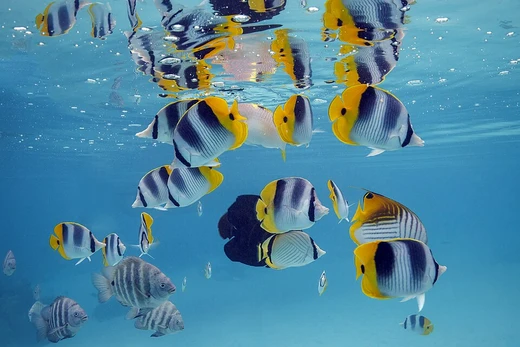
White-faced butterflyfish
A coral reef butterflyfish found in the northwestern Indian Ocean.

The white-faced butterflyfish (Chaetodon mesoleucos) is a species of marine ray-finned fish belonging to the family Chaetodontidae. It is notable for its distinctive coloration and its occurrence in the northwestern Indian Ocean, including the central Red Sea, Gulf of Aden, and around Socotra.
Quick Facts
- Genus
- Chaetodon
- Parent
- Chaetodon (Rabdophorus)
- Species
- mesoleucos
Facts from the source article.
Lore & Background
Chaetodon mesoleucos was first formally described in 1775 by the Swedish-speaking Finnish explorer and naturalist Peter Forsskål, with the description published posthumously by his expedition companion Carsten Niebuhr. The type locality is Al-Mukhā in Yemen. The species belongs to the large subgenus Rabdophorus, which some authorities suggest might warrant recognition as a distinct genus.
The white-faced butterflyfish has a bluish white anterior body with a vertical black band through the eye, while the rest of the body is pale grey marked with numerous vertical black lines. Its caudal fin is black with a white inner margin near the caudal peduncle. It attains a maximum total length of 13 cm, though 12 cm is more common.
This species occurs at depths between 1 and 25 meters on coral reefs, where it is typically found in pairs. It is thought to feed mainly on coral polyps but will also eat a variety of benthic invertebrates. Little is known about its biology.
Reader's Guide
The white-faced butterflyfish is uncommon in the aquarium trade, though it is not considered a difficult species to keep in captivity. Its limited distribution in the northwestern Indian Ocean, from the central Red Sea to the Gulf of Aden and around Socotra, makes it a relatively rare find for marine aquarists. The species' reliance on coral polyps as a primary food source suggests that captive care would require a diet mimicking this natural preference, along with other benthic invertebrates. Despite its availability in the trade, little is known about its biology, including reproductive behavior or lifespan, which limits broader understanding of its ecological role. Its placement within the subgenus Rabdophorus, which may eventually be elevated to genus status, adds taxonomic interest. The species' description by Peter Forsskål, published posthumously by Carsten Niebuhr, ties it to early natural history exploration of the Arabian Peninsula.
Did You Know?
- Chaetodon mesoleucos was first described in 1775 by Peter Forsskål, with the description published by Carsten Niebuhr.
- It has a vertical black band through the eye and a black caudal fin with a white inner margin.
- This species is thought to feed mainly on coral polyps but also eats benthic invertebrates.
A Lattice of Yellow and Black
The latticed butterflyfish presents one of the most visually arresting patterns among reef-dwelling fish. Its body is predominantly a warm yellow, but the true spectacle lies in the dark borders framing each individual scale, producing an intricate grid-like netting across the flanks. A bold vertical black stripe passes directly through the eye, while a small blue patch adorns the forehead, adding a contrasting splash of cool color. The soft-rayed portion of the dorsal fin carries a dark band near its trailing edge, and the tail fin is bisected by a broad black bar running through its center. In some individuals, a black spot appears beneath the spiny section of the dorsal fin, and younger fish display a similar dark marking on the soft-rayed dorsal area. Structurally, the dorsal fin bears between twelve and thirteen spines alongside twenty-one to twenty-three soft rays, while the anal fin contains three spines and eighteen to twenty soft rays. Adults typically measure around fifteen centimetres in total length, though the species can reach a maximum of eighteen centimetres.
A Vast Indo-Pacific Range
The latticed butterflyfish occupies an extraordinarily broad swath of tropical and subtropical waters spanning both the Indian and Pacific Oceans. Its known distribution stretches from the coast of Sri Lanka eastward all the way to the remote Tuamotu Islands, encompassing a remarkable longitudinal span. To the north, records extend as far as southern Japan, while to the south the range reaches the Great Barrier Reef off Australia. In the western Pacific, the species has been documented from Palau, historically referred to as Belau, through to the eastern Caroline Islands in Micronesia. This wide geographic footprint suggests the species is well adapted to the varied coral reef environments found across this vast region, though it remains classified as an uncommon species rather than a dominant or widespread one. The breadth of its range, from the Indian Ocean's island chains to the scattered atolls of the central Pacific, makes it a notable component of Indo-Pacific reef biodiversity, connecting ecosystems that span thousands of kilometres of open ocean.
Reef Dweller in Pairs
Despite its wide distribution, the latticed butterflyfish is considered an uncommon member of reef communities. It favors areas where coral growth is particularly lush and diverse, inhabiting lagoons, sheltered reef flats, and the seaward-facing reef slopes. Its preferred depth window spans from just one metre down to twenty metres, placing it squarely within the photic zone where light-dependent coral ecosystems thrive. The species' diet is notably specialized, drawing sustenance from sea anemones, polychaete worms, and the polyps of both octocorallian and scleractinian corals. This feeding strategy positions it as a selective grazer within the coral reef food web, targeting soft-bodied invertebrate components rather than algae or detritus. Socially, the latticed butterflyfish is typically encountered in pairs rather than in large aggregations, suggesting a bonded or territorial social structure. This paired behavior, combined with its preference for structurally complex coral habitats, paints a picture of a species that values both shelter and a consistent supply of small invertebrate prey within a relatively confined home range.
A Name Born from Colonial Exploration
The formal scientific description of the latticed butterflyfish carries a fascinating historical provenance tied to early nineteenth-century natural history. The species was first described in an anonymous account appended to a biography of Sir Stamford Raffles, the British statesman and colonial administrator who also served as the founding president of the Zoological Society of London. Raffles had employed botanists and zoologists to gather specimens from his colonial territories, and it is believed the actual description was penned by Edward Turner Bennett, a naturalist active between 1797 and 1836. The type locality was recorded as Sumatra, and the specific epithet rafflesii was chosen to honour the statesman whose expeditions made the specimen available. The biography itself was written by Raffles's widow, Sophia Hull, who preserved and published his legacy. Taxonomically, the species is placed within the large subgenus Rabdophorus, a group so extensive that some researchers have suggested it merits elevation to full genus status. Within that subgenus, the latticed butterflyfish occupies a rather unusual evolutionary position, with the white-faced butterflyfish, Chaetodon mesoleucos, appearing to be its closest relative in terms of lineage.
Frequently Asked Questions
What is the white-faced butterflyfish?
The white-faced butterflyfish (Chaetodon mesoleucos) is a small, distinctly colored coral reef fish in the family Chaetodontidae. As a ray-finned marine species, it is native to the northwestern Indian Ocean.
Where can I find the white-faced butterflyfish in the wild?
This species ranges across the central Red Sea, the Gulf of Aden, and the waters surrounding Socotra. It is typically encountered on coral reefs at depths of roughly 1 to 25 meters (3 to 82 feet).
How big does a white-faced butterflyfish get?
Most adults measure around 12 cm (4.7 in) in total length, while the largest recorded individuals reach 13 cm (5.1 in). That places it among the smaller members of the butterflyfish family.
Who first described the white-faced butterflyfish and when?
The species was formally named by the Swedish naturalist Peter Forsskål back in 1775. The type locality he recorded was Al-Mukhā, Yemen, on the Gulf of Aden coast.
What makes the white-faced butterflyfish stand out from other butterflyfish?
Its most eye-catching trait is a distinctive coloration pattern that clearly separates it from other Chaetodon species in the same waters. It is also geographically limited to a relatively narrow stretch of the northwestern Indian Ocean, making it less widespread than many of its relatives.
More in Butterflyfish, Part 3 1-24
Spotted an error? Know more?
Reader corrections go straight into our review queue. Suggest an edit · How this site is sourced