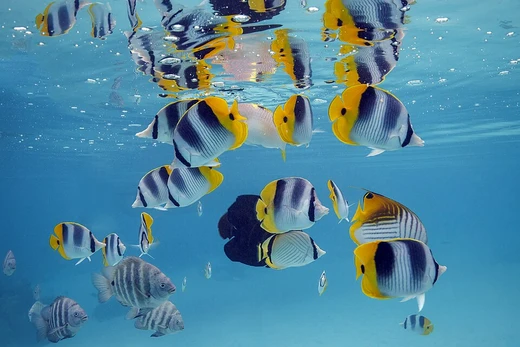
Teardrop butterflyfish
A butterflyfish with a teardrop blotch, found in Indo-Pacific reefs.

The teardrop butterflyfish (Chaetodon unimaculatus) is a species of marine ray-finned fish in the family Chaetodontidae, found in the Indo-Pacific region. It is notable for its distinctive teardrop-shaped black blotch on the upper flank and its popularity in the aquarium trade.
Quick Facts
- Genus
- Chaetodon
- Parent
- Chaetodon (Lepidochaetodon)
- Species
- unimaculatus
Facts from the source article.
Lore & Background
The teardrop butterflyfish was first formally described in 1787 by the German medical doctor and zoologist Marcus Elieser Bloch, with the type locality given as the East Indies (Indonesia). In the western Indian Ocean it is replaced by the yellow teardrop butterflyfish (Chaetodon interruptus), now a separate species but previously considered a subspecies of Chaetodon unimaculatus. In its subgenus Lepidochaetodon it is sometimes considered a separate genus, and it is only distantly related to other Chaetodon species such as the sunburst butterflyfish (Chaetodon kleinii) and the Tahiti butterflyfish (Chaetodon trichrous).
The species has a whitish body with yellow dorsal, anal and pelvic fins, the yellow extending onto the back. The upper flank is marked with a large teardrop-shaped black blotch, and there is a wide black vertical bar through the eye. Delicate yellowish-orange chevrons appear on the flanks in front of the black teardrop, and another black vertical band runs from the rear of the dorsal fin, across the caudal peduncle to the rear of the anal fin. The dorsal fin contains 12-13 spines and 19-23 soft rays, while the anal fin contains 3 spines and 18-20 soft rays.
Teardrop butterflyfish are normally encountered in small groups in reef flats, clear lagoon and seaward reefs, where they feed on soft and hard corals, as well as polychaetes, small crustaceans and filamentous algae. They are oviparous and monogamous, with the sexes forming pairs to breed. They may be found at depths of 1 to 60 metres and are most numerous where the leathery corals of the genera Sarcophyton and Sinularia grow.
Reader's Guide
The teardrop butterflyfish is relatively common in the aquarium trade, making it a notable species for marine aquarists. It is also caught by some artisanal fisheries, indicating its role in local subsistence or small-scale commercial fishing. Its distribution spans the eastern Indian and western Pacific Oceans, from Christmas Island and Cocos (Keeling) Island east to Hawaii, the Marquesas and Ducie Island, north to southern Japan, and south to Lord Howe in the Tasman Sea and the central coast of New South Wales. This wide range underscores its adaptability to various reef environments, including reef flats, clear lagoons, and seaward reefs. The species' feeding habits—consuming soft and hard corals, polychaetes, small crustaceans, and filamentous algae—highlight its ecological role as a generalist omnivore on coral reefs. Its monogamous breeding behavior and oviparous reproduction contribute to its life history, while its preference for areas with leathery corals of the genera Sarcophyton and Sinularia suggests a specific habitat association. The taxonomic history, including its former subspecies status and distant relation to other Chaetodon species, adds scientific context to its classification.
Did You Know?
- It attains a maximum total length of 20 centimetres (7.9 in).
- It is monogamous, with sexes forming pairs to breed.
Frequently Asked Questions
Who is Teardrop butterflyfish?
The teardrop butterflyfish (Chaetodon unimaculatus) is a small marine reef fish in the family Chaetodontidae that inhabits waters across the Indo-Pacific. It earns its common name from a single prominent black teardrop-shaped mark on its upper flank, which is the defining visual trait of the species.
What are Teardrop butterflyfish's most recognizable features?
Its standout feature is the large, single black blotch shaped like a teardrop on the upper side, a marking so distinctive that the species epithet 'unimaculatus' literally means 'single-spotted.' In terms of fin structure, it carries 12 to 13 dorsal spines with 19 to 23 soft dorsal rays, plus 3 anal spines and 18 to 20 anal soft rays.
How big does Teardrop butterflyfish get?
Adults typically measure around 16 cm (6.3 in) in total length, though the species can reach a maximum of roughly 20 cm (7.9 in). This makes it a mid-sized butterflyfish, large enough to be visually striking in a reef tank but small enough for many hobbyist setups.
Where does Teardrop butterflyfish live?
This ray-finned fish is found on coral reefs throughout the Indo-Pacific region, where it forages among reef structures. Its preference for established reef habitats means it is most commonly encountered in tropical and subtropical waters of that broad geographic range.
Why is Teardrop butterflyfish popular in the aquarium trade?
Its bold, easy-to-identify teardrop marking combined with a manageable adult size makes it a favorite display species among marine aquarium keepers. Because it is reef-associated, it generally needs a well-cycled tank with live rock and appropriate tankmates to feel secure and show its best coloration.
More in Butterflyfish, Part 3 1-24
Spotted an error? Know more?
Reader corrections go straight into our review queue. Suggest an edit · How this site is sourced