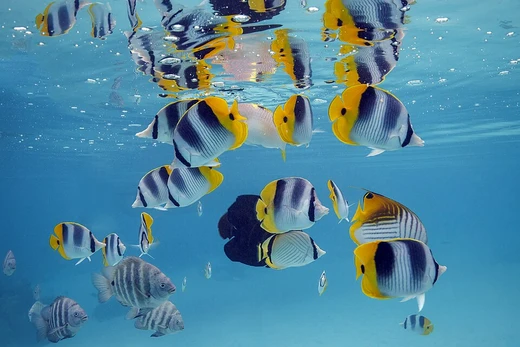
Yellow-dotted butterflyfish
A poorly known butterflyfish with age-fading black bars and yellow fins.

The Yellow-dotted Butterflyfish (Chaetodon selene) is a little-known marine fish from the family Chaetodontidae, living in the Indo-Western Pacific. Its body is whitish with diagonal rows of greyish spots. A vertical black band edged in yellow runs through the eye, and another black band stretches from the dorsal fin across the caudal peduncle to the anal fin. The dorsal, anal, and front part of the caudal fin are yellow. Juveniles show these black bars more clearly, but as the fish matures, the bars fade and the underlying yellow becomes more prominent, making the bands appear brownish. With age, the rear band also lengthens, running parallel to the dorsal fin base toward the eye band and nearly reaching it. The dorsal fin has 12 spines and 20–22 soft rays; the anal fin has 3 spines and 18–19 soft rays. This small butterflyfish reaches a maximum total length of 16 cm (6.3 in).
The species ranges across the Indo-Malayan region, from northern Java east to the north coast of Papua New Guinea, north to Taiwan, and on to the Ryukyu Islands and Kashiwa-jima in southern Japan. It inhabits coastal reefs, mainly on rubble slopes at depths of 8–50 m (26–164 ft). Adults are usually seen in pairs, while juveniles are solitary near coral outcrops; adults prefer rubble or sandy bottoms. Their diet includes tunicates, sea squirts, various benthic invertebrates, small amounts of algae, and coral polyps.
First formally described in 1853 by Dutch physician and ichthyologist Pieter Bleeker, the type locality is Lawajong on Solor Island, Indonesia. The specific name *selene* means “moon”; though Bleeker didn’t explain it, the name likely refers to the black crescent-shaped band running from the back of the head to the anal fin. This species belongs to the large subgenus *Rabdophorus*, which might be considered a distinct genus. Within this group, it is a somewhat distant relative of the blackback butterflyfish (*C. melannotus*) and the spot-tailed butterflyfish (*C. ocellicaudus*). All share an oval shape, silvery bodies with yellow fins and snout, ascending diagonal stripes (yellow in *C. selene*, dark in the others), and black markings around the eyes, on the caudal peduncle, and sometimes on the back. The saddle butterflyfish (*C. ephippium*) and dotted butterflyfish (*C.
Quick Facts
- Genus
- Chaetodon
- Parent
- Chaetodon (Rabdophorus)
- Species
- selene
Facts from the source article.
Lore & Background
The yellow-dotted butterflyfish has a whitish body marked with diagonal lines of greyish spots. It has a vertical black band with yellow edges through the eye and another vertical black band from the dorsal fin over the caudal peduncle to the anal fin. The dorsal, anal, and anterior part of the caudal fin are yellow. Juveniles have more obvious black bars, but as they mature the bars fade and the underlying yellow colouration becomes more apparent, changing the bands to brownish. The rear vertical band also grows longer with age, running parallel to the base of the dorsal fin toward the eye band, nearly reaching it.
It was first formally described in 1853 by the Dutch physician, ichthyologist and herpetologist Pieter Bleeker, with the type locality given as Lawajong on Solor Island in Indonesia. The specific name selene means 'moon' and is thought to refer to the black crescent-shaped band running from the back of the head to the anal fin. It belongs to the large subgenus Rabdophorus, which might warrant recognition as a distinct genus. Within this group, it appears a somewhat distant relative of the blackback butterflyfish and the spot-tailed butterflyfish, all sharing oval shape, silvery colour with yellow fins and snout, ascending diagonal stripes, and black markings around the eyes and caudal peduncle.
Reader's Guide
The yellow-dotted butterflyfish is found throughout the Indo-Malayan region from northern Java eastwards to the north coast of Papua New Guinea and northwards to Taiwan and on to the Ryukyu Islands and Kashiwa-jima in southern Japan. It inhabits coastal reefs, primarily on rubble slopes from 8 to 50 metres in depth. Normally encountered in pairs, juveniles are found solitarily near coral outcrops while adults prefer rubble or sandy bottoms. Its diet includes tunicates, sea squirts, a variety of other benthic invertebrates, small quantities of algae, and coral polyps. The species is poorly known, and its systematic placement within the subgenus Rabdophorus suggests it is a somewhat distant relative of the blackback butterflyfish and spot-tailed butterflyfish, with the saddle butterflyfish and dotted butterflyfish being even more distant, their ancestors thought to have diverged soon after the Rabdophorus lineage started to diversify. This entry highlights the limited available knowledge and the need for further study of this species.
Did You Know?
- The yellow-dotted butterflyfish attains a maximum total length of 16 centimetres (6.3 in).
- Its specific name selene means 'moon', thought to refer to a black crescent-shaped band on the body.
- Juveniles have more obvious black bars that fade with age, while the underlying yellow colouration becomes more apparent.
Frequently Asked Questions
What is the Yellow-dotted butterflyfish?
The Yellow-dotted butterflyfish (Chaetodon selene) is a small, poorly known marine species in the butterflyfish family Chaetodontidae, native to the Indo-Western Pacific. It is one of the less well-documented members of its family.
What does the Yellow-dotted butterflyfish look like?
Its whitish body is marked with diagonal rows of greyish spots, a vertical black bar edged in yellow through the eye, and a second black band running from the dorsal fin across the tail base to the anal fin. The dorsal, anal, and front portions of the caudal fin are yellow.
How big does the Yellow-dotted butterflyfish grow?
Adults reach a maximum total length of roughly 16 centimetres (about 6.3 inches), making it a modestly sized butterflyfish. Its fin structure includes 12 dorsal spines, 20 to 22 dorsal soft rays, and 3 anal spines.
Where is the Yellow-dotted butterflyfish found?
This species lives in the Indo-Western Pacific, though it remains one of the less well-studied butterflyfish in that broad region.
How does the Yellow-dotted butterflyfish change as it matures?
Young fish show their two black bars very sharply, but with age those dark stripes fade while the underlying yellow becomes more prominent, shifting the bands to a brownish tone in adults.
More in Butterflyfish, Part 3 1-24
Spotted an error? Know more?
Reader corrections go straight into our review queue. Suggest an edit · How this site is sourced