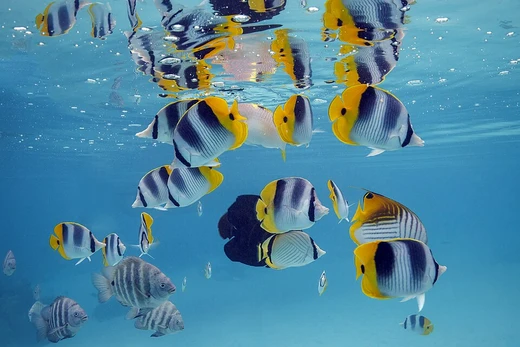
Schooling bannerfish
A schooling butterflyfish of the Indo-Pacific, often mistaken for the Moorish idol.

The schooling bannerfish (Heniochus diphreutes), often called the false moorish idol, is a butterflyfish in the family Chaetodontidae. It lives in the Indo-Pacific region.
This fish stays small, growing to between 18 and 21 centimeters long. Its body is flattened from side to side, and the first rays of its dorsal fin stretch out into a long white filament. The body is mostly white, with two wide black diagonal bands. Behind the second black stripe, the dorsal, tail, and pectoral fins turn yellow. The head is white, with black eyes connected by a black or gray band. The short snout has black or gray spots and a small mouth that can extend outward.
The species is found across tropical, subtropical, and temperate waters of the Indo-Pacific, from the eastern coast of Africa (including the Red Sea) to Polynesia and Hawaii, and from the Great Barrier Reef up to southern Japan and the Kermadec Islands near New Zealand. It prefers outer reef slopes and channels, living at depths of 5 to 30 meters, though it can reach 210 meters in some places.
True to its name, the schooling bannerfish gathers in large groups. It feeds on zooplankton in open water. Juveniles sometimes act as cleaner fish, and adults have also been seen doing this. The species is oviparous and forms pairs to breed. Off the Maldives, they have been observed cleaning parasites from the short sunfish (Mola ramsayi).
In some areas, the schooling bannerfish is caught for the aquarium trade and sold as a cheaper substitute for the Moorish idol. However, no major threats are known, and the IUCN lists it as Least Concern.
Quick Facts
- Taxon
- Heniochus diphreutes
Facts from the source article.
Lore & Background
The schooling bannerfish has a laterally compressed body, with the first rays of its dorsal fin forming a long white filament. Its background color is white with two large black diagonal bands; beyond the second black stripe, the dorsal, caudal and pectoral fins are yellow. The head is white, the eyes are black and linked by a black to gray band, and the short snout is spotted with black to gray, with a small terminal, extensible mouth. It prefers external reef slopes and channels, and is usually observed at 5–30 m depth, though it may reach 210 meters deep in some localities. As its common name indicates, it lives in large groups and feeds on zooplankton in open water. Juveniles may act as cleaner fish, and this behavior has also been seen in adults. This oviparous species forms pairs to breed. Off the Maldives, they have been observed cleaning parasites off the short sunfish (Mola ramsayi).
Reader's Guide
The schooling bannerfish is widespread throughout tropical, subtropical and temperate waters of the Indo-Pacific, from the eastern coast of Africa and the Red Sea to Polynesia and Hawaii, and from the Great Barrier Reef to south Japan and the Kermadec Islands. It is harvested for the aquarium trade in some geographic areas and is commonly sold as a cheaper alternative to the Moorish idol. Despite this, there do not appear to be any major current threats to the species, and it is listed as Least Concern by the IUCN. Its ecological role includes feeding on zooplankton and, notably, cleaning parasites off other fish such as the short sunfish. The species' schooling behavior and depth range make it a distinctive member of the butterflyfish family.
Did You Know?
- The schooling bannerfish is also known as the false moorish idol.
- It can reach a maximum length of 18–21 cm.
More in Butterflyfish, Part 3 1-24
Spotted an error? Know more?
Reader corrections go straight into our review queue. Suggest an edit · How this site is sourced