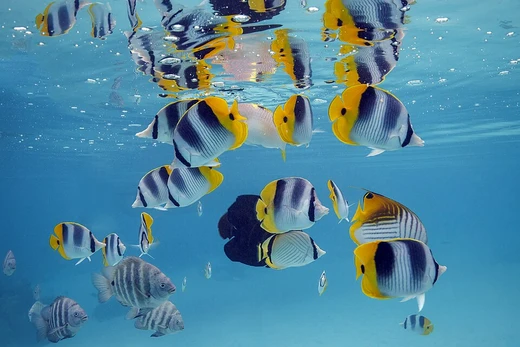
Red Sea bannerfish
A butterflyfish with a banner-like dorsal filament.

The Red Sea bannerfish (Heniochus intermedius) is a butterflyfish native to the western Indian Ocean, specifically the Red Sea and Gulf of Aden. It has also been recorded as an introduced species off southeastern Florida, likely from aquarium releases, and as a Lessepsian migrant in the eastern Mediterranean off Turkey, where it remains very rare.
This fish has a deeply compressed body that fades from pale yellow to white toward the head. Two wide, angled black bands run diagonally across the body—the first from the start of the dorsal fin over the eye to the pelvic fin, the second from the spiny dorsal fin to the rear of the anal fin. The pectoral fins, soft dorsal and anal fins, and caudal fin are yellow, while the pelvic fins are black. A long white filament extends from the front of the dorsal fin and waves like a banner as the fish swims. The dorsal fin has 11 spines and 25–26 soft rays; the anal fin has 3 spines and 17–18 soft rays. Maximum total length is 18 cm (7.1 in).
On coral reefs, the Red Sea bannerfish is usually solitary or in pairs, though large schools have been observed. Juveniles form large schools, especially in deep reef areas with low coral density. It feeds on zooplankton and benthic invertebrates; whether it also eats live coral is not yet confirmed. It is oviparous and spawns in monogamous pairs.
The species is collected for the aquarium trade, but on a limited scale that is not considered a threat to its population.
Quick Facts
- Taxon
- Heniochus intermedius
Facts from the source article.
Lore & Background
The Red Sea bannerfish has a deeply compressed body colored pale yellow fading to white on the neck toward the head. It bears two wide, angled oblique vertical blackish bands that are darker below and become more diffuse toward the back. The forward band starts at the origin of the dorsal fin, adjacent to or over the eye, and runs to the pelvic fin; the rear band starts at the spiny part of the dorsal fin and runs to the rear part of the anal fin. The pectoral, soft part of the dorsal and anal fins, and the caudal fin are yellow, while the pelvic fins are black. A very elongated white filament extends from the anterior part of the dorsal fin, moving while the fish swims, resembling a banner blown in the wind.
It is associated with coral reefs, most frequently recorded solitary or in pairs, though large schools have been recorded. Juveniles form large schools, particularly in areas of deep reef with low coral density. It feeds on both zooplankton and benthic invertebrates, but the extent to which it feeds on live coral has still to be determined. It is oviparous and forms monogamous pairs for spawning.
The species is native to the western Indian Ocean, found in the Red Sea and Gulf of Aden. It has been introduced to waters off southeastern Florida, probably by escapes or releases from the aquarium trade. It was recently recorded in the Gulf of Antalya on the Mediterranean coast of Turkey, likely introduced via the Suez Canal from the Red Sea, and remains very rare there.
Reader's Guide
The Red Sea bannerfish is collected for the aquarium trade, but its collection is of a limited scale and is not believed to be a threat to the species population. Its presence as an introduced species off southeastern Florida and as a Lessepsian migrant in the eastern Mediterranean off Turkey highlights its ability to establish populations outside its native range, likely through aquarium releases and passage through the Suez Canal. Despite these introductions, it remains very rare in the Mediterranean. The species' distinctive elongated dorsal filament, which moves like a banner while swimming, gives it its common name and makes it recognizable among butterflyfish. Its biology—including its association with coral reefs, feeding on zooplankton and benthic invertebrates, and monogamous spawning—provides context for its ecological role. The uncertainty about its feeding on live coral leaves open questions about its impact on reef ecosystems. Overall, the Red Sea bannerfish is a notable example of a marine fish that has expanded its range through human-mediated pathways while maintaining a limited commercial collection that does not currently threaten its populations.
Did You Know?
- The Red Sea bannerfish has a very elongated white filament extending from the anterior part of the dorsal fin that moves while swimming, resembling a banner in the wind.
- It has been recorded as an introduced species off Florida and as a Lessepsian migrant in the eastern Mediterranean Sea off Turkey.
- The species attains a maximum total length of 18 centimetres (7.1 in).
More in Butterflyfish, Part 3 1-24
Spotted an error? Know more?
Reader corrections go straight into our review queue. Suggest an edit · How this site is sourced