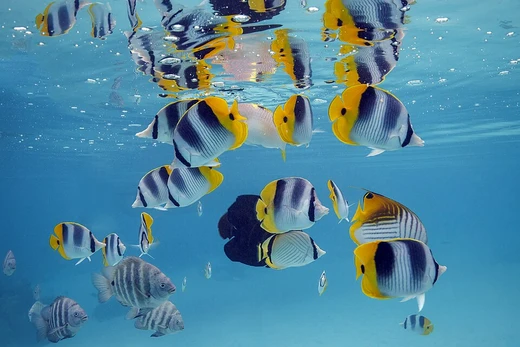
Pyramid butterflyfish
A planktivorous butterflyfish with a distinctive pyramidal pattern.

The pyramid butterflyfish (Hemitaurichthys polylepis) is a marine ray-finned fish in the butterflyfish family Chaetodontidae, found across the central Indo-Pacific. It grows up to 18 cm long, with a flattened, rounded body and a slightly protruding snout that has a small, extendable mouth. Its coloring is unmistakable: a dark brown-yellow patch covers the head and runs from the first dorsal fin rays to the start of the pelvic fins, while the rest of the body—including the tail base and fin—is white. Yellow-orange patches near the top of the sides create a pyramid-shaped pattern, giving the fish its name; the anal fin is also yellow-orange.
This species lives throughout tropical and subtropical waters of the central Indo-Pacific, from Cocos Keeling and Christmas Island to Polynesia, and from southern Japan to New Caledonia. It favors outer reef slopes, where it swims into open water to feed, and is found at depths of 3 to 60 meters. Pyramid butterflyfish gather in large schools and eat plankton in the open water away from the reef.
As a plankton-eater, it could be impacted by climate-driven drops in plankton productivity, but no current threats are known. The IUCN lists it as Least Concern.
Quick Facts
- Taxon
- Hemitaurichthys polylepis
Facts from the source article.
Lore & Background
The pyramid butterflyfish has a compressed laterally body with a rounded profile and a slightly protruding snout with a small protrusible mouth. Its livery is very characteristic: a dark brown-yellow area masks the head and extends from the first rays of the dorsal fin to the start of its pelvic fins, while the rest of the body is white, including the peduncle and caudal fin. Yellow-orange areas at the top of the side form a pyramidal pattern, giving the fish its name, and the anal fin is also yellow-orange.
This species is widespread throughout tropical and subtropical waters of the central Indo-Pacific, from Cocos Keeling and Christmas Island to Polynesia and from south Japan to New-Caledonia. It appreciates outer reef slopes, from which it swims into open water to feed, and can be seen at depths from 3 to 60 meters.
The pyramid butterflyfish lives in large schools and feeds on plankton in open water out of its shelter reef. As a planktivorous species, it could be affected by climate-induced reductions in planktonic productivity, but there do not appear to be any current threats, and it is listed as Least Concern by the IUCN.
Reader's Guide
The pyramid butterflyfish is significant as a planktivorous species that forms large schools in open water, a behavior that distinguishes it from many other butterflyfish that are more solitary or reef-associated. Its reliance on plankton makes it potentially vulnerable to climate-induced reductions in planktonic productivity, though no current threats are identified. The species is listed as Least Concern by the IUCN, indicating a stable population across its wide range in the central Indo-Pacific. Its distinctive pyramidal color pattern and schooling behavior make it a notable subject for marine biodiversity studies and reef ecosystem observations. The species' presence from Cocos Keeling and Christmas Island to Polynesia and from south Japan to New-Caledonia highlights its adaptability to various tropical and subtropical reef environments. Its maximum length of 18 cm and depth range of 3 to 60 meters provide key ecological parameters for understanding its habitat preferences. The lack of identified threats and its Least Concern status suggest that, for now, the pyramid butterflyfish remains a resilient component of its ecosystem, though ongoing monitoring of planktonic productivity may be warranted.
Did You Know?
- The pyramid butterflyfish can reach a maximum length of 18 cm.
- Its name comes from yellow-orange areas forming a pyramidal pattern on its sides.
More in Butterflyfish, Part 3 1-24
Spotted an error? Know more?
Reader corrections go straight into our review queue. Suggest an edit · How this site is sourced