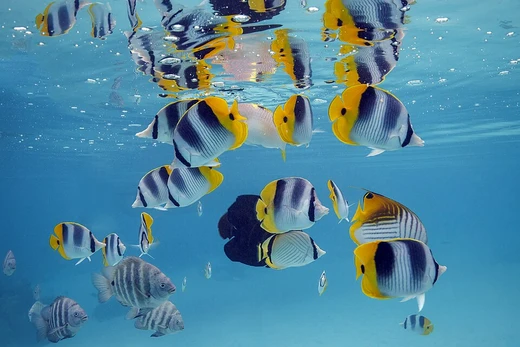
Pennant coralfish
A small Indo-Pacific fish with a long white dorsal filament.

The pennant coralfish (Heniochus acuminatus), also called the longfin bannerfish, reef bannerfish, or coachman, belongs to the family Chaetodontidae and lives in the Indo-Pacific. This fish is small, reaching up to 25 cm in length, though most seen in the wild are around 15 cm. Its body is flattened from side to side, and the first rays of its dorsal fin extend into a long white thread. The main body is white with two wide black diagonal bands. Behind the second black band, the dorsal and tail fins are yellow, as are the pectoral fins. The head is white, with black eyes linked by a black stripe. The snout is slightly elongated, spotted with black, and has a small mouth that can extend outward. Juveniles lack the white area behind the second black stripe that adults have. This species is easily mistaken for the similar schooling bannerfish (Heniochus diphreutes). Key differences include a longer snout and darker snout spots on the reef bannerfish, plus a longer pelvic fin with a rounded tip, whereas the schooling bannerfish has a smaller, more angular pelvic fin.
The pennant coralfish is found across tropical and subtropical waters of the Indo-Pacific, from the eastern coast of Africa (including the Red Sea) to Polynesia, and from southern Japan to the southern Great Barrier Reef. It prefers deeper waters in protected lagoons, channels, or outer reef slopes, at depths between 15 and 75 meters. Adults live in pairs and feed on zooplankton in the water column, coral polyps, and occasionally bottom-dwelling invertebrates. Juveniles are solitary and may clean other fish. The species is listed as Least Concern globally by the IUCN, but some local populations are declining. In the Persian Gulf, it is threatened because many coral reefs have been damaged and broken up, leaving no connected coral groups. The pennant coralfish was first formally described as Chaetodon acuminatus by Linnaeus in 1758 in the 10th edition of Systema Naturae. Linnaeus also named a species Chaetodon macrolepidotus, which Georges Cuvier later used as the type species for the genus Heniochus; this name is now considered a synonym of H. acuminatus.
Quick Facts
- Taxon
- Heniochus acuminatus
Facts from the source article.
Lore & Background
The pennant coralfish has a compressed body, with the first rays of its dorsal fin stretching into a long white filament. Its body is white with two large black diagonal bands; beyond the second black stripe, the dorsal and caudal fins are yellow, as are the pectoral fins. The head is white, the eyes black and linked by a black band, and the snout is slightly stretched with a small terminal protractile mouth spotted with black. Juveniles lack the white area beyond the second black stripe that adults have.
This species can be confused with the similar schooling bannerfish (Heniochus diphreutes). The main visible differences are a longer snout and darker snout spots in the reef bannerfish, and a longer pelvic fin with a rounded end, whereas the schooling bannerfish has a smaller, more angular pelvic fin.
The pennant coralfish is widespread throughout tropical and subtropical waters of the Indo-Pacific, from the eastern coast of Africa and the Red Sea to Polynesia, and from southern Japan to the south of the Great Barrier Reef. It inhabits relatively deep waters in protected lagoons, channels, or outer reef slopes from 15 to 75 meters deep.
Reader's Guide
The pennant coralfish is a species of the family Chaetodontidae, first formally described by Linnaeus in 1758 as Chaetodon acuminatus. Linnaeus also described a species he named Chaetodon macrolepidotus, which Georges Cuvier used as the type species for the genus Heniochus, and which has since come to be regarded as a synonym of H. acuminatus. The species is globally assessed as Least concern by the IUCN, though some local populations are in decline. In the Persian Gulf, it is threatened because several coral reefs have been damaged and severely fragmented with no contiguous coral assemblages. The fish lives in pairs and feeds on zooplankton in the water column, coral polyps, and occasionally benthic invertebrates. Juveniles are solitary and can feed by cleaning other fishes. Its average size in nature is around 15 cm, with a maximum length of 25 cm. The species is also known by common names including longfin bannerfish, reef bannerfish, and coachman.
Did You Know?
- The pennant coralfish can reach a maximum length of 25 cm, but the average size observed in nature is around 15 cm.
- Its first rays of the dorsal fin stretch into a long white filament.
- The species is threatened in the Persian Gulf due to damaged and severely fragmented coral reefs.
More in Butterflyfish, Part 3 1-24
Spotted an error? Know more?
Reader corrections go straight into our review queue. Suggest an edit · How this site is sourced