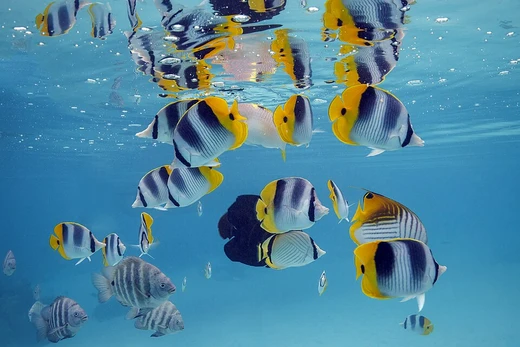
Heniochus varius
A butterflyfish with prominent horns and a hump on the forehead.

Heniochus varius, commonly known as the horned bannerfish or humphead bannerfish, is a species of marine ray-finned fish belonging to the family Chaetodontidae. It is native to the central Indo-Pacific area and is notable for the distinctive pair of horns and a prominent bump on the forehead of adults, which set it apart from other bannerfish.
Quick Facts
- Taxon
- Heniochus varius
Facts from the source article.
Lore & Background
The horned bannerfish was first formally described as Taurichthys varius in 1829 by the French anatomist Georges Cuvier, with the type locality given as Ambon Island in Indonesia. It has the typical deep-bodied and highly compressed body of butterflyfishes. Adults are distinguished by a pair of obvious horns on the forehead just above the eyes and a prominent bump on the forehead. The predominant body color is brown to blackish, broken by a thin white band behind the head and a second white band running from the spiny part of the dorsal fin to the caudal peduncle, creating a triangle of the base color on the body.
Reader's Guide
The horned bannerfish is widespread throughout tropical and subtropical waters of the central Indo-Pacific, from Indonesia to Polynesia and from south Japan to New Caledonia. It inhabits areas rich in coral in shallow lagoons and external reef slopes from the surface to a depth of 30 meters. The species is solitary but can live in pairs or small groups. Its diet consists of coral polyps and various benthic invertebrates. In some geographic areas, it is occasionally harvested for the aquarium trade, but the species does not currently appear threatened and is listed as Least Concern by the IUCN.
Did You Know?
- The type locality is Ambon Island in Indonesia.
- It can reach a maximum length of 19 centimeters (7.5 in).
More in Butterflyfish, Part 3 1-24
Spotted an error? Know more?
Reader corrections go straight into our review queue. Suggest an edit · How this site is sourced