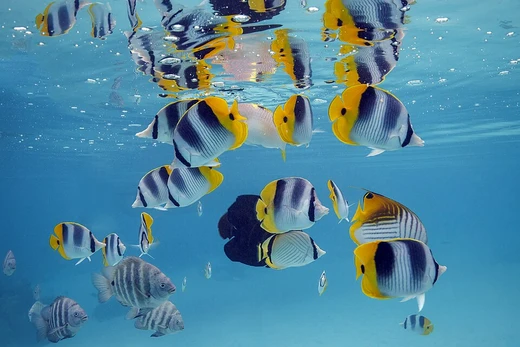
Heniochus monoceros
A small Indo-Pacific butterflyfish with two black vertical bands.

The masked bannerfish (*Heniochus monoceros*) is a small, laterally compressed butterflyfish found in the Indo-Pacific region. It grows to a maximum length of 23 cm. Its most striking feature is a white filament, edged in yellow, formed by the first rays of its dorsal fin. The body is white with two vertical black bands. The first band runs from the mouth to the base of the dorsal fin, covering the snout and eyes, while the lips remain white. A whitish band runs between the eyes, with another above them. A small growth on the forehead radiates a bright whitish to yellowish area. The second black band sits at the fish’s midline. Behind this band, a yellow area extends from the posterior edge to the middle of the anal fin, including the dorsal and caudal fins. Within this yellow zone, near the caudal peduncle, is a brown-yellow blotch that varies in size between individuals.
This species is widespread across tropical and subtropical Indo-Pacific waters, from East Africa to Polynesia, and from southern Japan to New Caledonia. It typically inhabits outer reef slopes and coral-rich lagoons at depths of 2 to 30 meters. Depending on location, the masked bannerfish lives in pairs or groups—especially along island reefs in the Indian Ocean—always staying close to its shelter reef. It feeds on benthic invertebrates.
While occasionally harvested for the aquarium trade in some areas, no current threats are known, and the IUCN lists it as Least Concern.
Quick Facts
- Taxon
- Heniochus monoceros
Facts from the source article.
Lore & Background
The masked bannerfish has a body compressed laterally, with the first rays of its dorsal fin stretching into a white filament outlined with yellow. Its background body color is white with two black vertical bands. The first band masks its face from the mouth to the base of the first dorsal fin rays, including the snout and eyes. The lips are white, and a whitish band runs between the eyes, with another on top of the eyes. A small growth on the axis of the forehead radiates a bright whitish to yellowish area. The second black band is in the middle of the fish's side. A yellow area extends from the posterior edge of the second black band to the middle of the anal fin, including the dorsal and caudal fins. Within this yellow area, near the caudal peduncle, a brown-yellow blotch of variable size emerges.
The masked bannerfish is widespread throughout tropical and subtropical waters of the Indo-Pacific, from the eastern coast of Africa to Polynesia and from south Japan to New Caledonia. It typically lives on external reef slopes and in lagoons rich in corals, at depths of 2–30 metres.
Depending on geographic area, the masked bannerfish lives in pairs or in groups, especially along island reefs in the Indian Ocean, but always close to its shelter reef. It feeds on benthic invertebrates.
Reader's Guide
The masked bannerfish is a species of butterflyfish found in the Indo-Pacific area. Its conservation status is listed as Least Concern by the IUCN, and there do not appear to be any current threats to this species. In some geographic areas, it is harvested occasionally for the aquarium trade. The species is known for its distinctive appearance, including two black vertical bands and a white filament on the dorsal fin. It inhabits external reef slopes and lagoons rich in corals at depths of 2–30 metres. Its social behavior varies by location, forming pairs or groups, and it feeds on benthic invertebrates. The masked bannerfish is a representative of the family Chaetodontidae and contributes to the biodiversity of coral reef ecosystems in its range.
Did You Know?
- The masked bannerfish can reach a maximum length of 23 cm.
- It has a small growth on the axis of the forehead from which a bright whitish to yellowish area radiates.
- It lives in pairs or groups depending on geographic area, always close to its shelter reef.
More in Butterflyfish, Part 3 1-24
Spotted an error? Know more?
Reader corrections go straight into our review queue. Suggest an edit · How this site is sourced