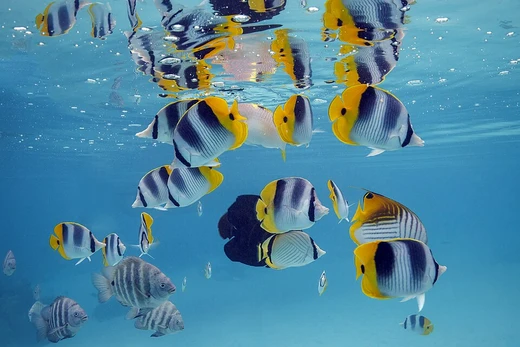
Heniochus chrysostomus
A butterflyfish with three brown bands and a yellow mouth.

The threeband pennantfish, also known as the threeband bannerfish or pennant bannerfish, is a marine butterflyfish in the family Chaetodontidae. It lives throughout the Indo-Pacific, from the western coast of India to Polynesia, and from southern Japan to New Caledonia. This species typically stays in coral-rich areas of reef flats, lagoons, and seaward reefs at depths between 2 and 40 meters. Juveniles are often found in lagoons and estuaries.
Growing up to 18 centimeters long, the fish has a strongly flattened body. Its basic color is white, with three broad, oblique brown bands: one from the forehead to the ventral fins, a second from the dorsal fin to the anal fin, and a third near the dorsal fin. The first rays of the dorsal fin are elongated, forming a black-and-white feather-like shape. The head has a short snout and a small, protractile mouth. A distinctive yellow patch appears on the mouth, the top of the snout, and between the eyes. The rear of the dorsal fin, the caudal fin, and the pectoral fins are orange-yellow. Juveniles have a black spot rimmed with orange-yellow, called an ocellus, on the bottom of the anal fin.
During breeding, Heniochus chrysostomus forms pairs. It feeds mainly on coral polyps. Juveniles are solitary. The species is sometimes collected for the aquarium trade, but no current threats are known, and it is listed as Least Concern by the IUCN.
Quick Facts
- Taxon
- Heniochus chrysostomus
Facts from the source article.
Lore & Background
Heniochus chrysostomus is a small-sized fish that can reach a maximum length of 18 cm. The body is laterally strongly flattened, with a basic white color and three broad oblique brown bands. The first dark brown band runs from the forehead up to the ventral fins, the second from the dorsal fin to the anal fin, the third is adjacent to the dorsal fin. The first rays of the dorsal fin is elongated and looks like a black and white feather. The head shows a short snout and a small protractile mouth. This bannerfish has a distinctive yellow coloration pattern on the mouth, top of the snout and running between its eyes. The posterior part of its dorsal fin, its caudal fin and the pectoral fins are orange-yellow. Juveniles have an ocellus which is a black spot rimmed with orange-yellow, on the bottom of its anal fin.
Reader's Guide
Heniochus chrysostomus is widespread throughout the tropical and subtropical waters of the central Indo-Pacific from the western coast of India to Polynesia and from south Japan to New-Caledonia. It typically inhabits coral-rich areas of reef flats, lagoon and seaward reefs at a depth of 2–40 metres. Juveniles are usually found in lagoons and estuaries. The species forms pairs during breeding and mainly feeds on coral polyps. Juveniles are solitary. It is subject to some fishing activities to collect specimens for aquarium, but there do not appear to be any current threats to this species. It is listed as Least Concern (LC) by the IUCN. Its distinctive appearance, including the elongated dorsal fin and yellow mouth, makes it a recognizable member of the butterflyfish family.
More in Butterflyfish, Part 3 1-24
Spotted an error? Know more?
Reader corrections go straight into our review queue. Suggest an edit · How this site is sourced