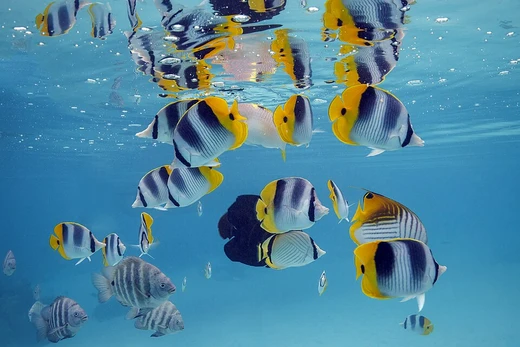
Hemitaurichthys multispinosus
A drab grey butterflyfish of deep southern Pacific reefs.

The many-spined butterflyfish (Hemitaurichthys multispinosus), also known as the multispine butterflyfish or spiny butterflyfish, is a species of marine ray-finned fish in the family Chaetodontidae. It is notable for its association with deeper reefs around only three island groups in the southern central Pacific Ocean, and for its uniform grey coloration.
Quick Facts
- Taxon
- Hemitaurichthys multispinosus
Facts from the source article.
Lore & Background
The many-spined butterflyfish was first formally described in 1975 by American ichthyologist John Ernest Randall, with the type locality given as the Patch reef off the Gannet Ridge on the northern side of Pitcairn Island. Its common names refer to the numerous spines in its dorsal fin, which number 14 to 16, and the 5 spines in its anal fin. The species is a rather drab uniform grey colour, and reaches a maximum recorded length of 20.8 centimetres (8.2 in).
This butterflyfish is found only around a few island groups in the southern Pacific Ocean: the British overseas territory of Pitcairn Island, Easter Island in Chile, and a single island in the Austral Islands, Rurutu, in French Polynesia. It occurs on deep seaward coral reefs, where it aggregates into schools varying in size from small to large in the middle of the water column at depths between 30 and 50 metres (98 and 164 ft). It feeds on plankton and is an oviparous species in which males and females form pairs for breeding.
The many-spined butterflyfish is almost unknown in the aquarium trade. Local fishermen collect this species for food using spears and the piscicide rotenone.
Reader's Guide
The many-spined butterflyfish holds significance primarily as a rare and localized species within the butterflyfish family. Its distribution is restricted to three island groups in the southern central Pacific Ocean—Pitcairn Island, Easter Island, and Rurutu in the Austral Islands—making it a geographically limited fish. Described in 1975 by John Ernest Randall, it is one of the less colorful butterflyfishes, being a uniform grey, and is distinguished by its high number of dorsal fin spines (14–16) and 5 anal fin spines. Its biology includes schooling behavior in the middle of the water column on deep seaward reefs at depths of 30 to 50 meters, where it feeds on plankton and breeds as an oviparous species with pair formation. The species is almost unknown in the aquarium trade, but local fishermen collect it for food using spears and the piscicide rotenone. Its legacy lies in its restricted range and the fact that it is one of the few butterflyfish species harvested for subsistence rather than the ornamental trade.
More in Butterflyfish, Part 3 1-24
Spotted an error? Know more?
Reader corrections go straight into our review queue. Suggest an edit · How this site is sourced