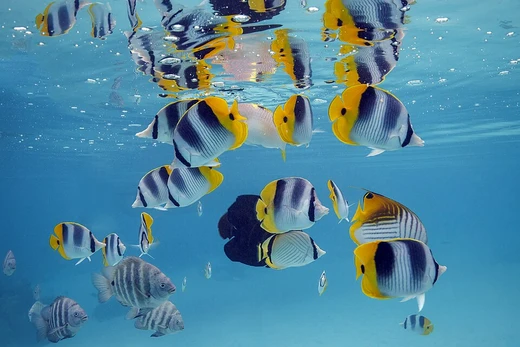
Bank butterflyfish
A shy reef fish of the western Atlantic.

The Bank butterflyfish (Prognathodes aya) is a marine ray-finned fish in the butterflyfish family Chaetodontidae. It lives in the tropical and subtropical western Atlantic Ocean. Its body is silvery white to tan, with yellow coloring on all fins except the pectorals. Two dark brownish bars mark the body: one runs across the eye and follows the face and snout, while the other starts at the rear of the dorsal fin and drops near the tail, without reaching the caudal fin. A yellow band sits behind this second bar, stretching from the fifth spine of the dorsal fin to the back of the anal fin. The species is uncommon across its range, appearing on natural and artificial reefs in Florida, the Gulf of Mexico, and off the Yucatán Peninsula. It rarely ventures as far north as North Carolina. The Bank butterflyfish is listed as Least Concern by the IUCN, faces no known threats, and is harvested for saltwater aquariums without harming global populations. It is not protected by specific laws but lives in several protected areas. Scuba divers find it shy; it darts into reef shelters when approached, though some individuals linger at crevice entrances to watch divers.
Quick Facts
- Taxon
- Prognathodes aya
Facts from the source article.
Lore & Background
The Bank butterflyfish is silvery white to tan in color, with yellow on all fins except the pectoral fins. It has two sub-vertical dark, brownish bars: the first lies across its eyes and follows the profile of the face and snout; the second begins at the back of the dorsal fin and extends downward near the tail but does not appear on the caudal fin. There is also a yellow band located behind the second dark bar that extends from the fifth spine of the dorsal fin down to the back of the anal fin.
The Bank butterflyfish is uncommon throughout its range. It is found on natural and artificial reefs in Florida, the Gulf of Mexico, and off the Yucatán Peninsula. It is also found as far north as North Carolina, though it only rarely appears that far north.
In regard to conservation, the Bank butterflyfish is not known to be threatened and is listed as Least Concern by the IUCN. Though it is harvested for use in salt water aquaria, this commercial use does not appear to negatively impact the global population. It is not protected by name in any specific legislation, though it is known to inhabit a number of protected areas.
Reader's Guide
The Bank butterflyfish is notable as a member of the butterflyfish family Chaetodontidae, found in the western Atlantic. Its conservation status as Least Concern reflects that it is not known to be threatened, despite being harvested for the aquarium trade. This commercial use does not appear to negatively impact the global population. The species is not protected by name in any specific legislation, but it does inhabit several protected areas. For scuba divers, the Bank butterflyfish is generally regarded as shy, darting into reef shelter upon approach. Once sheltered, some individuals will remain at the entrance of a crevice, apparently watching divers. Its range includes natural and artificial reefs in Florida, the Gulf of Mexico, and off the Yucatán Peninsula, with rare appearances as far north as North Carolina. The species is uncommon throughout its range, adding to its interest for observers and collectors.
Did You Know?
- The Bank butterflyfish has two sub-vertical dark brown bars, one across the eyes and one near the tail.
- It is listed as Least Concern by the IUCN and is not known to be threatened.
- When approached by scuba divers, it is shy and darts into reef shelter, but some individuals will watch divers from crevice entrances.
More in Butterflyfish, Part 3 1-24
Spotted an error? Know more?
Reader corrections go straight into our review queue. Suggest an edit · How this site is sourced