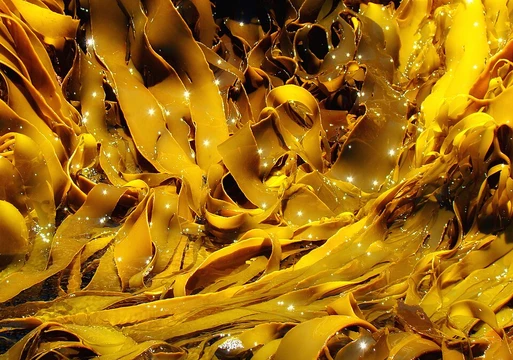
Wrack (seaweed)
Wrack refers to seaweeds and seagrasses cast up on shore.

Wrack is a term used for several species of seaweed in the family Fucaceae, and more generally for any seaweeds or seagrasses that wash up on beaches and accumulate in the wrack zone. It consists largely of species of Fucus, brown algae with flat branched ribbon-like fronds, and may also include seagrasses such as Zostera marina or Posidonia australis.
- Common species
- Fucus vesiculosus (bladder wrack), Pelvetia canaliculata (channelled wrack), Ascophyllum nodosum (knotted wrack), Fucus spiralis (spiral wrack or flat wrack), Fucus serratus (toothed wrack or serrated
- Notable feature f serratus
- saw-toothed margin
- Notable feature f vesiculosus
- bearing air-bladders
- Seagrass example
- Zostera marina (marine flowering plant with bright green long narrow grass-like leaves)
- Seagrass example 2
- Posidonia australis (occurs sub-tidally on southern coasts of Australia, sheds older ribbon-like leaf blades in winter)
- Historical uses
- making manure, and for making 'kelp', a form of potash
- Word origin possible
- from Middle Dutch 'wrak', from its root - to push, to shove, to drive
Lore & Background
Historically, wrack was used for making manure and for making 'kelp', a form of potash. The word's origin is possibly from Middle Dutch 'wrak', from its root meaning to push, to shove, to drive. In the case of seaweed, its sense is in a possible derivation of the word wreck — cast up on shore. The term encompasses several named species: bladder wrack (Fucus vesiculosus), channelled wrack (Pelvetia canaliculata), knotted wrack (Ascophyllum nodosum), spiral wrack or flat wrack (Fucus spiralis), and toothed wrack or serrated wrack (Fucus serratus). These are brown algae with flat branched ribbon-like fronds, with F. serratus characterized by a saw-toothed margin and F. vesiculosus by bearing air-bladders. Another component of sea wrack may be seagrasses such as Zostera marina, a marine flowering plant with bright green long narrow grass-like leaves, and Posidonia australis, which occurs sub-tidally on the southern coasts of Australia and sheds its older ribbon-like leaf blades in winter, resulting in thick accumulations along more sheltered shorelines.
Reader's Guide
Wrack holds significance as a collective term for seaweeds and seagrasses that wash ashore, forming the wrack zone on beaches. The article notes that wrack consists largely of species of Fucus, brown algae with flat branched ribbon-like fronds, and may also include seagrasses such as Zostera marina and Posidonia australis. Historically, wrack was used for making manure and for making 'kelp', a form of potash, indicating its practical value in agriculture and industry. The word's origin is possibly from Middle Dutch 'wrak', related to the concept of being cast up on shore, linking it to the word wreck. The article lists several named species—bladder wrack, channelled wrack, knotted wrack, spiral wrack, and toothed wrack—each with distinct characteristics such as air-bladders or saw-toothed margins. The legacy of wrack is tied to its role in coastal ecosystems as accumulated organic matter and its historical use as a resource. The article does not provide further details on modern significance, but the information given establishes wrack as a notable component of marine debris and a traditional material.
More in Brown Macroalgae and Kelp 1-24
Spotted an error? Know more?
Reader corrections go straight into our review queue. Suggest an edit · How this site is sourced