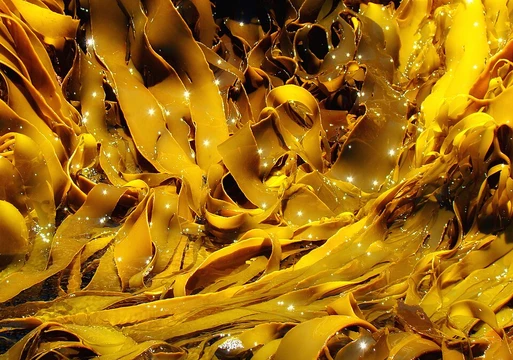
Durvillaea poha
A robust southern bull kelp with broad, honeycomb blades.

Durvillaea poha is a large, sturdy southern bull kelp that grows only in New Zealand. It is most common along the South Island coast and can be identified by its wide, flat blades. The blades are filled with air and have a honeycomb-like internal structure, while the stipes are stout, pale or orange, and unbranched. This species differs from *Durvillaea antarctica* mainly in having broader, flatter fronds.
For a long time, *D. poha* was considered just a regional form of *D. antarctica*, known as the "cape" lineage. In 2012, it was recognised as a separate species based on consistent differences in genetics, shape, and ecology. In southern New Zealand, the two species often grow side by side, but *D. poha* usually occupies higher or more sheltered spots on rock platforms, where wave action is gentler. Its fronds tend to be wider and can appear more orange. Some plants in Wellington show a mix of the two species’ DNA—nuclear DNA matching *D. poha* but mitochondrial DNA from *D. antarctica*—a sign of past hybridisation.
The name *poha* comes from the Māori word *pōhā*, which refers to storage bags traditionally made from kelp fronds. Along with *D. antarctica*, the blades of *D. poha* are used to make these bags, which carry and store food, fresh water, and live shellfish, and are also used for clothing and sports gear. *Pōhā* bags are especially linked to the Ngāi Tahu people and are often used to hold muttonbird (tītī) chicks.
*D. poha* is found mainly along the southern coasts of the South Island, on Stewart Island, and on the subantarctic Snares and Auckland Islands. Genetic evidence suggests it has recently expanded its range into the North Island, where it now occurs at low frequencies along the Wellington coastline. This spread appears linked to tectonic uplift and landslides from historic earthquakes, such as the 1855 Wairarapa earthquake. The removal of *D. antarctica* and the creation of new coastline by these disturbances likely gave *D. poha* an opening to colonise areas north of Cook Strait.
Quick Facts
- Taxon
- Durvillaea poha
Facts from the source article.
Lore & Background
Durvillaea poha was previously classified as the 'cape' lineage of Durvillaea antarctica but was recognized as a distinct species in 2012 due to consistent genetic, morphological, and ecological differences. In southern New Zealand, it frequently grows next to D. antarctica, though D. poha normally grows higher up or further back on rock platforms, or in more sheltered bays with weaker wave force. It generally has wider fronds than D. antarctica and can appear more orange across the frond area. Mitochondrial introgression has been observed between the two species, with some plants in Wellington exhibiting nuclear DNA of D. poha but mitochondrial DNA belonging to D. antarctica.
The species is endemic to New Zealand, predominantly found along southern coasts of the South Island and on Stewart Island, as well as on the subantarctic Snares and Auckland Islands. Based on genetic data, it appears to have undergone a recent range expansion into the North Island, found at low frequencies along the Wellington coastline. This expansion coincides with areas affected by tectonic uplift and landslides caused by historic earthquakes, including the 1855 Wairarapa earthquake. The removal of D. antarctica and formation of new coastline by such tectonic disturbance likely provided an ecological opportunity for D. poha to colonize coastline north of the Cook Strait.
Reader's Guide
Durvillaea poha holds significance both ecologically and culturally. Ecologically, it is a distinct species that diverged from Durvillaea antarctica, with which it coexists in southern New Zealand but occupies different microhabitats—typically higher on rock platforms or in more sheltered bays. Its recent range expansion into the North Island, linked to tectonic events like the 1855 Wairarapa earthquake, illustrates how geological disturbances can create opportunities for kelp colonization. The species also exhibits mitochondrial introgression with D. antarctica, indicating ongoing genetic exchange despite morphological and ecological differences.
Culturally, D. poha is used alongside D. antarctica to make traditional pōhā bags by Māori, especially the Ngāi Tahu people. These bags are used to carry and store food and fresh water, propagate live shellfish, and make clothing and sports equipment. Pōhā are particularly associated with carrying and storing muttonbird (tītī) chicks. The species' specific epithet directly references this cultural practice, underscoring its importance in Māori tradition. Its recognition as a distinct species in 2012 highlights the value of integrating genetic, morphological, and ecological data in taxonomy.
Did You Know?
- Its specific epithet comes from pōhā, storage bags made by Māori out of kelp fronds.
- Mitochondrial introgression has been observed between D. poha and D. antarctica in Wellington.
The Honeycomb Engine of Oceanic Drift
Durvillaea poha belongs to a trio of species—alongside D. antarctica and D. incurvata—that possess a remarkable internal architecture: a honeycomb-like tissue within the fronds that traps air and renders the kelp buoyant. This structural adaptation transforms a normally anchored organism into a potential ocean voyager. When storms tear individuals free from their rocky substrates, the trapped air keeps them afloat, and ocean currents carry them across vast stretches of water. Documented cases show D. antarctica rafts surviving up to 210 days at sea, with high winds propelling them as far as 10,000 kilometres. Latitude-dependent variables—temperature, solar radiation, surface winds—modulate both buoyancy and travel speed. Detachment timing matters too: rafts released during outgoing tides in autumn and winter tend to drift offshore more readily. This rafting mechanism is not merely a survival quirk; it is the primary engine of long-distance dispersal for the genus, enabling genetic exchange across the entire Southern Hemisphere and even carrying hitchhiking invertebrates and non-buoyant epiphytes to new shores.
A Rocky-Shore Metropolis
Durvillaea poha is an intertidal species, thriving on rocky, wave-battered coastlines where it can colonise even the uppermost reaches of the intertidal zone provided sufficient wave wash keeps it moist. Its holdfasts and fronds form a three-dimensional habitat that supports an extraordinary assemblage of invertebrate life. In New Zealand, communities associated with Durvillaea include the sea star Anasterias suteri, several crustaceans (Parawaldeckia kidderi, P. karaka, the gribbles Limnoria segnis and L. stephenseni), multiple molluscs (Cantharidus roseus, Onchidella marginata, Onithochiton neglectus, Sypharochiton sinclairi), and even the spider Desis marina. Many of these organisms burrow into or graze on the kelp tissue. Beyond animals, the holdfasts harbour epiphytic seaweeds such as Gelidium lingulatum and Corallina officinalis var. chilensis, while the fronds can host the obligate red algal epiphyte Pyrophyllon subtumens. The bacterial microbiome itself is shaped by local environmental conditions and by the density and connectivity of surrounding kelp populations, making each Durvillaea stand a self-contained, ever-shifting ecosystem.
Threads in Indigenous and Modern Life
Long before European contact, the people of the South Pacific wove Durvillaea into the practical fabric of daily existence. The tough, fibrous fronds served as material for clothing and tools across numerous indigenous cultures, while the kelp also functioned as an edible resource. In Chile, that culinary relationship endures: southern bull kelp remains a prominent ingredient in local cuisine, a living thread connecting present-day kitchens to centuries of coastal foraging tradition. The genus itself carries a European imprint in its name, honouring the French explorer Jules Dumont d'Urville (1790–1842), whose voyages mapped much of the Southern Ocean. The common name "southern bull kelp" distinguishes these species from the unrelated North Pacific Nereocystis luetkeana, a distinction that matters to anyone navigating the overlapping vocabulary of kelp biology. Together, the cultural uses and the taxonomic nomenclature illustrate how a single genus of large brown algae has occupied a place simultaneously in indigenous material culture, modern gastronomy, and the history of scientific exploration.
When the Shoreline Shifts
Durvillaea poha is built to shrug off relentless wave action, yet it is acutely vulnerable to sudden, large-scale environmental shifts. A marine heatwave during the summer of 2017/18 wiped out multiple Durvillaea species at Pile Bay on New Zealand's Banks Peninsula; in the vacated space, the invasive kelp Undaria pinnatifida quickly recruited in dense stands, illustrating how the loss of one foundational species can open a door for another. Earthquakes present a different but equally devastating threat: uplift of the intertidal zone by as little as 1.5 metres can kill bull kelp en masse, while associated landslides dump sediment that smothers survivors. The genetic consequences are profound—re-colonising individuals may originate from populations far outside the affected zone, reshaping local gene pools. Rising temperatures, increased sedimentation, and invasive competitors together form a compounding suite of stressors that challenge the resilience of these wave-exposed shorelines and the communities they anchor.
Frequently Asked Questions
What is Durvillaea poha?
Durvillaea poha is a large, sturdy southern bull kelp native to New Zealand. It is a brown macroalgae species recognised for its broad, flat blades and robust overall structure.
Where does Durvillaea poha grow?
It is found exclusively in New Zealand waters, with the highest concentrations along the South Island coast. Its range also extends to Stewart Island, the Snares Islands, the Auckland Islands, and the Wellington coastline.
How is Durvillaea poha different from Durvillaea antarctica?
The most reliable field distinction is that D. poha has noticeably broader, flatter fronds than its close relative. Both share honeycomb air-filled blades and stout, unbranched stipes, but blade width is the key visual difference.
What does Durvillaea poha look like?
Its blades are wide and flat with a honeycomb-like internal structure packed with air, giving them a buoyant, spongy quality. The stipes are thick, unbranched, and range from pale to orange in colour.
When was Durvillaea poha recognised as its own species?
For decades it was treated as a regional 'cape' form of Durvillaea antarctica rather than a separate taxon. In 2012, consistent morphological differences—especially in blade shape—led to its formal recognition as a distinct species.
More in Brown Macroalgae and Kelp 1-24
Spotted an error? Know more?
Reader corrections go straight into our review queue. Suggest an edit · How this site is sourced