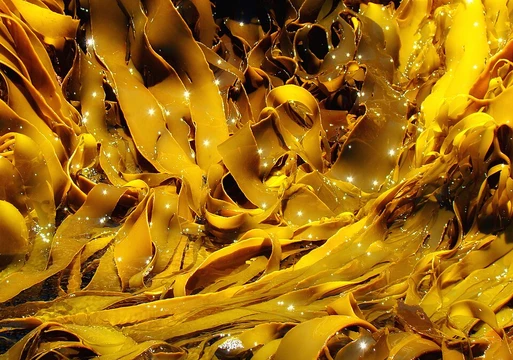
Durvillaea antarctica
A robust bull kelp that floats via honeycomb blades.

Durvillaea antarctica—known commonly as bull kelp, cochayuyo, or rimurapa—is a tough, oversized species of southern bull kelp that grows along the coasts of Chile, southern Peru, New Zealand, and Macquarie Island. Unlike many seaweeds, it has no air bladders. Instead, it stays afloat thanks to a honeycomb-like structure inside its blades, which also helps the kelp withstand the force of heavy surf.
The blades are green to golden brown and feel leathery. That honeycomb interior gives them both strength and buoyancy. This unusual structure is thought to explain why the genus has spread so widely: when the holdfast gives way, the kelp can float away. In this way, it can colonize new coastlines and has been known to carry entire communities of invertebrates across vast ocean distances. Individual specimens have been recorded floating for up to 210 days, and high winds can push these rafts as far as 10,000 kilometers. How buoyant a raft stays and how fast it travels depends on temperature, sunlight, and surface winds—all of which change with latitude. Rafts are more likely to drift offshore if the plants detach during an outgoing tide in autumn or winter. Scientists think this kind of rafting, with Durvillaea antarctica and other floating seaweeds, allowed many species to repopulate sub-Antarctic shores that had been scoured clean by ice during the last Ice Age.
The holdfast is large and extremely hard to remove. The kelp must resist forces equivalent to 1,100 km/h on land. When the holdfast does fail, it’s usually because worms and mollusks feed on the tissue in the sheltered habitat the holdfast creates. Often, the rock itself breaks off before the holdfast loses its grip, and this contributes significantly to erosion in some areas. Recruitment rates for this species are very low, so harvesting it has a heavy ecological impact.
First described in 1822 as *Fucus antarcticus*, it was reclassified as *Durvillaea antarctica* in 1892. In 2012, a taxonomic revision split off a new species, *Durvillaea poha*, based on genetic, morphological, and ecological evidence. This new species had previously been considered the “cape” lineage of *D. antarctica*. *D. poha* is the only other member of the genus with the honeycomb structure and buoyancy. It is found only in southern New Zealand and on subantarctic islands such as the Snares and Auckland Islands, while *D.
Quick Facts
- Genus
- Durvillaea
- Species
- antarctica
Facts from the source article.
Lore & Background
Durvillaea antarctica was first described in 1822 as Fucus antarcticus and revised in 1892 to its current name. The genus name honors French explorer Jules Dumont d'Urville, while the epithet refers to its distribution in southern oceans. The Māori name rimurapa derives from the Polynesian word rimu for seaweed, and the English name bull kelp likely relates to its whip-like shape or leathery texture.
The blades are green to golden brown with a leathery texture, and their honeycomb structure provides strength and buoyancy. This structure is thought to explain the genus's wide distribution, as the kelp can float when its holdfast fails, colonizing other coastlines and carrying invertebrate communities across vast distances. Specimens have floated for up to 210 days, traveling up to 10,000 km. Environmental factors like temperature, solar radiation, and surface winds affect buoyancy and travel rate. Rafts are more likely to disperse offshore if plants detach during outgoing tides in autumn and winter.
The holdfast is large and difficult to remove, resisting forces equivalent to 1100 km/h on land. Holdfast failure usually results from worms and molluscs feeding on the tissue, or the host rock breaking off. Recruitment rates are very low, making harvesting ecologically impactful. In 2012, a taxonomic revision recognized the new species Durvillaea poha, which shares the honeycombed structure and buoyancy but occurs only in southern New Zealand and subantarctic islands, while D. antarctica has a wider distribution.
Reader's Guide
Durvillaea antarctica holds significant ecological and cultural importance. Ecologically, its rafting ability has allowed it to disperse across the Southern Hemisphere, carrying communities of invertebrates and even parasites like Herpodiscus durvillaeae and Maullinia across ocean basins. This rafting is thought to have enabled many species to recolonize sub-Antarctic shores scoured by ice during the last Ice Age. The holdfasts host diverse epifaunal invertebrates, including crustaceans, molluscs, and the intertidal spider Desis marina.
Culturally, in Chile, the species is harvested for cuisine, used in salads and stews, and known as cochayuyo or hulte. The expression 'remojar el cochayuyo' refers to sexual intercourse, derived from the practice of soaking dried kelp. In Māori and Moriori culture, known as rimurapa, the blades are used to make pōhā bags for carrying food and water, propagating shellfish, and making clothing and equipment. Pōhā are especially associated with Ngāi Tahu for storing muttonbird chicks. The kelp was also used to create semi-submerged dinghies called waka kōrari by Moriori and Ngāi Tahu, and is a traditional Māori food source.
Did You Know?
- Durvillaea antarctica does not have air bladders but floats due to a unique honeycomb structure in its blades.
- Specimens have been found to float for up to 210 days and travel up to 10,000 km.
- A large individual can produce 100 million eggs in twelve hours.
- The holdfast of D. antarctica has to resist forces equivalent to 1100 km/h on land.
Architecture of Resilience
Unlike most kelps that rely on gas-filled bladders to stay afloat, Durvillaea antarctica achieves buoyancy through an extraordinary internal architecture. Its blades—ranging in color from deep green to golden brown and possessing a distinctly leathery texture—contain a honeycomb lattice of air-filled chambers. This cellular engineering serves a dual purpose: it provides the structural strength needed to withstand wave forces equivalent to 1,100 kilometers per hour on land, while simultaneously keeping the plant afloat. The holdfast anchoring this kelp to rocky substrates is so tenacious that in many cases the host rock itself fractures before the attachment fails. When detachment does occur, it is rarely the result of mechanical stress alone; burrowing worms and grazing molluscs that shelter within the holdfast's architecture gradually weaken the tissue from within. This same tenacity, paradoxically, drives coastal erosion in certain regions, as entire rock fragments are torn free while the holdfast maintains its grip. The result is a plant whose very survival mechanism reshapes the shores it inhabits.
Oceanic Nomads
When a Durvillaea antarctica holdfast finally gives way—often after months of invertebrate grazing—the resulting kelp raft becomes one of the most remarkable long-distance dispersal vehicles in the Southern Ocean. Documented floating periods reach 210 days, during which prevailing winds and currents can carry these rafts up to 10,000 kilometers across open water. The journey is not passive: temperature, solar radiation, and surface wind patterns, all of which shift with latitude, modulate both the raft's buoyancy and its speed of travel. Detachment timing matters enormously; plants that break free during outgoing tides in autumn and winter are far more likely to be swept offshore than those released at other times. Perhaps most strikingly, these rafts are not solitary. They carry entire communities of invertebrates—crustaceans, molluscs, even the intertidal spider Desis marina—across vast oceanic distances. Scientists believe this rafting mechanism enabled a wide array of species to recolonize sub-Antarctic shorelines that had been scoured bare by glacial ice during the last Ice Age, effectively seeding life across a frozen and lifeless landscape.
A Genus in Flux
The taxonomic identity of Durvillaea antarctica has shifted repeatedly as science has refined its tools. First described in 1822 under the name Fucus antarcticus, the species was reclassified into its current genus in 1892. A far more consequential revision came in 2012, when genetic, morphological, and ecological evidence prompted the recognition of a separate species, Durvillaea poha, previously lumped within the 'cape' lineage of D. antarctica. The two species share the honeycomb buoyancy structure, yet they differ in distribution, frond width, and coloration—D. poha tends toward broader, more orange fronds and favors sheltered bays or higher positions on rock platforms where wave energy is reduced. In southern New Zealand, both species can grow side by side, and mitochondrial introgression has even been documented in Wellington, where some individuals carry the nuclear DNA of D. poha alongside mitochondrial DNA belonging to D. antarctica. Beyond these two recognized species, additional unclassified lineages continue to be identified within the broader complex, suggesting the genus harbors more hidden diversity than currently acknowledged.
Living Ecosystems and Human Threads
A single Durvillaea antarctica holdfast functions as a miniature ecosystem, sheltering a diverse assemblage of epifaunal invertebrates. In New Zealand waters, these include crustaceans such as Parawaldeckia kidderi, P. karaka, and Limnoria stephenseni, alongside molluscs like Cantharidus roseus, Onchidella marginata, Onithochiton neglectus, and Sypharochiton sinclairi. The kelp also hosts parasitic organisms: the endophytic algal parasite Herpodiscus durvillaeae and the intracellular protistan genus Maullinia, both of which genetic evidence suggests spread across the Southern Hemisphere via rafting. Despite this richness, the species' recruitment rate is very low, making it acutely vulnerable to harvesting—a concern with significant ecological implications. In Chilean culture, the stems and holdfasts are gathered for salads and stews, known in Quechua as cochayuyo and in Mapuche as collofe. The Māori name rimurapa, rooted in a Polynesian word for seaweed-like organisms, has even influenced the Māori term for pasta, parāoa rimurapa.
Frequently Asked Questions
What is Durvillaea antarctica?
It is a large, tough species of southern bull kelp—commonly called cochayuyo or rimurapa—that grows along the rocky coasts of Chile, southern Peru, New Zealand, and Macquarie Island roughly between 29°S and 55°S latitude.
How does Durvillaea antarctica stay afloat without air bladders?
Rather than relying on gas-filled bladders like many other seaweeds, it keeps its leathery blades buoyant through a honeycomb-like internal architecture that also gives the tissue enough rigidity to shrug off heavy surf.
What do Durvillaea antarctica's blades look and feel like?
The blades range in colour from green to golden brown and have a distinctly leathery texture; that same honeycomb interior is what makes them both buoyant and unusually resistant to wave impact.
How far can Durvillaea antarctica drift across the ocean?
Individual plants have been recorded rafting for up to 210 days and travelling as much as 10,000 km, a dispersal ability scientists credit with explaining how the genus spread so widely across the Southern Hemisphere.
When and where was Durvillaea antarctica first described?
It was originally named Fucus antarcticus in 1822, with its type locality at Cape Horn, Chile, and was later reclassified into the genus Durvillaea in 1892.
More in Brown Macroalgae and Kelp 1-24
Spotted an error? Know more?
Reader corrections go straight into our review queue. Suggest an edit · How this site is sourced