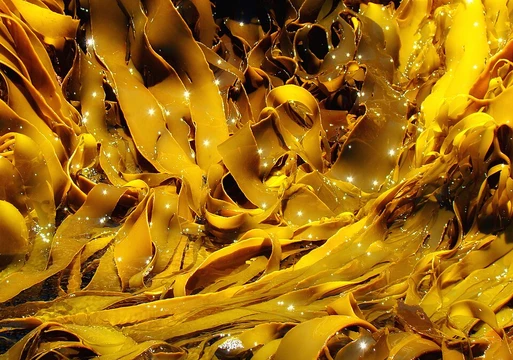
Gongolaria baccata
A brown seaweed with berry-like air bladders, found in Atlantic and Mediterranean waters.

Gongolaria baccata, also known as Cystoseira baccata, is a brown seaweed belonging to the family Fucaceae. Its species name means "berry-like," a reference to its small air bladders. This seaweed is found in the northeast Atlantic, the Baltic Sea, and the Mediterranean Sea. Before 1950, it was called Cystoseira fibrosa, but P.C. Silva noted that S.G. Gmelin had first described it in 1768 as Fucus baccatus, based on a specimen from the Netherlands. That original material is lost, but Gmelin’s illustration still identifies the species. More recently, genetic studies showed it does not belong in Cystoseira, so it was moved to the genus Gongolaria along with related species. This perennial seaweed is tough and leathery, yellowish or brownish. Each year, it grows new branches up to 50 cm long from a dark brown, cone-shaped base. The main axis is flattened, about 1 cm by 0.5 cm in cross-section. Side branches are alternate, cylindrical, and arranged in a pinnate pattern; the smallest branches are fine and wiry. Small, lemon-shaped air bladders (aerocysts) appear on the smaller branches, usually singly but sometimes in chains. In winter, when lateral branches are shed, the main axis shows a zigzag shape from the bases of these deciduous branches. The receptacles are terminal, up to 5 cm long, cylindrical with knot-like swellings, and covered in tiny threads. In spring, new lateral shoots have few aerocysts, but by autumn they become numerous and noticeable. Its range extends from the Baltic Sea south to the Mediterranean, the Canary Islands, Mauritania, and Western Sahara. It is most common in France and Spain; in the British Isles, it appears mainly in the Channel Islands, southern England, and western Ireland. It typically grows on the lower shore and in the sublittoral zone attached to rocks, or higher up in deep pools with sandy bottoms. Reproduction occurs through conceptacles, specialized cavities that form in the receptacles, which are fertile from June to autumn. Inside, antheridial hairs produce male gametes (antheridia), while each conceptacle also develops about forty female gametes (oospheres). The antheridia are released first through a pore called the ostiole, accumulating in an orange mound around it. The ripe oospheres then emerge and are fertilized externally. They become rounder, sink to the seafloor, and begin segmentation within hours.
Quick Facts
- Genus
- Gongolaria
- Species
- baccata
Facts from the source article.
Lore & Background
This species was known as Cystoseira fibrosa until 1950, when P.C. Silva pointed out that it had first been described in 1768 by S.G. Gmelin, who had found the lectotype in the Netherlands and called it Fucus baccatus. Gmelin's original material cannot now be found, but his illustration serves to identify this species. This species was recently found to not belong in Cystoseira, and was moved to the genus Gongolaria along with related species. Gongolaria baccata is a tough, leathery seaweed of a yellowish or brownish colour. It is a perennial, each year growing new branches up to 50 cm long from a dark brown, cone-shaped base. The main axis is flattened and has a cross section of 1 cm x 0.5 cm. The side branches are alternate and cylindrical, arranged in a pinnate fashion.
Reader's Guide
Gongolaria baccata holds significance as a brown seaweed that was reclassified from Cystoseira to Gongolaria based on recent findings that it did not belong in the former genus. Its taxonomy is rooted in a 1768 description by S.G. Gmelin, who named it Fucus baccatus from a lectotype found in the Netherlands; though the original material is lost, Gmelin's illustration remains the identifying reference. The species name baccata, meaning 'berry-like,' refers to its small air bladders. Ecologically, it is a perennial that grows new branches each year from a dark brown, cone-shaped base, with distinctive lemon-shaped aerocysts that become more numerous by autumn. Its reproductive biology involves conceptacles in the receptacles, which are fertile from June until autumn; male gametes develop on antheridial hairs, and about forty oospheres develop per conceptacle. Fertilisation is external, with oospheres sinking to the sea floor and beginning segmentation within hours. The species is distributed from the Baltic Sea to the Mediterranean, the Canary Islands, Mauritania and Western Sahara, and is commonest in France and Spain, with British Isles populations in the Channel Islands, south coast of England and west coast of Ireland. It typically inhabits the lower shore and sublittoral zone on rocks, or higher shore deep pools with sandy bases.
Did You Know?
- The species name baccata means 'berry-like' and refers to its small air bladders.
- It was first described in 1768 by S.G. Gmelin as Fucus baccatus, based on a lectotype from the Netherlands.
- The original material of Gmelin cannot now be found, but his illustration serves to identify the species.
- This species was recently moved from the genus Cystoseira to Gongolaria after being found not to belong in Cystoseira.
Frequently Asked Questions
What is Gongolaria baccata?
Gongolaria baccata (synonym Cystoseira baccata) is a brown macroalga in the family Fucaceae, easily recognized by the small, berry-shaped air bladders dotting its fronds. It is a marine species rather than a freshwater or terrestrial plant.
What does the species name 'baccata' mean?
The epithet 'baccata' translates to 'berry-like' and refers directly to the tiny gas-filled bladders (pneumatocysts) that line the seaweed's blades, giving it a beaded, fruit-like appearance.
Where is Gongolaria baccata found?
This seaweed occurs across the northeast Atlantic, the Baltic Sea, and the Mediterranean Sea, typically in shallow coastal waters where it can anchor to hard substrates.
Why was it moved out of the genus Cystoseira?
Molecular and genetic analyses showed that this species does not cluster within Cystoseira, prompting its transfer to the genus Gongolaria. Prior to 1950 it was even catalogued under the name Cystoseira fibrosa, so the taxonomic history has been particularly tangled.
Who first described this species and what happened to the original specimen?
S. G. Gmelin published the first formal description in 1768 under the name Fucus baccatus, based on a specimen collected in the Netherlands. The physical type material is now lost, but Gmelin's accompanying illustration remains the key reference for identifying the species.
More in Brown Macroalgae and Kelp 1-24
Spotted an error? Know more?
Reader corrections go straight into our review queue. Suggest an edit · How this site is sourced