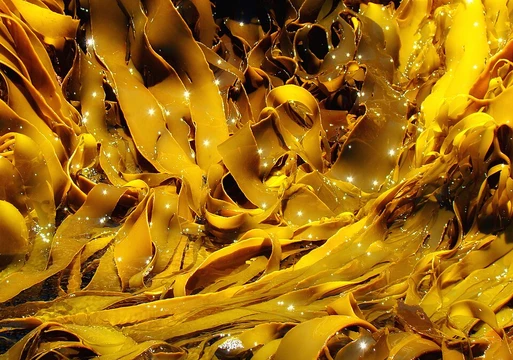
Himanthalia elongata
A brown alga, the sole species in its genus and family.

Himanthalia elongata is a brown seaweed belonging to the order Fucales, commonly called thongweed, sea thong, or sea spaghetti. It is the sole species in its genus, Himanthalia, and the only member of its family, Himanthaliaceae, as listed by the World Register of Marine Species.
This alga grows on the lower shore, starting as a small, flat disc up to three centimetres wide with a short stalk. During autumn or winter, long, branching thongs emerge from the disc’s centre, dividing dichotomously several times. These thongs grow quickly, reaching up to two metres by the following summer, when they mature and develop reproductive structures called conceptacles. After releasing gametes into the water, the thongs begin to decay. The disc itself lives for two to three years.
Himanthalia elongata occurs in the Baltic Sea, the North Sea, and the northeast Atlantic Ocean, from Scandinavia and Ireland south to Portugal. It inhabits gently sloping, rocky shores in the lower intertidal and subtidal zones, especially where wave exposure is moderate. It can be abundant, forming a distinct band just below the zone of *Fucus serratus*.
Quick Facts
- Genus
- Himanthalia
- Species
- elongata
Facts from the source article.
Lore & Background
Himanthalia elongata is a common brown alga of the lower shore. Its thallus begins as a small flattened or saucer-shaped disc up to three centimetres wide with a short stalk. In autumn or winter, long thongs grow from the centre of this disc, branching dichotomously several times. These thongs grow rapidly and can reach up to two metres by the following summer, when they become mature. They bear the conceptacles, the reproductive organs, and begin to decay once the gametes have been released into the water. The discs themselves live for two or three years.
Reader's Guide
Himanthalia elongata is found in the Baltic Sea, the North Sea, and the north east Atlantic Ocean, ranging from Scandinavia through Ireland and south to Portugal. It inhabits gently shelving rocky shores in the lower littoral and sublittoral zones, particularly on shores with moderate wave exposure. It is sometimes abundant and forms a distinct zone just below the Fucus serratus zone. Its unique morphology—starting as a disc and later producing long, branching thongs—distinguishes it from other brown algae. As the only species in its genus and family, it holds taxonomic significance within the order Fucales.
Did You Know?
- Himanthalia elongata is the only member of its genus, Himanthalia, and the only member of its family, Himanthaliaceae.
- Its thallus begins as a small disc up to three centimetres wide, from which long thongs grow in autumn or winter.
- The thongs can reach up to two metres by the following summer and bear the reproductive conceptacles.
- It is found in the Baltic Sea, North Sea, and north east Atlantic Ocean from Scandinavia to Portugal.
Frequently Asked Questions
What is Himanthalia elongata?
It is a brown macroalga in the order Fucales, widely known by nicknames like thongweed, sea thong, or sea spaghetti. It holds a unique position as the only species in the genus Himanthalia and the sole member of the family Himanthaliaceae.
How big does Himanthalia elongata get?
The basal disc starts out at roughly three centimetres across, while the long, branching thongs that emerge from its centre can stretch to about two metres by the following summer. That makes it one of the more strikingly elongated seaweeds on the lower shore.
What does the life cycle of Himanthalia elongata look like?
It begins as a small, flat disc anchored on the lower shore, then sends out long thongs that divide dichotomously several times during autumn or winter. The disc persists for two to three years before the cycle starts anew.
Where does Himanthalia elongata typically grow?
It is a lower-shore species, with its disc sitting on the substrate and the thongs extending upward into the water. The rapid summer growth of the thongs is well adapted to the shifting conditions of that intertidal zone.
Why is Himanthalia elongata taxonomically notable?
It is a monotypic lineage at two levels: the only species in the genus Himanthalia (named by Lyngbye in 1819) and the sole representative of the family Himanthaliaceae (formalised by De Toni in 1891). This makes it a one-of-a-kind branch on the brown-algae tree of life.
More in Brown Macroalgae and Kelp 1-24
Spotted an error? Know more?
Reader corrections go straight into our review queue. Suggest an edit · How this site is sourced