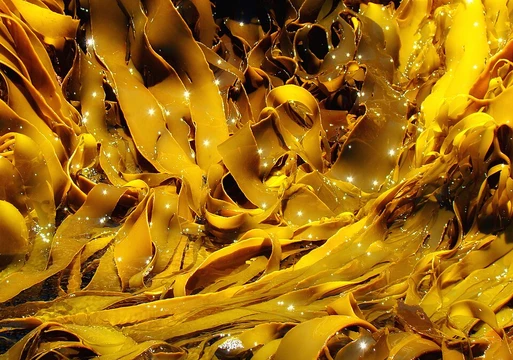
Chorda filum
A brown alga with rope-like fronds, notable for a 2025 cultivation breakthrough.

Chorda filum, also called dead man's rope, sea lace, mermaid's tresses, cat's gut, bootlace weed, sea-twine, or mermaid's fishing line, is a brown alga belonging to the genus Chorda. It occurs widely in the temperate waters of the Northern Hemisphere. The plant has long, unbranched, hollow, rope-like fronds roughly 5 mm across, which can reach up to 8 m in length. Its holdfast is disc-shaped. The alga grows in sheltered marine and estuarine habitats, typically on loose substrates such as gravel, pebbles, other macroalgae, or eelgrass, at depths down to 5 m. Growth averages about 17 cm per month. The spiral-shaped, often gas-filled tips of the fronds are dead; new growth comes from a sub-terminal meristem. The plant is annual and dies back in winter. During summer, the fronds bear short, colorless hairs. It resembles *Halosiphon tomentosus*, but that species is rarer and covered with long brown sterile hairs. *C. filum* is found on very sheltered shores, often abundant near low water and in the sublittoral zone down to 25 m on mud and sand. Its distribution includes the temperate coasts of the northern Atlantic and Pacific oceans, and it is widespread and common around Ireland, Great Britain, the Shetland Isles, and the Isle of Man. In spring 2025, a major advance occurred in its cultivation: the Danish company Dansk Tang successfully grew it from spores for the first time, a milestone that allows seaweed farming in waters with lower salinity than previously feasible.
Quick Facts
- Genus
- Chorda
- Species
- filum
Facts from the source article.
Lore & Background
Chorda filum has long, unbranched, hollow, rope-like brown fronds about 5 mm in diameter, reaching lengths of up to 8 m. The holdfast is disc-shaped. The fronds bear short colorless hairs in summer, and their spiral-shaped, often gas-inflated termini are dead, replaced by growth from a sub-terminal meristem. The species is annual and dies during winter. It is found in sheltered marine and estuarine bodies of water at depths up to 5 m, anchored to loose substrates like gravel and pebbles or other macroalgae and eelgrass. Chorda filum is similar to Halosiphon tomentosus, but H. tomentosus is less common and covered with long brown paraphyses.
Reader's Guide
Chorda filum holds significance as a widespread brown alga in temperate northern hemisphere waters, particularly common around Ireland, Great Britain, the Shetland Isles, and the Isle of Man. Its many common names—including dead man's rope, mermaid's tresses, cat's gut, bootlace weed, sea-twine, and mermaid's fishing line—reflect its distinctive physical appearance. The species is found in very sheltered shores, often abundant near low water and in sublittoral areas to 25 m in mud and sand. Its legacy is marked by a historic cultivation breakthrough in spring 2025 by the Danish company Dansk Tang, which successfully grew it using spore propagation for the first time. This achievement enables seaweed farming in environments with lower salinity than previously thought possible, expanding potential cultivation areas.
Did You Know?
- The fronds can reach lengths of up to 8 m but are only about 5 mm in diameter.
- In spring 2025, Danish company Dansk Tang achieved the first successful spore propagation of this species.
- Chorda filum is annual and dies during winter, growing at an average of 17 cm per month.
Frequently Asked Questions
What is Chorda filum?
Chorda filum is a brown alga in the genus Chorda, widely known by folk names such as dead man's rope, mermaid's tresses, or bootlace weed. It inhabits temperate Northern Hemisphere waters and is instantly recognizable by its long, rope-like, hollow fronds.
What does Chorda filum look like?
Each frond is unbranched, hollow, and roughly 5 mm in diameter, giving it the appearance of a thin cord or bootlace. Individual strands can stretch to about 8 meters, all anchored to the seabed by a simple disc-shaped holdfast.
Where does Chorda filum typically grow?
It favors sheltered marine and estuarine settings, attaching to loose substrates like gravel, pebbles, other seaweeds, or eelgrass beds. It is generally encountered at depths up to around 5 meters.
How long does Chorda filum live?
It is an annual species that completes its growth cycle in a single season and dies off over the winter. While active, the fronds extend at an average pace of roughly 17 cm per month.
What was the 2025 cultivation breakthrough for Chorda filum?
In spring 2025, the Danish group Dansk Tang achieved the first successful spore-based propagation of this alga in a controlled environment. That milestone paves the way for laboratory cultivation and research that had previously been limited to collecting wild specimens.
More in Brown Macroalgae and Kelp 1-24
Spotted an error? Know more?
Reader corrections go straight into our review queue. Suggest an edit · How this site is sourced