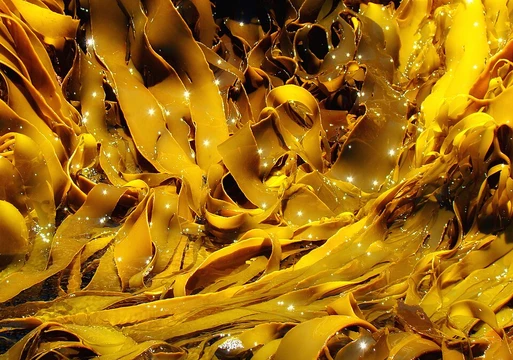
Bifurcaria galapagensis
Endemic Galapagos brown algae, possibly extinct since 1983.

Bifurcaria galapagensis, called the Galapagos stringweed, is a brown alga found only in the Galapagos Islands. The IUCN Red List classifies it as Critically Endangered (Possibly Extinct), based on a March 2007 assessment that noted no sightings of the species since 1983.
During a three-month expedition to Baja California, Central and South America, and the Galapagos Islands, William Randolph Taylor documented this seaweed (then known as *Blossevillea galapagensis*) along with many other Pacific marine algae. In the intertidal zones of Isla Santa Maria, Taylor observed that the dominant algal species appeared to be *Blossevillea galapagensis*, a notable endemic fucoid known since the Vettor Pisani Expedition. He wrote that it grew in great abundance high on the littoral rocks. Taylor recorded seven separate expeditions between 1872 and 1934—including his own—that had found this species.
Before its disappearance, there was some evidence that Galapagos stringweed possessed both antimicrobial and antimitotic properties.
**Description** Taylor described the plant as gregarious, olivaceous, firm in texture, and black and brittle when dried. It exceeds 4 dm in height, with small, irregularly lobed basal holdfasts. Branching occurs close to the base into several main axes about 1.0–1.5 mm in diameter, which branch irregularly into smaller divisions, especially above, bearing scattered lateral determinate aculeate to filiform branchlets 1–3 cm long. Upper parts are irregularly dichotomously branched, with slender sterile divisions that are somewhat fastigiate near the top. Fertile branches are dichotomous or sometimes laterally branched, with nodulose divisions up to 2.5 mm in diameter that taper. The conceptacles are hermaphrodite, and the oval sporangia measure 133–200 μ long and 46–80 μ in diameter, each producing one egg.
**Taxonomy** The classification of *Bifurcaria galapagensis* is uncertain, likely due to its rarity. AlgaeBase founder M.D. Guiry noted that as of December 2017, members of the genus *Bifurcaria* are found only in the eastern Atlantic. The species was first classified as *Fucodium galapagense* in 1886, as it seemed similar to *F. tuberculatum*.
- *Pelvetia galapagensis* (Piccone & Grunow) De Toni 1895 - *Blossevillea galapagensis* (Piccone & Grunow) W.R.
Quick Facts
- Genus
- Bifurcaria
- Species
- galapagensis
Facts from the source article.
Lore & Background
William Randolph Taylor documented Galapagos stringweed (then Blossevillea galapagensis) during a three-month expedition to Baja California, Central and South America, and the Galapagos Islands. In the intertidal zones of Isla Santa Maria, Taylor noted that the dominant algal species appeared to be Blossevillea galapagensis, a notable fucoid endemic known from the time of the Vettor Pisani Expedition, growing high on the littoral rocks in great abundance. Taylor recorded seven separate expeditions from 1872 to 1934 that found this species.
Taylor described Bifurcaria galapagensis as gregarious, olivaceous, firm in texture, black and brittle when dried, exceeding 4 dm in height, with small irregularly lobed basal holdfasts. Branching occurs close to the base into several main axes about 1.0–1.5 mm diam., which branch irregularly into smaller divisions, bearing scattered lateral determinate aculeate to filiform branchlets 1–3 cm long. Fertile branches are dichotomously or sometimes laterally branched, with nodulose divisions up to 2.5 mm diam., and conceptacles hermaphrodite containing oval sporangia 133–200 μ long and 46–80 μ diam., each producing one egg.
The classification of Bifurcaria galapagensis is uncertain, likely due to its scarcity. AlgaeBase founder M.D. Guiry noted that as of December 2017, members of the genus Bifurcaria are found only in the eastern Atlantic. The species was first classified as Fucodium galapagense in 1886, and has several homotypic synonyms including Pelvetia galapagensis and Blossevillea galapagensis, the latter based on Taylor's assessment of similarities in fructiferous parts and having one egg per sporangium.
Reader's Guide
The significance of Bifurcaria galapagensis lies in its status as an endemic species of the Galapagos Islands that has likely gone extinct. Researchers applying a key biodiversity area (KBA) methodology to the Galapagos Marine Reserve conducted numerous field surveys between 2000 and 2006 and were unable to find a single specimen. They considered crypsis or insufficient search effort as possible reasons but determined that the lack of sighting reflected true absence. The species was later described by many of the same researchers as regarded as probably extinct. The Spring/Summer 2010 issue of Galapagos News lamented that one in five of the marine species listed as threatened in Galapagos may already be extinct and that it may be too late to save the endemic Galapagos stringweed. Before its disappearance, there was some evidence suggesting that Galapagos stringweed had both antimicrobial and antimitotic properties. Its uncertain taxonomy, with members of the genus Bifurcaria now found only in the eastern Atlantic, further underscores the loss of a unique evolutionary lineage. The species serves as a case study in marine extinction risk, particularly for endemic island algae with limited distribution and no recent sightings.
Did You Know?
- The species had not been sighted since 1983 as of a March 2007 IUCN assessment.
- Before its disappearance, there was some evidence of antimicrobial and antimitotic properties.
Taxonomic Identity and Classification
Bifurcaria galapagensis, commonly known as the Galapagos stringweed, is a brown alga belonging to the class Phaeophyceae within the broader kingdom Chromista. This taxonomic placement carries particular weight in conservation biology, because the International Union for Conservation of Nature has, to date, confined its protist evaluations exclusively to members of Phaeophyceae. No other protist group has received formal IUCN assessment, making the brown algae the sole protist lineage under international scrutiny. The species' common name references its geographic association with the Galapagos archipelago, while the binomial places it within the genus Bifurcaria. As a member of Chromista, it shares a broader biological lineage with other algal groups, yet its conservation evaluation exists within a remarkably narrow framework: only fifteen Chromista species in total had been formally assessed by the IUCN as of September 2021, and the Galapagos stringweed is one of them.
Conservation Status and the Possibly Extinct Designation
The IUCN has placed Bifurcaria galapagensis in the Critically Endangered category with the additional designation of possibly extinct, a classification that sits at the very bottom of the threat spectrum. What makes this status especially striking is that, across all fifteen evaluated Chromista species, not a single one has been confirmed as fully extinct. Nevertheless, four species—including the Galapagos stringweed—carry the possibly extinct tag, meaning that despite surveys, no living individuals have been verified in the wild. The species shares this precarious designation with Desmarestia tropica, Dictyota galapagensis, and Spatoglossum schmittii. The distinction between confirmed extinction and possible extinction reflects the inherent difficulty of definitively proving the disappearance of a marine organism, yet the practical implication for the Galapagos stringweed is that its continued survival in natural habitats remains unproven and deeply uncertain.
The Narrow Scope of Chromista Conservation Assessment
The conservation picture for Bifurcaria galapagensis must be understood within the context of how limited international assessment of Chromista truly is. As of September 2021, the IUCN had evaluated just fifteen species across the entire Chromista kingdom. No subspecies or subpopulations within Chromista have received any evaluation whatsoever, meaning that even where a species is broadly assessed, the finer-scale population dynamics that might be critical for a localized alga like the Galapagos stringweed remain entirely outside the formal conservation framework. Furthermore, the IUCN's protist evaluations are confined to Phaeophyceae; no other protist taxa have been touched at all. This creates a situation in which the Galapagos stringweed's possibly extinct status rests on a very small, incomplete dataset, and the absence of subspecies-level data means that granular information about whether any remnant populations persist in Galapagos waters is simply unavailable.
The Broader Chromista Threat Landscape
The Galapagos stringweed does not exist in isolation within the Chromista conservation landscape. Among the fifteen IUCN-evaluated species, threat levels span a range: alongside the four possibly extinct species, Sargassum setifolium (string sargassum) is listed as Endangered, and Eisenia galapagensis (Galapagos kelp) is classified as Vulnerable. The remaining evaluated species fall into the Data Deficient category, spanning families such as Dictyotaceae, Chordariaceae, Sargassaceae, and Sporochnaceae, and include several Sargassum species as well as members of genera like Dictyopteris, Padina, Spatoglossum, Zosterocarpus, and Sporochnus. This broader picture underscores that the Galapagos stringweed's precarious status is part of a wider pattern of vulnerability and uncertainty among brown algae, even as the overall assessment framework remains sparse, with no subspecies-level data and no evaluations extending beyond Phaeophyceae into other protist groups.
Frequently Asked Questions
What is Bifurcaria galapagensis?
Bifurcaria galapagensis, commonly called the Galapagos stringweed, is a species of brown macroalgae that was endemic to the Galapagos Islands. It belongs to the broader kelp and brown alga group and was historically found in the intertidal zones of the archipelago.
Where was Bifurcaria galapagensis found?
The species was restricted to the Galapagos Islands, with William Randolph Taylor specifically documenting it in the intertidal habitats of Isla Santa Maria during a multi-region Pacific expedition. No populations have been confirmed anywhere else in the world.
What does Bifurcaria galapagensis look like?
It could grow to a height exceeding 40 cm (4 dm), giving it a substantial stringy form typical of its name. Its reproductive structures, the sporangia, measured roughly 133–200 μm long and 46–80 μm across.
Is Bifurcaria galapagensis extinct?
The IUCN Red List currently classifies it as Critically Endangered (Possibly Extinct) following a March 2007 assessment. No confirmed sightings of the species have been recorded since 1983, leaving its survival in serious doubt.
When was Bifurcaria galapagensis first described in science?
The organism was first formally classified in 1886 under the name Fucodium galapagense. It later passed through the intermediate name Blossevillea galapagensis before settling into its current binomial, Bifurcaria galapagensis.
More in Brown Macroalgae and Kelp 1-24
Spotted an error? Know more?
Reader corrections go straight into our review queue. Suggest an edit · How this site is sourced