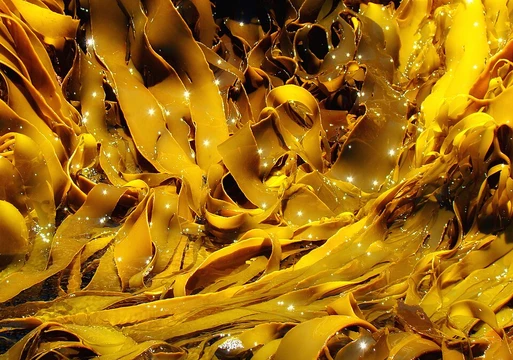
Kelp
Large brown algae forming dense underwater forests in cold oceans.

Kelps are large brown algae or seaweeds that make up the order Laminariales, comprising about 30 genera. Despite their plant-like appearance and use of photosynthesis, kelps are not plants but stramenopiles. They are notable for their fast growth, with genera such as Macrocystis and Nereocystis growing up to half a metre per day and reaching lengths of 30 to 80 metres, forming dense, forest-like areas under shallow temperate and Arctic oceans.
Quick Facts
- Taxon
- Laminariales
Facts from the source article.
Lore & Background
Through the 19th century, the word 'kelp' was closely associated with seaweeds that could be burned to obtain soda ash (primarily sodium carbonate), including species from both Laminariales and Fucales. The word was also used directly to refer to these processed ashes. The thallus consists of flat or leaf-like lamina (blades) originating from elongated stipes, anchored by a root-like holdfast. Gas-filled bladders (pneumatocysts) form at the base of blades of American species, such as Nereocystis lueteana, to hold blades near the surface for photosynthesis. Stipes are generally covered with a slimy mucilage layer rather than a waxy cuticle. Growth occurs at the base of the meristem, where blades and stipe meet, and may be limited by grazing—sea urchins can reduce ecosystems to urchin barrens. The life cycle involves a diploid sporophyte and haploid gametophyte stage; the haploid phase begins when mature organisms release spores that germinate into male or female gametophytes, leading to sexual reproduction and the diploid sporophyte stage. Kelp are only very distantly related to plants, having evolved plant-like structures through convergent evolution. A 2015 study aimed to evaluate the efficiency of giant kelp (Macrocystis pyrifera) transport anatomy looked at 6 different laminariales species to see if they had typical vascular plant allometric relationships.
Reader's Guide
Kelp are significant as ecosystem engineers, forming some of the most diverse and dynamic ecosystems on earth—kelp forests. Their evolutionary history includes convergent evolution both with plants and within their own phylogeny, leading to niche conservatism. A 2020 study of 14 species found that many functional traits (blade mass per area, stiffness, strength) evolved convergently across kelp phylogeny, with niche partitioning along wave disturbance gradients driving divergence. Plasticity of structural traits, especially blade morphology, has been key to adaptation in turbulent habitats, allowing individuals of the same species to differ based on wave disturbance regimes. For example, Macrocystis integrifolia can exhibit four distinct blade morphologies depending on habitat. Dispersal methods have also evolved, with buoyant structures like pneumatocysts enabling kelp rafts to travel great distances, colonizing new areas and explaining low genetic diversity in some regions. Kelp's ability to shape habitats and support diverse communities underscores their ecological legacy.
Did You Know?
- Kelp is not a plant but a stramenopile, despite using photosynthesis in chloroplasts.
- The genera Macrocystis and Nereocystis can grow as fast as half a metre per day.
- Kelp were present in the northeastern Pacific Ocean by at least 32 million years ago, earlier than the previously thought Miocene.
- Some kelp species have evolved transport mechanisms using trumpet-shaped sieve elements, similar to vascular plant phloem.
Biodiversity and the Role of Ecosystem Engineer
Kelp forests rank among the most productive and dynamic ecosystems on the planet. Although they cover only 0.1% of Earth's surface when combined with coral reefs, they deliver 0.9% of all global primary productivity. As a true ecosystem engineer, kelp supplies the physical structure that entire communities rely on for shelter and sustenance. In the North Pacific, rockfish, amphipods, shrimp, marine snails, bristle worms, and brittle stars all inhabit the forest. Seals, sea lions, whales, sea otters, gulls, terns, snowy egrets, great blue herons, cormorants, and various shore birds also depend on these underwater meadows. Over the past century, kelp forests have been a central focus of trophic ecology research, generating conceptual frameworks that reach well beyond the ecosystem itself. They shape coastal oceanographic patterns and furnish a broad suite of ecosystem services, making them an indispensable lens for understanding how marine environments function and interact.
Anatomy, Growth, and Environmental Requirements
Kelp belongs to the kingdom Protista, so its body is termed a thallus rather than a plant. That thallus is built from three basic units: a holdfast that grips the sea floor without absorbing nutrients, a stipe that serves as a vertical support stalk, and fronds—blade-like extensions along the stipe where photosynthesis and nutrient uptake take place. Many species also grow pneumatocysts, gas-filled bladders near the frond bases that keep the kelp upright in the water column. Survival demands hard substrate, plentiful nitrogen and phosphorus, and adequate light. In zones of strong upwelling, giant kelp can extend thirty to sixty centimeters in a single day. Annual species like Nereocystis complete their life cycle in one year, while perennials such as Eisenia persist for more than two decades, with peak growth in spring and summer and seasonal die-backs driven by reduced nutrients, shorter photoperiods, and increased storm activity.
Degradation, Loss, and Conservation Strategies
Human pressures have driven serious degradation of kelp forests around the world. A particularly destructive pathway runs through nearshore overfishing: removing top predators releases herbivores from their usual population checks, and the resulting overgrazing strips kelp and other algae from the seafloor. This cascade can swiftly convert a thriving forest into a barren landscape where only a handful of species remain. When combined with climate change, these forces have already erased kelp forests from many vulnerable regions, including Tasmania's east coast and the shoreline of Northern California. Marine protected areas represent one management tool that can limit fishing impacts and buffer the ecosystem against the additive stressors of a warming ocean. Preserving these forests is critical, because their loss represents a profound reduction in biodiversity and the ecosystem services they provide to coastal communities.
Global Distribution and the Tropical Deep-Water Discovery
Kelps are predominantly found in temperate and polar coastal oceans, with distinct genera dominating different regions. Laminaria thrives along both sides of the Atlantic and the coasts of China and Japan, Ecklonia in Australia, New Zealand, and South Africa, and Macrocystis across the Pacific and Southern Ocean archipelagos. The northeastern Pacific, from north of San Francisco to the Aleutian Islands, holds the greatest kelp diversity with more than twenty species. Kelp was long considered absent from tropical surface waters because warm, nutrient-poor conditions fail to meet its requirements. That assumption shifted in 2007 when kelp forests were found in tropical waters near Ecuador. A later research team modeled the physical parameters kelp needs and predicted subsurface forests throughout the tropics to depths of two hundred meters. Testing the model in the Galapagos, they found thriving kelp at all eight sampled sites, validating the prediction and suggesting hidden kelp forests may exist in tropical deep waters worldwide.
Frequently Asked Questions
What is Kelp?
Kelps are large brown algae grouped under the order Laminariales, which spans roughly 30 genera. Although they photosynthesize and look plant-like, they are biologically classified as stramenopiles, not true plants.
How fast can Kelp grow?
Genera such as Macrocystis and Nereocystis are capable of adding up to half a metre (about 20 inches) of new frond tissue in a single day, making them among the fastest-growing organisms known.
How tall does Kelp get?
Mature kelp fronds can reach lengths of 30 to 80 metres (roughly 100 to 260 feet). They spread out into dense, forest-like canopies beneath the surface of shallow coastal waters.
Where does Kelp thrive?
Kelps are most at home in cold, shallow temperate and Arctic oceans, typically in water between 6 and 14 °C (43 to 57 °F). Their preferred habitats are coastal regions where sunlight can still penetrate to the seabed.
How long has Kelp existed?
Fossil records from northeastern regions place kelps at least 32 million years ago, pushing back the earlier Miocene estimate of 5 to 23 million years and showing they are far older than previously thought.
More in Brown Macroalgae and Kelp 1-24
Spotted an error? Know more?
Reader corrections go straight into our review queue. Suggest an edit · How this site is sourced