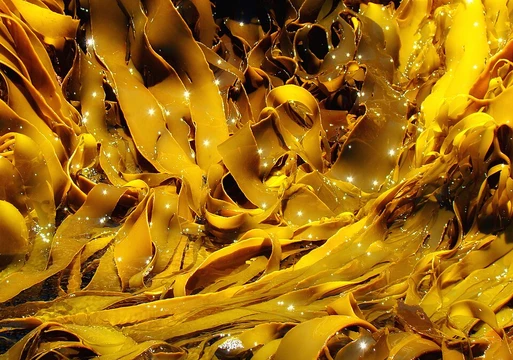
Durvillaea willana
A non-buoyant, chocolate-brown bull kelp endemic to New Zealand.

Durvillaea willana is a large southern bull kelp found only in New Zealand. Its color is a chocolate brown, making it darker than any other bull kelp species. The stipe is branched, and the fronds lack both buoyancy and the internal 'honeycomb' structure seen in some relatives. Its holdfast grows into a large, plate-like shape on rocky surfaces.
In appearance, it closely resembles *Durvillaea antarctica*, but *D. willana* has smaller blades and typically grows lower on the shore because it is less tolerant of strong wave action. Unlike *D. antarctica*, it has a branched stipe and non-buoyant fronds.
The species is named after Eileen Alice Willa, who collected many algae specimens for the researcher Lindauer.
Its distribution is limited to New Zealand’s southeastern North Island (though not in Cook Strait), the South Island, and Stewart Island. Gaps in its range may be linked to earthquake uplift events, such as the 1855 Wairarapa earthquake. However, older uplift (800–1400 years ago) in the Akatore fault zone does not appear to have caused lasting damage to the genetic diversity of *D. willana* in that area, suggesting that the subtidal kelp may not be completely wiped out by such events.
Quick Facts
- Taxon
- Durvillaea willana
Facts from the source article.
Lore & Background
Durvillaea willana is a large species of southern bull kelp endemic to New Zealand. It is chocolate brown in colour and darker than all other bull kelp species. The species has a branched stipe, is non-buoyant, and does not have 'honeycomb' in its fronds. Its holdfast becomes large and spreads like a plate on rocky substrates.
This species is superficially similar in appearance to Durvillaea antarctica, but D. willana has smaller blades and is usually found lower on the shoreline because of its lower tolerance of wave action. Unlike D. antarctica, it has a branched stipe and does not have buoyant fronds.
The species epithet, willana, honours Eileen Alice Willa, who collected many algal species for Lindauer. The species is found on the southeastern shores of the North Island (though not in Cook Strait), as well as on the shores of the South Island and Stewart Island. Gaps in its geographic range may have been caused by earthquake uplift events such as the 1855 Wairarapa earthquake, though historic uplift in the Akatore fault zone does not seem to have caused long-term disruption in genetic diversity, suggesting the subtidal D. willana may not die off completely due to such events.
Reader's Guide
Durvillaea willana is significant as a distinct, non-buoyant species of southern bull kelp endemic to New Zealand. Its darker chocolate-brown colour sets it apart from all other bull kelp species. The species' lack of buoyancy and 'honeycomb' in its fronds, along with its branched stipe, distinguish it from the superficially similar Durvillaea antarctica. Its distribution is limited to the southeastern shores of the North Island (excluding Cook Strait), the South Island, and Stewart Island. The species' legacy includes its naming after Eileen Alice Willa, a collector of algal species for Lindauer. The potential impact of earthquake uplift events on its range is noted, with evidence that historic uplift in the Akatore fault zone did not cause long-term genetic disruption, suggesting resilience in subtidal populations. This information contributes to understanding the ecology and biogeography of New Zealand's endemic kelp species.
Taxonomy and the Bull Kelp Name
Durvillaea willana is a member of the genus Durvillaea, a group of large brown algae that stands alone within the monotypic family Durvillaeaceae. The genus is widely known by the common name southern bull kelp, a label that in everyday usage is often trimmed down to simply bull kelp. That abbreviation, however, creates a well-known source of confusion because the same shortened name is applied to Nereocystis luetkeana, a North Pacific kelp that is entirely unrelated. The scientific genus name pays tribute to the French explorer Jules Dumont d'Urville, who lived between 1790 and 1842. Every species in Durvillaea is confined to the southern hemisphere, with documented populations along the coasts of Australia, New Zealand, South America, and a number of subantarctic islands. D. willana is one of several recognised species in the genus, which also includes D. antarctica, D. poha, and D. incurvata, among others.
Morphology and the Buoyancy Divide
Species of Durvillaea are noted for their prolific growth and a highly plastic morphology, meaning their physical form can shift substantially in response to local conditions. The genus is dioecious, with separate male and female individuals, and in at least one species the two sexes show no meaningful difference in colouration based on pigment levels in the thalli. A defining structural distinction sets D. willana apart from several of its close relatives. D. incurvata, D. antarctica, and D. poha all contain a honeycomb-like tissue within their fronds that traps air and grants the plant buoyancy. D. willana entirely lacks this honeycomb architecture. Consequently, its individuals are non-buoyant, and once they become detached from the seabed they are unable to float or drift. This single morphological difference has sweeping implications for the species' capacity to disperse over long distances and to recolonise areas where local populations have been lost.
Habitat, Range, and Ecological Niche
Durvillaea species, D. willana included, anchor themselves to rocky, wave-exposed coastal sites in the intertidal and shallow subtidal zones. While D. antarctica and D. poha are intertidal species capable of growing at the very upper limit of the intertidal zone where wave wash is sufficient, D. willana occupies a distinctly subtidal niche, found at depths reaching six metres. Across the genus, all members are restricted to the southern hemisphere, occurring along the shores of Australia, New Zealand, South America, and various subantarctic islands. Despite constant battering from wave action, these kelps tolerate a high degree of physical disturbance, although severe storms can still dislodge individuals from their substrates. The holdfasts and fronds of Durvillaea serve as critical habitat for a rich community of intertidal organisms. Research further indicates that the bacterial microbiomes living on and around these kelps are shaped significantly by local environmental conditions, and that the diversity of these microbial communities is influenced by the density and connectivity of the host kelp populations.
Vulnerability and the Cost of Non-Buoyancy
The absence of buoyant honeycomb tissue in D. willana carries profound ecological consequences. Unlike its buoyant congeners, which can detach during storms and raft for up to 210 days across distances reaching 10,000 kilometres, D. willana individuals that are dislodged cannot drift or travel. The species therefore has no mechanism for long-distance dispersal, leaving local populations far more exposed to extinction and considerably slower to recolonise after a disturbance. Durvillaea species face mounting pressure from rising temperatures, marine heatwaves, increased sedimentation, and invasive species such as Undaria pinnatifida. A marine heatwave in the summer of 2017/18 wiped out multiple Durvillaea species at Pile Bay on the Banks Peninsula, after which the invasive kelp rapidly recruited in high densities. Earthquake uplift of as little as 1.5 metres can kill off bull kelp in large numbers, and subsequent landslide-driven sedimentation compounds the damage. For a non-buoyant species like D. willana, recovery from such events depends almost entirely on nearby surviving populations, with no rescue from distant rafts.
Frequently Asked Questions
What is Durvillaea willana?
Durvillaea willana is a large southern bull kelp found exclusively in New Zealand. It stands out among its relatives for its deep chocolate-brown coloration, which makes it noticeably darker than any other bull kelp species.
Where can you find Durvillaea willana in the wild?
This kelp is restricted to New Zealand's southeastern North Island shores (it does not occur in Cook Strait), the South Island, and Stewart Island. It typically colonizes rocky substrates lower on the intertidal shore.
How does Durvillaea willana differ from Durvillaea antarctica?
Although the two look very similar at first glance, D. willana has smaller blades, a branched stipe, and fronds that lack both buoyancy and the internal honeycomb tissue seen in D. antarctica. It also tends to grow lower on the shore because it tolerates heavy wave action less well.
Who is Durvillaea willana named after?
The species honors Eileen Alice Willan, whose name is embedded in its scientific designation. The kelp was formally described to recognize her contribution to the study of New Zealand's coastal flora.
What does Durvillaea willana look like and how is it attached to rock?
Its fronds are a rich chocolate brown, and the stipe branches rather than remaining a single stalk. The holdfast spreads out into a broad, plate-like structure that grips the rocky surface firmly.
More in Brown Macroalgae and Kelp 1-24
Spotted an error? Know more?
Reader corrections go straight into our review queue. Suggest an edit · How this site is sourced