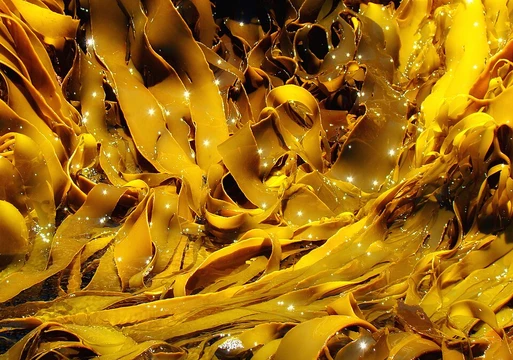
Laminariales
Large brown algae forming dense underwater forests.

Laminariales, commonly known as kelps, are an order of large brown algae or seaweeds comprising about 30 genera. They are notable for forming dense, forest-like areas under shallow temperate and Arctic oceans and for their extremely fast growth, with some genera reaching up to 80 meters in length. Despite their plant-like appearance and use of photosynthesis, kelps are not plants but stramenopiles.
Quick Facts
- Taxon
- Laminariales
Facts from the source article.
Lore & Background
The word 'kelp' was closely associated in the 19th century with seaweeds burned to obtain soda ash, including species from both Laminariales and Fucales. The thallus consists of flat blades originating from stipes, anchored by a holdfast. Gas-filled bladders (pneumatocysts) form at the base of blades in American species like Nereocystis lueteana to hold blades near the surface for photosynthesis. Stipes are covered with a slimy mucilage layer rather than a waxy cuticle.
Growth occurs at the base of the meristem where blades and stipe meet, and may be limited by grazing—sea urchins can reduce ecosystems to urchin barrens. The life cycle involves a diploid sporophyte and haploid gametophyte stage, beginning when mature organisms release spores that germinate into male or female gametophytes. Sexual reproduction then initiates the diploid sporophyte stage.
Kelp evolved plant-like structures through convergent evolution, independently developing blades, stipes, and sporangia. Some species have transport mechanisms using trumpet-shaped sieve elements, though a 2015 study found no universal allometric scaling in these networks, suggesting the transport system is still evolving. Niche conservatism and plasticity in blade morphology—such as width, ruffle, and thickness—help kelp adapt to wave disturbance gradients, with species like Macrocystis integrifolia showing up to four distinct blade morphologies depending on habitat.
Reader's Guide
Laminariales are significant as ecosystem engineers that create some of the most diverse and dynamic ecosystems on earth—kelp forests. Their fast growth and large size provide habitat and food for numerous marine organisms. The order's evolutionary history reveals convergent evolution with terrestrial plants, including independent development of transport mechanisms for organic and inorganic compounds. Studies of kelp structure evolution have illuminated adaptations for turbulent ocean environments, such as blade plasticity that reduces breakage and enhances photosynthesis. Dispersal methods, including raft formation via buoyant pneumatocysts, have allowed species like Macrocystis pyrifera to colonize vast coastal ranges, as evidenced by low genetic diversity in subantarctic regions. The order also has historical economic importance, as 19th-century 'kelp' referred to seaweeds burned for soda ash. Understanding Laminariales helps clarify the evolutionary constraints and ecological roles of brown algae, which are only distantly related to plants yet occupy similar structural and functional niches through convergent evolution.
Did You Know?
- Kelp is not a plant but a stramenopile, despite using photosynthesis in chloroplasts.
- The genera Macrocystis and Nereocystis can grow as fast as half a metre per day.
- Kelp were present in the northeastern Pacific Ocean by at least 32 million years ago.
- Some kelp species have evolved transport networks using trumpet-shaped sieve elements.
Morphology and Structural Design
The body of a kelp is organized into a series of specialized regions, each fulfilling a distinct mechanical or physiological role. Flat, leaf-like structures called lamina—or blades—radiate outward from elongated, stem-like supports known as stipes. At the very base, a root-like holdfast grips the ocean substrate, securing the entire organism against the pull of currents. In American species such as Nereocystis luetkeana, gas-filled bladders called pneumatocysts develop at the base of the blades, buoying them upward so they can intercept sunlight for photosynthesis. Rather than the waxy cuticle that protects terrestrial plant surfaces, kelp stipes are coated in a slimy mucilage layer. Together, these components—holdfast, stipe, blade, and pneumatocyst—form a vertical architecture that allows the organism to reach from the seafloor toward the surface while remaining firmly anchored in shallow temperate and Arctic waters.
Growth, Reproduction, and Ecological Vulnerability
New tissue in kelp is produced at the meristem, the junction where blades meet the stipe, allowing the organism to extend rapidly. Some genera, including Macrocystis and Nereocystis, can add as much as half a metre of new length in a single day, eventually reaching heights of thirty to eighty metres. This extraordinary growth rate, however, makes kelp vulnerable to grazing pressure. Sea urchins, in particular, can strip entire forests down to barren, kelp-less seafloors known as urchin barrens, effectively collapsing the local ecosystem. Reproduction follows an alternating life cycle: the mature diploid sporophyte releases vast numbers of spores, which germinate into haploid male or female gametophytes. Fertilization between these gametophytes initiates a new diploid sporophyte, which then develops into the next generation of the large, familiar kelp form.
Convergent Evolution: Mimicking Plants Without Being One
Although kelp photosynthesize in chloroplasts and bear a superficial resemblance to terrestrial plants, they are not plants at all but members of the stramenopile lineage. Their plant-like features—blades analogous to leaves, stipes analogous to stems, and sporangia analogous to reproductive organs—arose through convergent evolution rather than shared ancestry. Radiometric dating places the origin of vascular plants at roughly 419 to 454 million years ago, while the ancestors of Laminariales are considerably younger, at about 189 million years. Even so, some kelp species have independently evolved internal transport systems for both organic and inorganic compounds, using trumpet-shaped sieve elements that loosely parallel the xylem and phloem of trees. A 2015 study of six laminariales species found no universal allometric scaling among these structures, suggesting that the brown-algae transport network is still in the early stages of adapting to the demands of their ecological niches.
Plasticity, Niche Partitioning, and the Challenge of Classification
Kelp inhabit highly variable, wave-turbulent environments, and this has driven the evolution of remarkable morphological plasticity. Individuals of the same species can display noticeably different blade widths, ruffling, and thicknesses depending on the intensity of wave disturbance in their particular habitat. The giant bull kelp Nereocystis luetkeana, for instance, adjusts its blade shape to increase hydrodynamic drag and light interception under certain flow conditions. A 2020 study of fourteen kelp species found that many structural traits—blade mass per area, stiffness, strength—evolved convergently across the phylogeny, with species partitioning niches along a wave-disturbance gradient rather than diverging into entirely separate ecological roles. This high degree of homoplasy, where unrelated lineages develop similar forms, has made taxonomic classification of brown algae notoriously difficult, as locally similar species may look quite different from conspecifics growing in a different wave regime.
Frequently Asked Questions
Who is Laminariales?
Laminariales is the order of large brown algae commonly called kelps, encompassing roughly 30 genera of photosynthetic stramenopiles. Despite their plant-like appearance, they belong to the stramenopile lineage rather than the plant kingdom.
What are Laminariales's powers/role?
Kelps can grow up to half a metre per day and stretch to 30–80 metres in length, making them among the fastest-growing organisms on Earth. They anchor dense, forest-like ecosystems in shallow temperate and Arctic waters between 6 and 14 °C.
What's Laminariales's origin/backstory?
The lineage traces back roughly 189 million years, with the earliest confirmed fossil record dating to at least 32 million years ago. That gives kelps a deep evolutionary history long before modern marine ecosystems took their current shape.
Why is Laminariales important?
Their dense underwater forests provide habitat, shelter, and food for countless marine species, functioning as critical ecosystem engineers in cold coastal waters. Without them, entire temperate and Arctic marine food webs would lose their structural backbone.
More in Brown Macroalgae and Kelp 1-24
Spotted an error? Know more?
Reader corrections go straight into our review queue. Suggest an edit · How this site is sourced