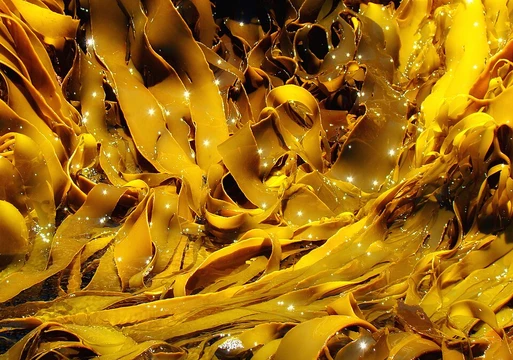
Durvillaea
Southern bull kelp that raft vast distances, shaping ecosystems.

Durvillaea is a genus of large brown algae in the monotypic family Durvillaeaceae, commonly known as southern bull kelps. All members are found in the southern hemisphere, including Australia, New Zealand, South America, and various subantarctic islands, where they occur on rocky, wave-exposed shorelines and provide habitat for numerous intertidal organisms. The genus is notable for species that possess a honeycomb-like structure in their fronds that provides buoyancy, allowing detached individuals to raft alive at sea for hundreds of days over thousands of kilometres, facilitating long-distance dispersal.
Quick Facts
- Taxon
- Durvillaea
- Type Species
- D. antarctica
- Type Species Authority
- (Chamisso) Hariot
Facts from the source article.
Lore & Background
Durvillaea species are dioecious, with males and females not significantly differing in colouration based on pigment concentration, though holdfasts of males and females can be joined together. Three species—Durvillaea incurvata, D. antarctica, and D. poha—are buoyant due to a honeycomb-like structure in their fronds that holds air, enabling long-distance dispersal when detached. In contrast, species such as D. willana lack this honeycomb tissue and are non-buoyant, preventing long-distance movement. Intertidal species like D. antarctica and D. poha can grow at the uppermost limit of the intertidal zone if sufficient wave wash is present, while D. willana is subtidal to depths of 6 metres.
Durvillaea individuals can detach from substrates, particularly during storms, and buoyant species float as rafts driven by ocean currents. Environmental factors such as temperature, solar radiation, and surface winds affect buoyancy and travel rate. Rafts of D. antarctica are more likely to disperse offshore if individuals detach during outgoing tides in autumn and winter. Attached male and female individuals can raft together, providing an opportunity for reproduction. Rafts of D. antarctica currently reach Antarctica, though freezing negatively impacts buoyancy and photosynthetic activity. The genus has been used for clothing, tools, and as a food source by many indigenous cultures throughout the South Pacific, and continues to play a prominent role in Chilean cuisine.
Reader's Guide
Durvillaea holds significant ecological and cultural importance as described in the article. Ecologically, it provides habitat for a diverse array of epifaunal and infaunal invertebrates, including the sea-star Anasterias suteri, crustaceans such as Parawaldeckia kidderi and P. karaka, gribbles Limnoria segnis and L. stephenseni, molluscs including Cantharidus roseus, Onchidella marginata, Onithochiton neglectus, and Sypharochiton sinclairi, and the spider Desis marina. Rafting individuals transport these associated invertebrates, potentially leading to long-distance dispersal and significant impact on their population genetic structure. Rafts can also be colonised by goose barnacles Lepas australis and L. pectinata, and beachcast decomposing bull-kelp is colonised and consumed by sandhoppers Bellorchestia quoyana and kelp flies Chaetocoelopa littoralis. Other seaweeds, including Gelidium lingulatum, G. rex, Corallina officinalis var. chilensis, and Lessonia spicata, grow as epiphytes in holdfasts, and rafting on D. antarctica has influenced their dispersal and phylogeography. Fronds can be infected by the obligate red algal epiphyte Pyrophyllon subtumens and by endophytic parasites such as Herpodiscus durvillaeae and Maullinia, both of which have probably been dispersed across the Southern Hemisphere via rafting bull kelp.
Culturally, Durvillaea species have been used for clothing, tools, and as a food source by indigenous cultures throughout the South Pacific, and they continue to play a prominent role in Chilean cuisine. The genus is named after French explorer Jules Dumont d'Urville. Disturbance from earthquake uplift can cause large-scale die-offs, as seen after the 2010 Chile earthquake (uplift ~0.2 to 3.1 m) and the 2016 Kaikoura earthquake (uplift up to 6 m). Intertidal species can be used to estimate earthquake uplift height, though slightly less accurately than other intertidal kelp such as Carpophyllum maschalocarpum. Increased temperatures, heatwaves, sedimentation, and invasive species like Undaria pinnatifida are sources of physiological stress; a marine heatwave in summer 2017/18 appears to have caused local extinction of multiple Durvillaea species at Pile Bay on the Banks Peninsula, after which Undaria pinnatifida recruited in high densities.
Did You Know?
- Specimens of D. antarctica have been found to float for up to 210 days, travelling up to 10,000 km.
- Earthquake uplift of as little as 1.5 metres can cause Durvillaea bull kelp to die off in large numbers.
The Honeycomb Architecture
Durvillaea antarctica solves a remarkable engineering problem without air bladders. Instead of gas-filled floats, this bull kelp relies on a honeycomb lattice woven throughout its leathery blades, which range in colour from deep green to golden brown. This internal architecture serves a dual purpose: it provides the structural strength needed to endure wave forces equivalent to 1,100 km/h on land, and it generates enough buoyancy to keep the frond afloat. The holdfast anchoring the plant to rock is so tenacious that in some cases the host rock itself fractures and detaches before the kelp lets go, contributing noticeably to coastal erosion. Recruitment of new individuals is extremely slow, making each colony a long-lived fixture of the intertidal zone. The combination of robust blade construction and a grip that resists even the most violent surf makes this species a dominant presence on exposed southern shores, from Cape Horn to the coasts of New Zealand.
Oceanic Rafting and Dispersal
When storms or the feeding activity of worms and molluscs finally break the holdfast's grip, Durvillaea antarctica becomes a vessel. Individual specimens have been documented floating for as long as 210 days, carried by surface winds and currents across distances reaching 10,000 km. These drifting rafts are not empty: they carry communities of invertebrates, including crustaceans, molluscs, and even the intertidal spider Desis marina, potentially reshaping the genetic structure of those populations across entire ocean basins. Dispersal is most likely during outgoing tides in autumn and winter, when plants are more prone to detach. Temperature, solar radiation, and wind patterns all modulate how far and how fast a raft travels. Perhaps most significantly, scientists believe this rafting mechanism enabled a broad array of species to recolonise sub-Antarctic shorelines that had been stripped bare by glacial ice during the last Ice Age, making Durvillaea a living ark across the Southern Ocean.
Taxonomic Identity and the D. poha Split
First described in 1822 under the name Fucus antarcticus, this species was reclassified in 1892 into its current genus, named in honour of French explorer Jules Dumont d'Urville. For nearly two centuries it stood as the sole representative of its genus, until a 2012 revision elevated the so-called "cape" lineage to full species status as Durvillaea poha. D. poha shares the honeycombed blade structure but is restricted to southern New Zealand and subantarctic islands such as the Snares and Auckland groups. Where the two species overlap on southern New Zealand rock platforms, D. poha tends to occupy higher or more sheltered positions, displays broader fronds, and often takes on a more orange hue. Genetic analysis has even revealed mitochondrial introgression: some Wellington plants carry the nuclear genome of D. poha alongside mitochondrial DNA belonging to D. antarctica. Additional unclassified lineages continue to be identified, suggesting the genus harbours more hidden diversity than previously recognised.
A Kelp on the Table and in Language
In Chilean coastal communities, the stems and holdfasts of Durvillaea antarctica are gathered for the kitchen, appearing in salads and stews. The species carries multiple indigenous names: Quechua speakers call it cochayuyo, a compound meaning roughly "lake weed," while Mapuche people know it as collofe or kollof. The cultural footprint extends into everyday language; the Chilean Spanish expression "remojar el cochayuyo" (literally, to soak the cochayuyo) has entered colloquial usage. In Māori, the name rimurapa derives from a broader Polynesian root for seaweed-like organisms, and this word is likely the source of the Māori term for pasta, parāoa rimurapa. The English common name "bull kelp" has no confirmed etymology, though it may reference the whip-like silhouette or the tough, leathery feel of the blades. Despite its culinary and linguistic presence, the species' very low recruitment rate means that harvesting exerts a disproportionately heavy ecological cost, a tension that coastal communities must navigate.
Frequently Asked Questions
What is Durvillaea?
Durvillaea is a genus of large brown algae that makes up the entire family Durvillaeaceae, and its members are widely known as southern bull kelps. It is a monotypic family, so no other genus is grouped alongside it.
How can Durvillaea survive floating at sea for months?
The fronds contain a honeycomb-like internal architecture that traps air, giving the plant natural buoyancy. This lets a broken piece remain alive and photosynthesising while adrift, with documented rafting trips lasting up to 210 days and spanning roughly 10,000 kilometres.
Where does Durvillaea grow in the wild?
Every species is confined to the southern hemisphere, clinging to rocky, wave-exposed shorelines in Australia, New Zealand, South America, and various subantarctic islands. They occupy the intertidal zone and can reach down to about six metres below the surface.
Why is Durvillaea ecologically important?
Its dense, three-dimensional fronds shelter a rich community of intertidal invertebrates, small fish, and other marine organisms. Because detached pieces can raft across ocean basins, the kelp also acts as a living raft that transports organisms and nutrients to distant coastlines, helping seed new habitats.
What can cause a Durvillaea population to die off suddenly?
Even a modest seismic uplift of the seabed—on the order of 1.5 metres—can push the kelp above its normal tidal range, stranding it in air during low tide. Once it can no longer stay submerged and hydrated, the entire local colony can collapse rapidly.
More in Brown Macroalgae and Kelp 1-24
Spotted an error? Know more?
Reader corrections go straight into our review queue. Suggest an edit · How this site is sourced