Hijiki
A brown seaweed from East Asia with arsenic health concerns.

Hijiki (ヒジキ, also written as 鹿尾菜 or 羊栖菜; scientific name *Sargassum fusiforme*, formerly *Hizikia fusiformis*), known as hiziki or tot (Korean: 톳), is a type of brown seaweed that grows naturally on rocky shores in East Asia. For centuries, it has been a staple in Japanese cooking. In the United Kingdom, it has been available in natural food stores for about three decades, and its use has spread to North America. However, research has found that hijiki contains potentially harmful levels of inorganic arsenic. As a result, food safety authorities in several countries—though not Japan—have warned people not to eat it.
Quick Facts
- Genus
- Sargassum
- Species
- fusiforme
Facts from the source article.
Lore & Background
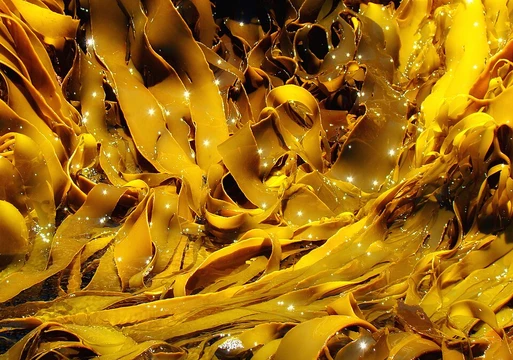
Hijiki is green to brown in colour when found in the wild. Fishermen and professional divers harvest it with a sickle at low tide during the spring tide from May to March. After collection, the seaweed is boiled and dried before being sold as dried hijiki, which turns black once processed. To prepare dried hijiki for cooking, it is first soaked in water then cooked with ingredients like soy sauce and sugar to make a dish that goes by the same name. In Japan, hijiki is normally eaten with other foods such as vegetables or fish, and may be added to foods that have been steamed, boiled, marinated in soy sauce or fish sauce, cooked in oil, or added to soup, stir fries or quiches. It may be mixed with rice, but not used as a wrap, to prepare sushi. Konjac is typically prepared with hijiki mixed in to give the dish known by the same name its characteristic grey color and texture. In Korea, the seaweed is called tot (톳) and eaten as namul (seasoned vegetable side dish) or cooked with bap (rice).
Reader's Guide
Hijiki's significance lies in its long-standing role in Japanese cuisine and its spread to Western markets, particularly through the macrobiotic movement starting in the 1960s in the United States. The word 'hijiki' first appeared in an English-language publication in 1867, and from the 1960s onward it became widely used in the U.S., with dried hijiki imported from Japan becoming available at natural food stores and Asian-American grocery stores. However, its legacy is complicated by health concerns: several government food safety agencies—including the Canadian Food Inspection Agency, the Food Standards Agency of the United Kingdom, and the United States Department of Agriculture—advise consumers to avoid consumption due to significantly higher concentrations of inorganic arsenic than other types of seaweed. The Ministry of Health, Labour and Welfare of Japan responded with a report noting that consumption of more than 4.7 g per day could exceed the tolerable daily intake, while average Japanese daily consumption is estimated at 0.9 g. Although no known illnesses have been associated with consuming hijiki to date, inorganic arsenic is identified as carcinogenic to humans, and people following a macrobiotic diet that often includes large amounts of seaweed may be at greater risk.
Did You Know?
- Hijiki is green to brown when wild but turns black after being boiled and dried.
- Several countries' food safety agencies advise against consuming hijiki due to inorganic arsenic, but Japan does not.
- In Korea, hijiki is called tot (톳) and eaten as namul or cooked with rice.
Frequently Asked Questions
What is Hijiki?
Hijiki is a brown macroalgae (seaweed) that naturally grows on rocky shorelines in East Asia and has long been a dietary staple in Japanese kitchens. It is also called hiziki, and in Korean it goes by the name tot (톳).
What is Hijiki's scientific name and when did it first appear in English?
It is currently classified as Sargassum fusiforme, having been reclassified from the older name Hizikia fusiformis. The term first showed up in an English-language reference in 1867, in James C. Hepburn's Japanese-English dictionary.
Where does Hijiki grow and where can people buy it?
In the wild it colonizes rocky coastal habitats along East Asian shores. Outside its native region, it has been stocked in UK natural-food shops for roughly thirty years and has since become a common sight in North American specialty stores.
How is Hijiki used in cooking?
It has been a fixture of Japanese cuisine for centuries, typically rehydrated and tossed into stews, mixed salads, and small side dishes. The average Japanese person consumes about 0.9 grams per day.
Is Hijiki safe to eat given the arsenic warnings?
Research has identified potentially harmful levels of inorganic arsenic in the seaweed, leading food-safety agencies in several countries to issue consumption advisories. Japan has notably not followed suit, and the tolerable daily intake threshold is set at 4.7 grams per day.
More in Brown Macroalgae and Kelp 1-24
Spotted an error? Know more?
Reader corrections go straight into our review queue. Suggest an edit · How this site is sourced