Turbinaria (alga)
A brown algal genus with high thermal tolerance and alginate value.

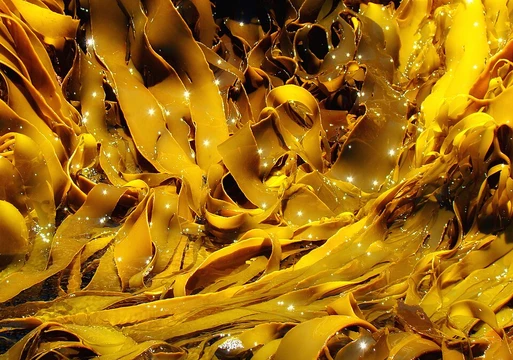
Turbinaria, also called turbanweed or turbinweed, is a genus of brown algae that lives mainly in warm tropical seas, typically attached to rocky surfaces. Its thallus is upright and tough, with branches that spread out radially and bear blades. These blades can be stalked, turban-shaped, crowned, or obpyramidal, giving the whole plant a look similar to a long pinecone. A holdfast made of spreading branches from the main axes keeps the thallus anchored. Mature individuals develop receptacles—reproductive structures that sprout from the tips of the blade stalks.
Like all brown algae, Turbinaria contains the carotenoid pigment fucoxanthin, which helps capture light and transfer energy. The genus is rich in iron (about 893.7 ± 210.5 micrograms per gram dry weight) and can absorb arsenic and nickel from its surroundings depending on local concentrations. It is a good source of alginate, yielding up to 40% of its dry weight, and also contains fucoidan, a sulfated polysaccharide known for antioxidant, anti-inflammatory, and anticancer properties.
Turbinaria is most common in tropical coral reefs but also appears in subtropical and temperate waters. The highest species diversity occurs in Southeast Asia and the Indian Ocean. The most widespread species, *Turbinaria ornata*, ranges from the West Atlantic across the Indo-Pacific to East Africa.
Species classification relies on morphological traits such as leaf shape, vesicles, receptacles, and axis development. The genus has received less study than other members of the Sargassaceae family, and its high phenotypic plasticity has caused taxonomic confusion. Molecular analysis has helped clarify relationships. AlgaeBase currently lists 32 species.
Ecologically, Turbinaria can live in tide pools, rocky intertidal zones, forereefs, and depths up to 30 meters, in habitats with varying wave exposure. It adapts its form accordingly: in high-wave areas, thalli are shorter, tougher, and non-buoyant; in sheltered spots, they grow longer, have weaker tissue, and become buoyant when sexually mature. This genus is a major macroalgal colonizer of degraded reefs after hard coral loss, partly because it tolerates higher temperatures than some corals. Its thalli can also abrade and kill corals.
*Turbinaria ornata* is monoecious and reproduces both sexually and asexually.
Quick Facts
- Taxon
- Turbinaria (alga)
Facts from the source article.
Lore & Background
Turbinaria is characterized by an upright thallus with radially branched axes bearing blades, with a tough texture and a resemblance to a long pinecone. The blades come in forms described as stipitate, turbinate, crowned, and obpyramidal. The thallus is kept upright by a holdfast consisting of spread out branches growing from the main axes. Mature thalli possess receptacles, their reproductive organs, which branch out from the tips of the stalks on the blades. The genus contains fucoxanthin, a carotenoid pigment found in all brown algae, and has high levels of iron, as well as an affinity for arsenic and nickel depending on environmental concentrations. Turbinaria also contains fucoidan, a sulfated polysaccharide with antioxidant, anti-inflammatory, and anticancer properties. The genus is mainly distributed in tropical coral reefs but is also found in subtropics and temperate regions, with Southeast Asia and the Indian Ocean containing the highest diversity. Classification of Turbinaria species is based on morphological characteristics, but the large degree of phenotypic plasticity has led to many taxonomic uncertainties, which molecular analyses have helped to address.
Reader's Guide
Turbinaria is significant for its ecological role in degraded reef systems, where it can dominate after hard coral loss due to its higher thermal tolerance. Its thalli can cause abrasions on corals, leading to coral death. The genus is harvested in India, Indonesia, and the Philippines for alginate production, which is used as a thickening, gelling, and stabilizing agent in food, drinks, cosmetics, and pharmaceuticals. Young thalli of Turbinaria ornata are consumed in Indonesia fresh, salted, or with curry sauce, and dried Turbinaria can be ground as seasoning; in Samoa it is used as a stir-fry ingredient. It is also used as fertilizer in many Asian countries. A study found that freshwater prawn feeds containing T. ornata supplements led to increased growth, survival, and digestion. Turbinaria remains chemically and pharmacologically underexplored, but pure compounds isolated from it show promise for antiproliferative, antipyretic, anti-inflammatory, immunostimulatory, anti-diabetic, anti-obesity, antiviral, antimicrobial, cardioprotective, hepatoprotective, and hypolipidemic activities. The genus has also shown promise for removing lead from aqueous solutions.
Did You Know?
- Turbinaria can yield up to 40% of its dry weight in alginate.
- Turbinaria ornata is the species with the widest distribution, ranging from the West Atlantic to the Indo-Pacific and East Africa.
- The genus has a higher thermal tolerance than some coral species, giving it a competitive advantage during high temperatures.
More in Brown Macroalgae and Kelp 1-24
Spotted an error? Know more?
Reader corrections go straight into our review queue. Suggest an edit · How this site is sourced