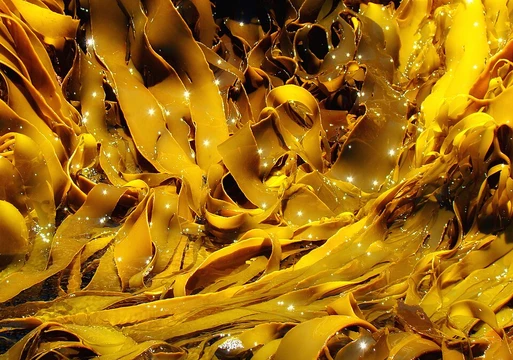
Sargassum muticum
A large brown seaweed invasive in some non-native regions.

Sargassum muticum, also called Japanese wireweed or japweed, is a large brown seaweed from the genus Sargassum. It originally comes from the Western Pacific Ocean, specifically the coasts of China, South Korea, Japan, and southern Russia. In the mid-1900s, it was introduced to the Eastern Pacific Ocean, the Atlantic Ocean, and the Mediterranean Sea. Because it grows quickly and spreads easily, it is considered invasive in some places where it is not native.
This seaweed is brown to yellowish and can reach up to 10 meters in length. It is an autotroph, using sunlight for energy. Its aerial vesicles help it float to the water’s surface, which aids photosynthesis. The plant has two main parts: a perennial part, made up of a holdfast and one or more short main axes, and an annual part, which consists of secondary axes that grow from the main axis. These secondary axes have unlimited growth and vary in size. There are three types of branches: ones with leaf-like fronds, ones with fronds and air bladders (aerocysts), and ones with fronds, aerocysts, and reproductive organs called receptacles. In winter, only the perennial part survives, growing to about 5 centimeters. In summer, the lateral part reaches its maximum development, from 2–3 meters up to 10 meters.
Reproduction is both sexual and asexual. Sexual maturity occurs in summer, when gametes are produced in the receptacles. The species is monoecious, meaning one individual can produce both male and female gametes. Its life cycle is monogenic, with only one generation present. Male gametes are released into the seawater, while female gametes stay in the receptacle, where fertilization happens. Development also occurs in the receptacle, and once the seedling stage is reached, it detaches and attaches to a new surface to form a new individual. Asexual reproduction is possible but has never been observed in temperate environments.
Sargassum muticum grows from the half-tide zone down to infralittoral areas, up to 10 meters deep. It attaches to solid surfaces like rocks, stones, and shells. It tolerates a wide range of temperatures and salinities, with an optimal range between 17 and 20 °C, but it can survive from 0 to 30 °C.
Originally from Japan, the seaweed likely spread worldwide by hitching a ride with Japanese oysters (Crassostrea gigas).
Quick Facts
- Genus
- Sargassum
- Species
- muticum
Facts from the source article.
Lore & Background
Sargassum muticum is a brown to yellowish autotroph that uses aerial vesicles to rise to the water's surface for photosynthesis. It has two distinct parts: a perennial part (holdfast and short main axes) that persists in winter at about 5 cm, and an annual part (secondary axes) that can grow 2–3 meters to 10 meters in summer. The species has three types of ramifications: laterals with fronds, laterals with fronds and aerocysts, and laterals with fronds, aerocysts, and reproductive receptacles.
Reproduction is both sexual and asexual. It is monoecious, producing male and female gametes in summer. Male gametes disperse in seawater while female gametes remain in the receptacle for fertilization; development occurs there until the seedling detaches to form a new individual. Asexual reproduction has never been observed in temperate environments.
Originally from Japan, S. muticum is thought to have spread globally via transport with Japanese oysters (Crassostrea gigas). It was introduced to the Californian coast in the 1940s and to Europe in the 1970s, first found in the British Isles at the Isle of Wight in 1973. Its current range extends from Norway to Portugal along Atlantic coasts, from British Columbia to Baja California, and into the Mediterranean, Adriatic, and Baltic Sea, with recent specimens found on Moroccan coasts.
Reader's Guide
Sargassum muticum is not invasive in all regions it has spread to; in many areas, populations grew aggressively early in introduction but later shifted to an established species integrated with the local ecosystem. However, in more recently introduced areas such as Ireland (1995), it grows in large mats causing ecological and economic problems. Ecologically, it can decrease native algal species by forming a dense screen that blocks light and capturing nutrients at the expense of other species, including phytoplankton. It also serves as shelter for fish larvae and crustaceans. Economically, it fixes to oyster shells, creating problems in shellfish farming, wraps around farming structures, and entangles boat propellers, requiring additional maintenance. Large mats can detach and wash ashore, rotting and decreasing beach use. Removal options include mechanical, chemical (herbicides), and biological (release of predators) methods, but studies have concluded all options were ineffective or had varying levels of success. Potential uses include agricultural fertilizer, aquaculture feed for juvenile sea cucumbers, water treatment via flocculants from cell-wall alginates and fucoidans, biosorption of heavy metals, antifouling agents from secondary metabolites, and pharmaceutical antioxidant compounds such as phenolic compounds, pigments, and vitamins.
Did You Know?
- Sargassum muticum can grow up to 10 meters in length.
- The species is monoecious, producing both male and female gametes on the same individual.
- Its cell walls contain alginates and fucoidans that can form a biodegradable flocculant for sewage treatment.
More in Brown Macroalgae and Kelp 1-24
Spotted an error? Know more?
Reader corrections go straight into our review queue. Suggest an edit · How this site is sourced