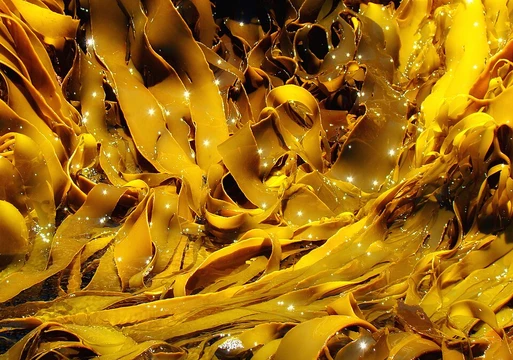
Sargassum johnsonii
Endemic brown seaweed of the Three Kings Islands.

Sargassum johnsonii is a brown seaweed endemic to New Zealand’s Three Kings Islands. It gets the common name totara weed because its leaves look like those of the native totara tree. The species was named after Magnus Earle Johnson, a captain of the yacht *Rosemary* who explored the islands and landed botanists there on multiple trips. This seaweed grows on rocky shores and can extend into deeper water down to 40 m. It is a foundation species, very abundant around the Three Kings, and its presence creates many microhabitats for bryozoans, sea squirts, and sponges.
Plants are typically large, reaching 50–60 cm tall. The main stem is bare and knobby. Basal leaves are strap-shaped, simple or lobed, with an indistinct midrib. Upper leaves are small and narrow, also with an indistinct midrib. The holdfast is a small, flat disc. The thallus is dark brown, tough, and leathery. There are no air-vesicles. The receptacles are small, swollen, about 2 mm long, and clustered in the axils of the upper leaves.
Quick Facts
- Genus
- Sargassum
- Species
- johnsonii
Facts from the source article.
Lore & Background
Sargassum johnsonii was discovered by Magnus Earle Johnson, an explorer and captain of the yacht Rosemary, who landed botanists on the Three Kings Islands on several occasions. Its scientific name derives from him. The species is sometimes called totara weed because its foliage resembles that of the New Zealand native tree totara.
The seaweed grows in rocky intertidal habitats and often extends into the subtidal zone up to a depth of 40 m. It is a foundation species, and its abundance around the Three Kings Islands creates numerous microhabitats for other marine life, including bryozoans, sea squirts, and sponges.
Morphologically, plants are usually large, 50–60 cm tall, with a bare, knobby main stem. Basal leaves are strap-shaped, simple or lobed with an indistinct midrib, while upper leaves are small and narrow with an indistinct midrib. The holdfast is a small truncate disc. The thallus is dark brown with a tough, leathery texture. It has no air-vesicles, and its receptacles are small, swollen, about 2 mm long, clustered in the axils of the upper leaves.
Reader's Guide
Sargassum johnsonii is significant as a foundation species endemic to the Three Kings Islands. Its abundance in rocky intertidal and subtidal habitats up to 40 m depth creates numerous microhabitats that support other marine life such as bryozoans, sea squirts, and sponges. The species is named after its discoverer, Magnus Earle Johnson, an explorer and captain of the yacht Rosemary, who facilitated botanical landings on the islands. Its common name, totara weed, reflects a resemblance to the foliage of the New Zealand native tree totara. The seaweed's morphology—large size, lack of air-vesicles, dark brown leathery thallus, and small clustered receptacles—distinguishes it within the genus. Its role in structuring local marine communities underscores its ecological importance, though the article does not discuss any economic or cultural uses beyond its naming.
Did You Know?
- Sargassum johnsonii is endemic to the Three Kings Islands in New Zealand.
- Its scientific name honors its discoverer, Magnus Earle Johnson, captain of the yacht Rosemary.
More in Brown Macroalgae and Kelp 1-24
Spotted an error? Know more?
Reader corrections go straight into our review queue. Suggest an edit · How this site is sourced