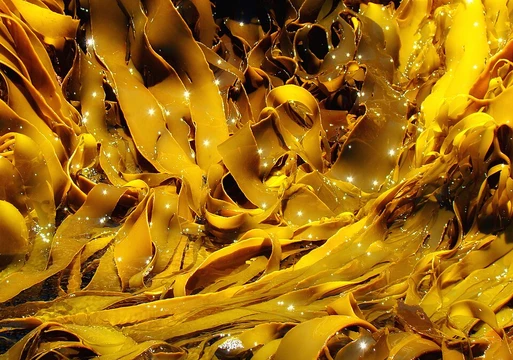
Sargassum horneri
Brown macroalgae native to Japan and Korea, invasive in the Pacific.

Sargassum horneri is a brown seaweed that grows naturally along the coasts of Japan and Korea. This annual algae has a fertile season that varies by location; in Wakasa Bay, Japan, it starts growing in early autumn, continues through winter, and reaches maturity in spring when water temperatures range from about 11.6 to 15.2 °C. Known as "devil weed," it has spread to the Eastern Pacific, first appearing off Baja California and then moving northward along California's coast. In its native habitat, S. horneri attaches to hard surfaces and grows into kelp forests that support local biodiversity. However, this species is the main component of the northwest Pacific golden tide—a massive drift of Sargassum horneri that moves up the eastern coast of China toward Korea, where it acts as an invasive species and harms the coastal ecosystem.
Taxonomy and etymology Dawson Turner first described S. horneri in 1808, naming it *Fucus horneri*. Carl Adolph Agardh later reclassified it into the genus *Sargassum* in 1820. The species name *horneri* honors Dr. Horner, an astronomer and naturalist who sailed on the first Russian circumnavigation of the globe from 1803 to 1806 under Captain Adam von Krusenstern.
Quick Facts
- Genus
- Sargassum
- Species
- horneri
Facts from the source article.
Lore & Background
Sargassum horneri was first described in 1808 by Dawson Turner under the basionym Fucus horneri. It was later reclassified into the genus Sargassum by Carl Adolph Agardh in 1820. The specific epithet horneri was given in honor of Dr. Horner, an astronomer and naturalist aboard the first Russian circumnavigation of the globe, which took place from 1803 to 1806 under Captain Adam von Krusenstern.
In its natural ecosystem, Sargassum horneri grows attached to a hard substrate and blooms into a kelp forest which encourages and maintains local biodiversity. It is an annual algae with a varying fertile season along the coast. In Wakasa Bay, Japan, it begins to grow in early autumn through winter and matures in spring, when the sea water temperature is around 11.6–15.2 °C (53–59 °F).
Also called 'devil weed,' S. horneri has invaded the Eastern Pacific, beginning in Baja California and advancing north along the California coastline. This species is the major component of the northwest Pacific golden tide, a biomass of Sargassum horneri that drifts up the eastern coast of China towards Korea as an invasive species and is detrimental to the coastal ecosystem there.
Reader's Guide
Sargassum horneri holds dual significance as both a native ecosystem engineer and a problematic invasive species. In its native waters along Japan and Korea, it grows attached to hard substrates and forms kelp forests that encourage and maintain local biodiversity, playing a positive ecological role. However, its behavior as the major component of the northwest Pacific golden tide marks it as an invasive species that drifts up the eastern coast of China toward Korea, where it is detrimental to coastal ecosystems. Additionally, it has invaded the Eastern Pacific, starting in Baja California and advancing north along the California coastline, where it is known as 'devil weed.' The species was first described in 1808 by Dawson Turner as Fucus horneri, later reclassified by Carl Adolph Agardh in 1820, with its name honoring Dr. Horner, an astronomer and naturalist on the first Russian circumnavigation. Its annual life cycle and varying fertile season along the coast, such as in Wakasa Bay where it matures in spring at specific water temperatures, contribute to its adaptability and spread. The legacy of S. horneri is thus one of contrast: a native biodiversity supporter that becomes a harmful invader beyond its range.
Did You Know?
- In Wakasa Bay, Japan, it matures in spring when sea water temperature is 11.6–15.2 °C (53–59 °F).
- It is the major component of the northwest Pacific golden tide, drifting up the eastern coast of China toward Korea as an invasive species.
More in Brown Macroalgae and Kelp 1-24
Spotted an error? Know more?
Reader corrections go straight into our review queue. Suggest an edit · How this site is sourced