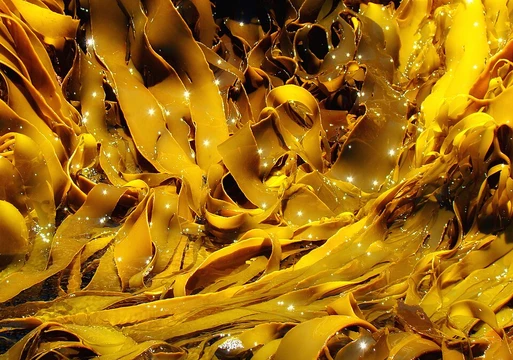
Sargassum aquifolium
Endemic Hawaiian brown alga, used in food and sacred ceremonies.

Sargassum aquifolium, once called Sargassum echinocarpum, is a plentiful brown seaweed belonging to the order Fucales, class Phaeophyceae, and genus Sargassum. In Hawaii, it goes by the name limu kala. This alga is native to the Hawaiian Islands and is one of only four Sargassum species found nowhere else.
This seaweed can grow up to 30 centimeters tall, with a flat main stem and broad, short, spiny leaves. Its size shifts depending on where it grows; individuals on reef flats tend to be larger and narrower. Leaves measure between 2.54 and 10.16 centimeters long and about 1.27 centimeters wide. They are golden-brown with brown spots and a clear spine, and their edges may be smooth or toothed. The leaves have pneumatocysts, which allow the alga to float.
Sargassum aquifolium is found only in the Hawaiian Islands, where it is the most common and largest Sargassum species. It grows year-round in subtidal areas with rocky ground and reef flats, and it is often seen on wave-washed lava benches. It also thrives in warm, calm tide pools deeper than 3 meters. This seaweed prefers habitats with moderate wave action, especially in the North Pacific, where winter swells occur.
People harvest the youngest leaves for food, as older leaves become too tough. After washing and soaking overnight in fresh water, the leaves are chopped or ground, then mixed with other seaweeds or cooked in soup. Whole leaves can be deep-fried into chips. Fresh leaves are also eaten at the beach alongside raw fish or octopus, and the seaweed is used as fish bait.
In Hawaiian culture, limu kala is believed to have appeared among other seaweeds during the first period of creation, as recorded in the Kumulipo. It plays a role in sacred ceremonies, including Hoʻoponopono, where its leaves are used in prayers for forgiveness when a family faces conflict, due to its association with purification. Hawaiians also used it as bait for certain fish, and it earned the name limu honu because turtles enjoy eating it. Additionally, limu kala appears in healing and purification rituals and as adornment for hula dancers. In July 2023, Hawaii’s governor signed Act 230, designating limu kala as the official state limu.
Quick Facts
- Genus
- Sargassum
- Species
- aquifolium
Facts from the source article.
Lore & Background
Sargassum aquifolium can reach up to 30 centimeters with a flat main branch and wide, short, spiny leaves. Size varies based on where they live, but S. aquifolium that live on reef flats are usually larger and more narrow. Leaves range from 2.54–10.16 centimeters in length and 1.27 centimeters in width. Leaves are golden-brown color with brown dots and a clear spine. Edges of leaves are smooth or spiny with toothlike edges. Sargassum aquifolium can float due to the pneumatocysts found on the leaves.
Sargassum aquifolium is endemic to the Hawaiian islands and is the most common and largest species of Sargassum in Hawaii. It can be found growing year-round in subtidal ranges with rocky terrain and reef flats. It is common to wave-washed lava benches and can also be found in warm, calm tide pools with depths of more than 3 meters. This seaweed grows in habitats where waves are present and moderate and usually thrives in the North Pacific where winter swells come in.
Reader's Guide
Sargassum aquifolium holds significance both as a food source and in Hawaiian cultural practices. Leaves are used as food; the youngest leaves are picked and used because older leaves are too tough to eat. Leaves are washed and soaked in fresh water overnight and can then be used in food. It is usually chopped or ground up and combined with other seaweeds or cooked in soup. Whole leaves are deep fried into chips. Sargassum aquifolium is also eaten fresh at the beach with raw fish or octopus, and is used for fish bait.
Culturally, limu kala was believed to be among many of its kind appearing in the first period of creation (wā) as mentioned in the Kumulipo. It is often used in sacred ceremonies in Hawaiian culture. A ceremony called Hoʻoponopono used the leaves of the seaweed to pray to the gods and ask for forgiveness. This ceremony was usually done when a family was having problems and limu kala was used because it was associated with purification. Another use Hawaiians had for the seaweed was when they were going fishing, using it as bait. It gained the name limu honu after people realized that turtles enjoyed eating the seaweed too. S. aquifolium was also used in other healing and purifying ceremonies and adornment on hula dancers. In July 2023, Hawaii's governor signed Act 230 legislation designating limu kala as the state's official limu.
Did You Know?
- Sargassum aquifolium is one out of four endemic species of Sargassum in Hawaiʻi.
- It can float due to pneumatocysts found on the leaves.
- The leaves are used in the Hoʻoponopono ceremony to pray for forgiveness.
- In July 2023, limu kala was designated as Hawaii's official limu by Act 230.
More in Brown Macroalgae and Kelp 1-24
Spotted an error? Know more?
Reader corrections go straight into our review queue. Suggest an edit · How this site is sourced