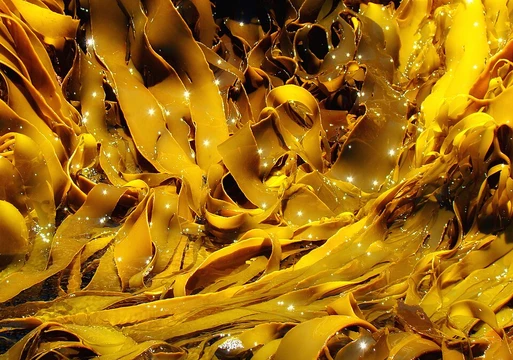
Phyllospora comosa
Crayweed forms temperate seaweed forests vital for marine habitat and carbon capture.

Phyllospora comosa, or crayweed, is a brown alga belonging to the Seirococcaceae family. It grows up to 2.5 meters long and forms dense, shallow underwater forests in temperate waters. These forests serve as crucial habitat for many marine species, while also producing oxygen and capturing carbon from the atmosphere.
Crayweed has a central stem, often reaching 3 meters, lined with many branches and leaf-like structures. Some of these structures contain conceptacles where sperm and eggs develop. Growth is strongly seasonal, driven by daylight length, and occurs only at the tips of the top 20–30 centimeters of the branches.
The species is found around Australia and New Zealand, particularly in cooler waters along southeastern Australia, Tasmania, and South Australia. On the east coast, it grows to about five meters deep, while farther south it reaches around three meters. In some Tasmanian areas, it can occur as deep as 18 meters. Crayweed once thrived near Sydney but vanished from metropolitan areas in the 1970s and 1980s due to human pressures.
A restoration initiative called "Operation Crayweed" has been working to bring the species back to Sydney’s waters. Transplants have succeeded at sites including Malabar, Coogee, Little Bay, Freshwater, and Bondi, with plans for Newport and Dee Why as of January 2020. In 2022, the project was folded into Project Restore, a larger biodiversity effort led by the Sydney Institute of Marine Science and funded by the NSW Government.
Quick Facts
- Genus
- Phyllospora
- Species
- comosa
Facts from the source article.
Lore & Background
Crayweed grows up to 2.5 m in length and forms dense, shallow forests. The algae have a central main axis, usually up to 3 m long, which bear many branches along their length, with closely arranged, leaf-like laterals. Some laterals have conceptacles, in which develop cells which produce sperm and eggs. The strongly seasonal growth of the algae depends on the length of daylight; it occurs from apical cells and is restricted to the top 20–30 cm of the branches.
Crayweed is found in the oceans around Australia and New Zealand. It is abundant in cooler waters along the south-eastern coastline of Australia, around Tasmania and in South Australia. It occurs to a depth of around five metres on the east coast and farther south to about three metres. On some Tasmanian coasts it can occur at depths of 18 metres. It used to occur around Sydney, but disappeared from metropolitan areas under pressure from human activities during the 1970s and 1980s.
A conservation effort known as 'Operation Crayweed' has been working to re-establish the species in the waters around Sydney. Transplants have been established at sites including Malabar, Coogee, Little Bay, Freshwater, and Bondi; other transplants were being planned for Newport and Dee Why as of January 2020. In 2022 Operation Crayweed was absorbed into a larger biodiversity restoration project, led by the Sydney Institute of Marine Science, called Project Restore, with funding from the NSW Government.
Reader's Guide
Crayweed forests are ecologically significant as habitat for many marine species and for producing oxygen and capturing atmospheric carbon. The species once formed dense forests around Sydney but disappeared from metropolitan areas under pressure from human activities during the 1970s and 1980s. In response, the conservation effort 'Operation Crayweed' began re-establishing the species in Sydney waters, with transplants at Malabar, Coogee, Little Bay, Freshwater, and Bondi, and further transplants planned for Newport and Dee Why as of January 2020. In 2022, Operation Crayweed was absorbed into Project Restore, a larger biodiversity restoration project led by the Sydney Institute of Marine Science with funding from the NSW Government. The restoration work highlights the importance of crayweed as a habitat-forming alga that supports marine biodiversity and contributes to oxygen production and carbon capture, underscoring its legacy as a keystone species in temperate seaweed forests.
Did You Know?
- Crayweed can grow up to 2.5 m (8 ft 2 in) in length.
- It disappeared from Sydney metropolitan areas during the 1970s and 1980s due to human activities.
- Transplants have been established at Malabar, Coogee, Little Bay, Freshwater, and Bondi.
More in Brown Macroalgae and Kelp 1-24
Spotted an error? Know more?
Reader corrections go straight into our review queue. Suggest an edit · How this site is sourced