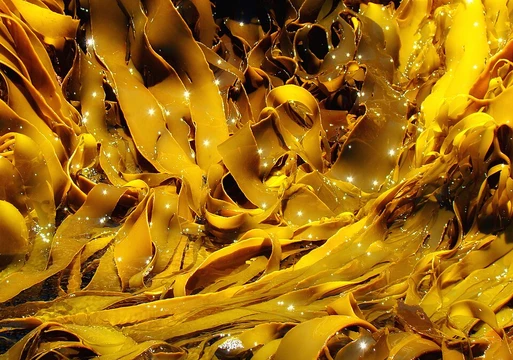
Notheia anomala
Obligate epiphyte of Hormosira banksii, native to Australasia.

Notheia anomala is a small, branching brown macroalga in the family Notheiceae and the order Fucales. It is notable as an obligate epiphyte of another brown alga, Hormosira banksii, a rare relationship between closely related species.
Quick Facts
- Unranked Regnum
- SAR
- Unranked Superphylum
- Heterokonta
- Classis
- Phaeophyceae
- Ordo
- Fucales
- Familia
- Notheiaceae
- Genus
- Notheia
- Species
- N. anomala
- Binomial
- Notheia anomala
- Binomial Authority
- Harvey & J.W.Bailey (1851)
Facts from the source article.
Lore & Background
Notheia anomala is an obligate epiphyte of Hormosira banksii, with a single unconfirmed observation on Xiphophora chondrophylla. Its growth appears entirely dependent on its host; culture attempts failed until Hormosira extracts were added. The costs to Hormosira are unclear, and no plasmodesmata connect the two species. Benefits to Notheia may include long-distance dispersal via drifting Hormosira fronds, which are weakly attached and frequently dislodged during storms. Notheia has a higher photosynthetic capacity than its host, possibly due to greater surface area or lower allocation to chemical defenses. In Australian tide pools, infection rates are consistently higher than on the low shore reef, suggesting narrower environmental tolerances. Sexually mature Hormosira carry more infections, typically on conceptacles near the osteoles, with no preference for male or female hosts.
Reader's Guide
Notheia anomala is significant as a rare example of an obligate epiphyte within the same order (Fucales) as its host, Hormosira banksii. Its distribution matches that of its host across New Zealand and southeastern Australia. The relationship is ecologically complex: Notheia provides food, protection, and niche space for small invertebrates, boosting local biodiversity, while tetrahydrofurans from Notheia inhibit larval development of parasitic nematodes, potentially benefiting Hormosira. The species' reproductive strategy involves monoecious conceptacles producing male and female gametes that intermingle; female gametes settle after about four hours, then attract male gametes. This timing and the potential for long-distance dispersal via drifting host fronds may explain its distributional success. The lack of plasmodesmata and unclear costs to the host highlight unresolved aspects of this symbiosis.
Did You Know?
- Notheia anomala is an obligate epiphyte of Hormosira banksii, with only one unconfirmed observation on another host.
- Female gametes of Notheia contain 8 zooids, while male gametangia contain 64 zooids.
More in Brown Macroalgae and Kelp 1-24
Spotted an error? Know more?
Reader corrections go straight into our review queue. Suggest an edit · How this site is sourced