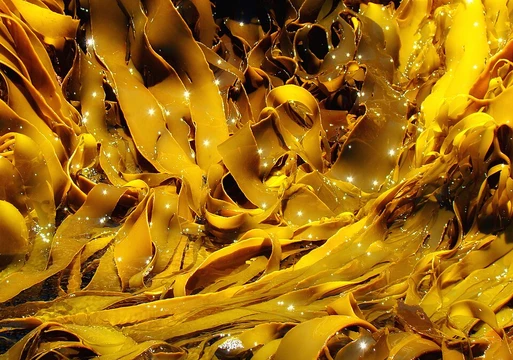
Macrocystis
The largest brown alga, forming vast kelp forests in cool oceans.

Macrocystis is a genus of brown algae that contains just one species, *Macrocystis pyrifera*, also called giant kelp or bladder kelp. It is the largest member of the brown algae group, Phaeophyceae. The defining feature of Macrocystis is the presence of pneumatocysts—gas-filled bladders—located at the base of each blade. The visible, large form is the sporophyte, which is perennial and the individual may live for up to three years; individual fronds within the organism die off after about 100 days. This kelp is found across subtropical, temperate, and sub-Antarctic waters of the Southern Hemisphere, as well as in the northeast Pacific Ocean, and it often forms the backbone of temperate kelp forests. Despite looking like a plant, Macrocystis is actually a stramenopile. Giant kelp is especially common along the northeastern Pacific coast, from Baja California up to southeast Alaska, and also appears in southern oceans near South America, South Africa, Australia, and New Zealand. Individual algae can exceed 45 meters (150 feet) in length, growing as fast as 60 centimeters (2 feet) per day. They grow in dense stands called kelp forests, which provide food and shelter for many marine animals. The main commercial product from giant kelp is alginate, though people also harvest it on a small scale for food. It is rich in iodine, potassium, and other minerals, and can be used in cooking like other sea vegetables, especially to add flavor to bean dishes. The sole species, *M. pyrifera*, can grow up to 60 meters (200 feet) long. Its stipes emerge from a holdfast and branch three or four times near the base, with blades appearing at irregular intervals along the stipe. The stipes are unbranched and each blade has a gas bladder at its base. The sporophyte stage is perennial, and individuals can persist for many years, sometimes reaching over 50 meters (160 feet). Kelp often grows diagonally due to ocean currents, so it may be longer than the water depth. Stalks arise from a basal meristem, with older, well-protected individuals having up to 60 stalks. At the base of each stalk is a cluster of blades without pneumatocysts; these sporophylls instead develop small sacs that release biflagellated zoospores. Smaller forms, once called *Macrocystis integrifolia*, have deep brown, flattened rhizomes that branch dichotomously and are attached by root-like structures.
Quick Facts
- Genus
- Macrocystis
- Species
- pyrifera
Facts from the source article.
Lore & Background
Macrocystis is a monospecific genus; the sole species is M. pyrifera. Some individuals are so huge that they may grow to up to 60 m (200 ft) long. The stipes arise from a holdfast and branch three or four times from near the base. Blades develop at irregular intervals along the stipe. M. pyrifera grows to over 45 m (150 ft) long. The stipes are unbranched and each blade has a gas bladder at its base. The stage of the life cycle that is usually seen is the sporophyte, which is perennial and individuals persist for many years. Individuals may grow to up to 50 m (160 ft) long or more. The kelp often grows even longer than the distance from the bottom to the surface as it will grow in a diagonal direction due to the ocean current pushing against the kelp.
Reader's Guide
Macrocystis is notable as the largest of all brown algae and one of the fastest-growing organisms on Earth, capable of growing 60 cm per day and reaching over 45 metres in a single growing season. It forms extensive kelp forests on rocky substrata in cool waters, primarily in the northeastern Pacific from Baja California to southeast Alaska, and in the Southern Hemisphere around South America, South Africa, Australia, and New Zealand. These kelp forests provide habitat and food for numerous marine animals. The primary commercial product obtained from giant kelp is alginate, but it is also harvested on a limited basis for direct human consumption, being rich in iodine, potassium, and other minerals. Ecologically, giant kelp alters light availability, ocean currents, and water chemistry in its environment. It can compete with other kelp species such as Pterygophora californica. Translocation of nutrients occurs through sieve elements resembling phloem, moving carbon-rich photosynthate from mature to growing regions and downward to reproductive sporophylls. Recent research indicates that Arctic kelp forests can increase pH levels by 0.15 units over 10 days during summer daylight, helping mitigate ocean acidification effects on calcifying organisms.
Did You Know?
- Macrocystis is not a plant but a stramenopile.
- Individual fronds persist for approximately 100 days, while the whole sporophyte may live up to three years.
- The species can grow diagonally due to ocean currents, often exceeding the water depth.
- Macrocystis integrifolia was formerly considered a separate species but is now synonymous with M. pyrifera.
More in Brown Macroalgae and Kelp 1-24
Spotted an error? Know more?
Reader corrections go straight into our review queue. Suggest an edit · How this site is sourced