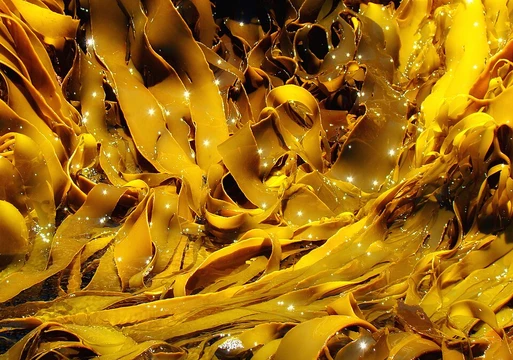
Hormosira
Monotypic brown alga with buoyant beads, native to Australia and New Zealand.

Hormosira is a monotypic genus of brown macroalgae in the family Hormosiraceae, comprising the single species Hormosira banksii. Commonly known as Neptune's necklace, Neptune's pearls, sea grapes, or bubbleweed, it is native to Australia and New Zealand and is notable for its distinctive thallus of olive-brown, gas-filled beads and its role as an ecosystem engineer in intertidal zones.
Quick Facts
- Grandparent Authority
- Fritsch
- Genus
- Hormosira
- Species
- banksii
Facts from the source article.
Lore & Background
Hormosira is a perennial brown alga in the order Fucales, abundant on low-energy rocky reefs within the intertidal zone. Its thallus consists of strings of olive-brown, spherical, gas-filled pneumatocysts (beads) that taper toward a small holdfast. The beads are buoyant, rising to the water surface at high tide to allow the plant to move with currents and access more sunlight. The species produces a slime layer to reduce desiccation and often grows in high densities, further reducing dehydration by limiting surface area exposed to the sun. Despite substantial morphological variation across its range, genetic analyses of mitochondrial COI and microsatellite DNA sequence data indicate low genetic variation across the Australian range, confirming it as a single species.
Reproduction is sexual and monoecious, with sex organs (conceptacles) visible as rough dimples on the bead surfaces. Eggs are released directly into the water at high tide, are negatively buoyant, and sink to the substrate to develop for several days before attachment. All individuals release simultaneously to maximize fertilization. Peak reproduction occurs from July to October in northern New Zealand when sea temperature is around 14 °C, as egg viability is low at higher temperatures (17–22 °C). The species can also reproduce asexually from broken and dislodged fragments.
Reader's Guide
Hormosira is regarded as an ecosystem engineer or habitat former, occurring in large patches and outcompeting other algal species due to its high tolerance to desiccation. It serves as a food source for sea urchins, many small crustaceans, and some juvenile fish. Young crustaceans and molluscs rely on its dense canopies for niche space, protection from predators, and avoidance of desiccation at low tide. The alga also provides a substrate for sessile organisms, including sea urchins and a wide range of facultative and obligate algal epiphytes such as Notheia anomala. This is beneficial in the intertidal environment, where competition for habitat space is a primary limiting factor. The holdfast attaches strongly to substrate but can be easily dislodged by human trampling. Floating plants can drift out to sea over considerable distances and remain fertile for several weeks. Historically, due to the species' high iodine content, Tasmanian schoolchildren were urged to eat a bead a day to keep goitres away.
Did You Know?
- Hormosira is monotypic, with only one species: Hormosira banksii.
- Its gas-filled beads (pneumatocysts) make the thallus buoyant, allowing it to rise to the surface at high tide.
- The species can reproduce both sexually and asexually from broken fragments.
- Tasmanian schoolchildren were once urged to eat a bead a day due to its high iodine content.
Frequently Asked Questions
What is Hormosira?
Hormosira is a monotypic genus of brown macroalgae in the family Hormosiraceae, containing a single species, Hormosira banksii. It is widely recognized by colorful common names such as Neptune's necklace, sea grapes, and bubbleweed, all of which nod to its striking bead-like form.
What does Hormosira look like?
Its thallus consists of a chain of olive-brown, gas-filled bead structures that give the alga a buoyant, grape-cluster appearance. These inflated segments are the source of nicknames like Neptune's pearls and bubbleweed among coastal observers.
Where is Hormosira found?
It is native to the intertidal zones of southeastern Australia—including Tasmania, Lord Howe Island, and Norfolk Island—as well as the coastlines of New Zealand. It favors shallow, wave-exposed rocky habitats where its gas-filled beads help it stay afloat.
When does Hormosira reproduce?
In northern New Zealand, its reproductive peak falls between July and October, with an optimal sea temperature of roughly 14 °C for successful spawning. This seasonal window lines up with the cooler months in the Southern Hemisphere.
Why is Hormosira ecologically important?
It functions as an ecosystem engineer in intertidal zones, providing three-dimensional structural habitat that shelters small invertebrates and juvenile fish. Its gas-filled bead morphology also lets it resist wave impact, helping stabilize rocky shoreline communities.
More in Brown Macroalgae and Kelp 1-24
Spotted an error? Know more?
Reader corrections go straight into our review queue. Suggest an edit · How this site is sourced