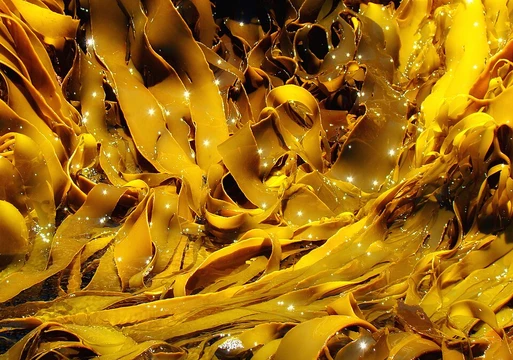
Fucus ceranoides
Brown algae restricted to estuarine intertidal habitats with fluctuating salinities.

Fucus ceranoides is a brown alga that lives in the sea shore's littoral zone. It resembles other Fucus species, with linear fronds about 1 cm wide attached by a discoid holdfast. Branches can reach 60 cm in length and have a clear midrib. The margin is smooth, unlike the serrated edge of *Fucus serratus*, and it lacks the air vesicles of *Fucus vesiculosus*, though irregular swellings make it look similar. *Fucus spiralis* has spirally twisted fronds. This species is restricted to estuarine intertidal habitats where salinity fluctuates. Its range extends from Portugal to Norway and Iceland, including rocky shores where freshwater flows into the sea and brackish water in sheltered bays. It is well adapted to varying estuarine salinities, but high salinity causes stress—leading to a rust-brown decay—which explains its absence from marine conditions and inability to colonize open coasts. Fucoids have no planktonic dispersal stages, limiting gamete spread, and the alga is found on shores of Ireland, Great Britain, the Isle of Man, and Shetland.
Quick Facts
- Genus
- Fucus
- Species
- ceranoides
Facts from the source article.
Lore & Background
Fucus ceranoides is a species similar to other species of Fucus. It is linear to about 1 cm wide and is attached by a discoid holdfast. The branches grow to a length of 60 cm and show a clear midrib. Its margin is entire and it differs from Fucus serratus in not having a serrated edge and unlike Fucus vesiculosus it does not have air vesicles, however irregular swellings gives it a resemblance to F. vesiculosus. Fucus spiralis has spirally twisted fronds.
Fucoids have no planktonic dispersal stages, restricting gamete dispersal. They can be found on the shores of Ireland and Great Britain including the Isle of Man and Shetland. The modern distribution of Fucus ceranoides ranges from Portugal to Norway and Iceland. This includes the rocky shores in the littoral generally where fresh water flows into the sea, brackish water in sheltered bays.
Fucus ceranoides are well adapted to abiotic conditions encountered across estuarine salinities. Increased levels of salinity present the most stress to Fucus ceranoides, hence their absence from marine conditions and its inability to colonize the coasts. At levels of high salinity, Fucus ceranoides will decay to a rust brown color.
Reader's Guide
Fucus ceranoides is significant as a brown algae species that is strictly limited to estuarine intertidal habitats with fluctuating salinities, distinguishing it from other Fucus species that occupy fully marine shores. Its inability to colonize marine coasts is directly linked to stress from high salinity, which causes the algae to decay to a rust brown color. This ecological specialization highlights the species' adaptation to brackish conditions and its vulnerability to increased salinity. The species' distribution from Portugal to Norway and Iceland, including the shores of Ireland, Great Britain, the Isle of Man, and Shetland, reflects its reliance on freshwater inflow into the sea. Unlike many other Fucus species, Fucus ceranoides lacks air vesicles and a serrated edge, but irregular swellings give it a resemblance to Fucus vesiculosus. Its lack of planktonic dispersal stages restricts gamete dispersal, further tying its distribution to specific estuarine environments. The species serves as an example of how abiotic factors like salinity can shape the habitat and range of a macroalga.
Did You Know?
- Fucus ceranoides is restricted to estuarine intertidal habitats under fluctuating salinities.
- At high salinity, Fucus ceranoides decays to a rust brown color.
More in Brown Macroalgae and Kelp 1-24
Spotted an error? Know more?
Reader corrections go straight into our review queue. Suggest an edit · How this site is sourced