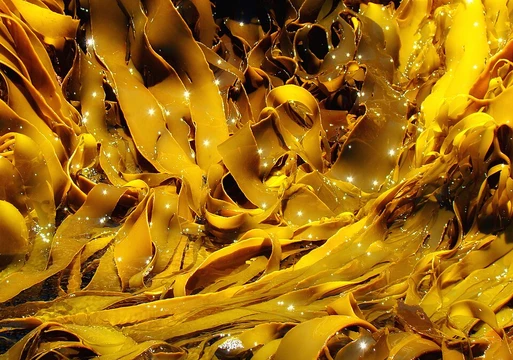
Ectocarpales
A large brown algal order with diverse tissue organization.

Ectocarpales is a very large order within the brown algae, class Phaeophyceae. The order includes families with pseudoparenchymatous (Splachnidiaceae) or true parenchymatous (Scytosiphonaceae) tissue. Pseudoparenchymatous tissue, found in the Splachnidiaceae family, is made of filaments whose cells are packed so tightly that they mimic the look of parenchyma. True parenchymatous tissue, seen in the Scytosiphonaceae, is composed of cells that can divide in three dimensions—an unusual ability among algae. Most filamentous algae only divide in one plane, growing longer as single or multi-row strands. Division in two planes allows for sheet-like bodies, while a third plane of division enables more complex forms, such as an erect thallus and a holdfast for attachment. A 2014 classification lists these families: Acinetosporaceae, Adenocystaceae, Chordariaceae, Ectocarpaceae, Petrospongiaceae, and Scytosiphonaceae.
Quick Facts
- Taxon
- Ectocarpales
Facts from the source article.
Lore & Background
Ectocarpales includes families with pseudoparenchymatous (Splachnidiaceae) or true parenchymatous (Scytosiphonaceae) tissue. Pseudoparenchymatous refers to a filamentous alga with cells packed very close together to give an appearance of parenchymatous tissue. True parenchymatous tissue is composed of cells that can truly divide in three dimensions, which is unusual among the algae. Filamentous algae are composed of cells that divide along a single plane, allowing only elongation to form filaments of one or more rows of cells. Algae that can divide in two planes can form sheet-like thalli or bodies. Cells that can divide in a third plane potentially allow for the organism to develop a more complex body plan, and diversification of body plans into an erect thallus and a holdfast for attaching the upright portion to the substrate. A 2014 classification recognizes six families: Acinetosporaceae, Adenocystaceae, Chordariaceae, Ectocarpaceae, Petrospongiaceae, and Scytosiphonaceae.
Reader's Guide
The significance of Ectocarpales lies in its demonstration of varying cellular division capabilities among brown algae. The order includes families with pseudoparenchymatous tissue, where filamentous cells are packed closely to mimic true parenchyma, and families with true parenchymatous tissue, where cells can divide in three dimensions—a rare trait among algae. This range illustrates evolutionary steps in body plan complexity: from simple filaments (one plane of division) to sheet-like thalli (two planes) to erect thalli with holdfasts (three planes). The 2014 classification provides a framework for understanding these differences. The order's legacy is in serving as a model for studying tissue development and diversification in brown algae, as noted in the referenced literature by Clayton (1974) on the development, life history, and taxonomy of Ectocarpales in southern Australia.
Did You Know?
- Ectocarpales includes families with pseudoparenchymatous or true parenchymatous tissue.
- True parenchymatous tissue, composed of cells dividing in three dimensions, is unusual among algae.
- A 2014 classification recognizes six families within Ectocarpales.
- Cells dividing in a third plane can allow development of an erect thallus and a holdfast.
More in Brown Macroalgae and Kelp 1-24
Spotted an error? Know more?
Reader corrections go straight into our review queue. Suggest an edit · How this site is sourced