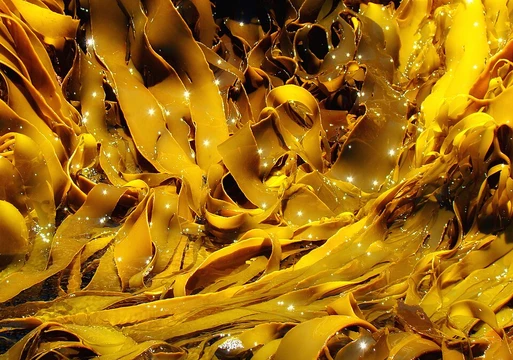
Dictyota sandvicensis
A brown seaweed endemic to the Hawaiian Islands.

Dictyota sandvicensis, known in Hawaiian as limu 'Alani, is a brown seaweed endemic to the Hawaiian Islands and belongs to the family Dictyotaceae. Growing up to 15 cm tall, it stands out among local Dictyota species due to its iridescent yellow-green color and the small branches that sprout from the edges of its main branches. The plant has a single basal thallus that anchors firmly, supporting rhizoids, from which one to several erect fronds—each 1–5 mm wide—emerge. Found across all the Hawaiian Islands, this seaweed lives in mid- to low-tide pools, on low intertidal benches, and on reef flats, either on rocks or as an epiphyte on other algae, in shallow waters down to 7 meters deep. As a traditional limu, it has been harvested from shores and is a regular part of the diet, valued for containing more vitamins and essential minerals than other staple foods; it provides proteins, lipids, carbohydrates, minerals, and vitamins, with a caloric content exceeding one calorie per gram of ash-free dry weight.
Quick Facts
- Genus
- Dictyota
- Species
- sandvicensis
Facts from the source article.
Lore & Background
Dictyota sandvicensis reaches up to 15 cm in height and has an iridescent yellow greenish color. It can be easily spotted from other species of Dictyota in Hawai'i because it has small branches that break out from the edges of the main branches. The species consists of a single basal thallus that is firmly rooted and can support rhizoids, which lead to one to several erect fronds 1-5 mm wide. Dictyota sandvicensis is endemic to Hawaii and occurs throughout the Hawaiian Islands. It can be found in mid- to low-tide pools, on low intertidal benches, and on reef flats growing on rocks or as epiphytes on other algae in shallow waters up to 7 m depth.
Reader's Guide
Dictyota sandvicensis holds significance as a traditional food source in Hawaii, where it is one of many species of limu that have been harvested from the shores. Limu is a regular part of the diet and is considered to contain more vitamins and essential mineral nutrients than other staple food items. Dictyota sandvicensis contains proteins, lipids, carbohydrates, minerals, and vitamins and has a caloric content of over cal g-1 ash-free dry weight. Its endemic status to the Hawaiian Islands and its distinctive iridescent yellow greenish color, along with the characteristic small branches breaking from the edges of main branches, make it a notable species within the genus Dictyota in Hawai'i. The species is found in shallow marine habitats such as tide pools, intertidal benches, and reef flats, where it grows on rocks or as an epiphyte.
Did You Know?
- Dictyota sandvicensis is also called limu 'Alani in Hawaiian.
- It can be distinguished from other Dictyota species in Hawai'i by small branches that break out from the edges of the main branches.
More in Brown Macroalgae and Kelp 1-24
Spotted an error? Know more?
Reader corrections go straight into our review queue. Suggest an edit · How this site is sourced