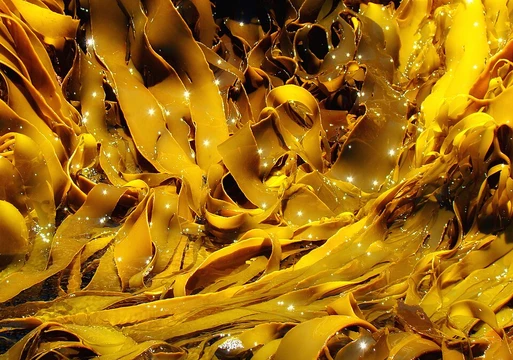
Alaria marginata
A dominant intertidal kelp with chemical defenses and seasonal spore release.

Alaria marginata, known as winged kelp, is a brown alga belonging to the genus Alaria. It reaches lengths of up to 13 feet, with long, narrow fronds that feature a raised midrib and wavy edges. In winter, each frond bears two rows of several smooth, oblong spore-producing blades at its base, each about 5 inches long.
This kelp thrives in wave-exposed intertidal zones, as noted in a 1971 study by Widdowson. Its range spans the northeast Pacific from Alaska down to near Point Conception, California. Along the Big Sur coast, it is the dominant macroalga on exposed mid-to-low rocky shores, often forming extensive patches that offer shelter and food for tide pool animals.
Chemical defenses help protect Alaria marginata from herbivores. Phenolic compounds are concentrated more heavily in the reproductive fronds than in the vegetative blades, which herbivorous snails consume at a higher rate.
Seasonal changes in the kelp’s growth and reproduction have been documented by McConnico and Foster. Thinning of the patches was inversely related to density. From February to July, the kelp grows rapidly, adding up to 1.4 meters in length per month and forming thick canopies. Sorus development begins as early as March, peaking between late August and October, and is positively linked to size. Spore release occurs most frequently from October through January, coinciding with periods of high water movement.
Alaria marginata is edible and typically harvested in spring and early summer to avoid damage from summer storms. Harvesters take the upper frond and midrib, leaving the lower portion to regrow. The kelp can be used fresh or dried; for drying, fronds are hung on clotheslines to preserve both sides evenly. The midrib may be cut out, separating the two opposing sheets from the stiffer central strip. Dried fronds are stored in strips or pieces in a cool, dry place.
Quick Facts
- Genus
- Alaria
- Species
- marginata
Facts from the source article.
Lore & Background
Alaria marginata fronds are long and narrow with a raised midrib and wavy edges. Each frond bears two rows of several smooth, oblong, 5-inch spore-bearing blades at the base in winter. According to a study by Widdowson (1971), this kelp occupies wave-exposed intertidal habitats in the northeast Pacific from Alaska to near Point Conception, California. It is the dominant macroalga on exposed mid-to-low rocky shores along the Big Sur coast, commonly growing in large patches that offer habitat and sustenance for tide pool organisms. In this species, phenolics act as a chemical defense against herbivores; higher concentrations were found in reproductive fronds compared to vegetative blades, which were consumed at a higher rate by herbivorous snails.
Reader's Guide
Alaria marginata is significant as a dominant intertidal kelp that structures wave-exposed rocky shore communities from Alaska to California. Its large patches provide critical habitat and food for tide pool organisms. The kelp exhibits seasonal growth, with fronds lengthening up to 1.4 meters per month from February to July, forming thick canopies. Sorus development begins as early as March, peaking from late August to October, and spore release occurs most frequently between October and January, associated with high water movement. The kelp is edible and commonly harvested in spring and early summer to avoid frond damage from summer storms. Harvesters take the upper frond and midrib, leaving the lower portion to regrow. Harvested fronds can be used fresh or dried by hanging on clotheslines for even preservation; the midrib can be cut out to separate the two opposing sheets and the stiffer midrib. Dried fronds are stored in strips or pieces in a cool, dry place.
Did You Know?
- Alaria marginata can grow up to 13 feet in length.
- Its fronds have a raised midrib and wavy edges, with two rows of 5-inch spore-bearing blades at the base in winter.
- Higher concentrations of phenolic chemical defenses are found in reproductive fronds than in vegetative blades.
More in Brown Macroalgae and Kelp 1-24
Spotted an error? Know more?
Reader corrections go straight into our review queue. Suggest an edit · How this site is sourced