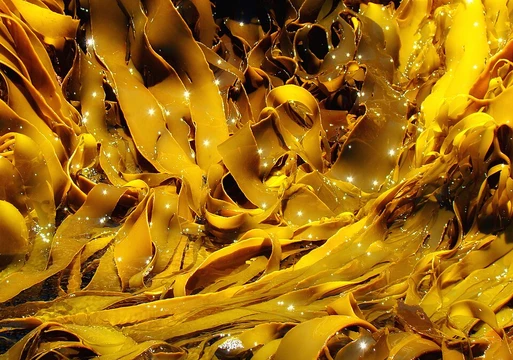
Alaria (alga)
A brown kelp genus eaten worldwide and sensitive to ocean temperature.

Alaria is a genus of brown algae, part of the Phaeophyceae group, with about 17 species. People dry and eat it in Western Europe, China, Korea, Japan (where it’s called sarumen), and South America. Because its spread depends on ocean temperatures, scientists use Alaria’s distribution as a sign of climate change. The most common type, Alaria esculenta, is a big brown seaweed often found along British Isles shores, and researchers have looked into farming it.
Quick Facts
- Taxon
- Alaria
Facts from the source article.
Lore & Background
Alaria is a genus of highly variable brown algae and a member of the order Laminariales, more commonly known as kelp. It has mature sporophytes as small as 15 centimetres and as large as 15 metres in length. It does not show definite air-floats. All species’ sporophytes consist of a ramified holdfast, an unbranched cylindrical stipe, and a blade with a percurrent, cartilaginous midrib. Alaria is frequently found with lacerations running from the margin to the midrib caused by the ravages of the sea. Alaria is the second largest genus of Laminariales, with about 17 currently recognized species. However, due to its highly plastic morphology, the kelp has over 100 specific and subspecific names, which have arisen since it was first described in 1830. These synonyms have been tailored down to the present species through genetic comparisons. Alaria is most commonly found in far northern waters of the Pacific and Atlantic oceans, with the greatest variety of species concentrated in the north Pacific. It has been found on the coasts of England, Ireland, Scotland, Iceland, Greenland, Denmark, Norway, Japan, China, Korea, Canada, and the United States. It is typically found in the sublittoral zones at a depth of 3–10 metres. An important factor in Alaria’s distribution is temperature; it is limited by sea temperature of 16°C and greater. Presumably due to this factor and rising sea temperatures, the genus has largely disappeared from the English Channel within the past 100 years.
Reader's Guide
Alaria holds significance as a food source across multiple continents, being dried and eaten in Western Europe, China, Korea, Japan (where it is called sarumen), and South America. In Ireland, Scotland, Greenland, Iceland, Denmark, and the Faroe Islands, the midrib is removed and the blade and sometimes the leaflets are eaten, although it is not commercially available. It is more commonly eaten in the Far East (China, Japan, and Korea), where seaweed consumption is much more popular than in the West. Seaweeds are considered highly nutritious because typically they are low in fat and have vitamins and minerals in amounts comparable or superior to terrestrial vegetables. Alaria esculenta, in particular, is an excellent source of protein and iodine. The genus also serves as a marker for climate change, as its distribution relates to oceanic temperatures. Recent research conducted on Alaria esculenta in the Arctic showed pronounced temperature effects on the photosynthesis and germination of the algae. Its disappearance from the English Channel within the past 100 years is presumably linked to rising sea temperatures. The most common species, Alaria esculenta, has been studied for its potential for aquaculture.
More in Brown Macroalgae and Kelp 1-24
Spotted an error? Know more?
Reader corrections go straight into our review queue. Suggest an edit · How this site is sourced