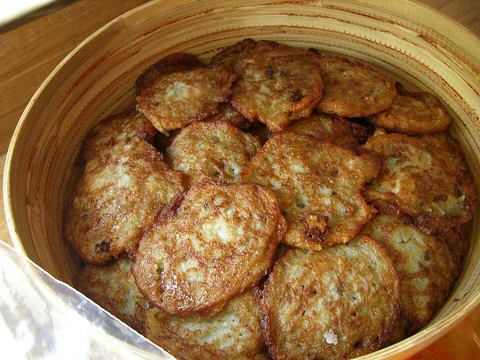
Kalduny
Dumplings of Belarusian, Lithuanian, and Polish cuisines.

Szdjantar · CC BY-SA 4.0
Kalduny (also known as kolduny, kołduny, or koldūnai) are dumplings made from unleavened dough and stuffed with meat, mushrooms, or other ingredients, found in Belarusian, Lithuanian, and Polish cuisines. They are akin to Polish pierogi, Russian pelmeni, and Ukrainian varenyky. The word means 'magicians' or 'sorcerers' in Slavic languages, though the reason for this association with the dish remains unclear.
Quick Facts
- Country
- Polish–Lithuanian Commonwealth
- Main Ingredient
- Unleavened dough (flour mixed with tepid water, eggs, salt); meat, mushrooms, or other filling
Facts from the source article.
Lore & Background
Kalduny are dumplings of unleavened dough filled with meat, mushrooms, or other stuffings, related to dishes from Italian ravioli to Central Asian manti. A notable variety, Kalduny Count Tyshkevich, made with smoked ham and mushrooms, is a 19th-century invention that gained some popularity but never achieved widely recognized canonical status before Soviet rule; it is still prepared in various Belarusian restaurants and home kitchens. The simplest dough uses flour, tepid water, eggs, and salt; some recipes use onion juice instead of water.
Reader's Guide
Kalduny are typically boiled in salted water, though they may also be boiled directly in soup, baked, or fried. They can be served as a main course or dessert, with sauces varying by filling: for example, Vilnius stuffing (mushrooms and smoked pork) is topped with melted butter, while farmer cheese or mashed potato fillings are paired with sour cream. Dessert kalduny are powdered with cinnamon or topped with fruit syrups. Large kalduny (manti) are prepared for major Muslim feasts by the Tatar population in Belarus, made with spiced mutton or veal and eaten by spoon to preserve the juice. The dish offers great potential for variation through combinations of dough, stuffing, and sauce.
Did You Know?
- The word 'kalduny' means 'magicians' or 'sorcerers' in Slavic languages, but how it became associated with the dish is unclear.
- A variety known in Russian cuisine as kundyumy is traditionally first boiled briefly, then baked or fried, not never boiled.
- Large kalduny (manti) are prepared for major Muslim feasts by the Tatar population that has lived continuously in Belarus since the end of the 14th century.
Culinary Identity and Cross-Cultural Kinship
Kalduny occupy a distinctive niche within the vast family of stuffed-dough dishes that stretches from the Mediterranean to Central Asia. They share a close kinship with Polish pierogi, Russian pelmeni, and Ukrainian varenyky, yet their lineage reaches even further, echoing Italian ravioli, Hungarian derelye, Ashkenazi Jewish pirogen, and the manti or chuchvara of Central Asian kitchens. This wide web of resemblance underscores how the basic act of sealing a filling inside a pocket of unleavened dough is a near-universal culinary instinct. Nevertheless, kalduny carry their own Slavic identity, appearing in the cuisines of Belarus, Lithuania, and Poland under slightly different names. The dish thus functions as a cultural bridge, connecting Eastern European traditions to broader Eurasian foodways while retaining a specifically Belarusian, Lithuanian, and Polish character that sets it apart from its neighbors.
Dough, Technique, and the Art of Cooking
The craft of making kalduny begins with a deceptively simple dough: flour, tepid water (or, in some regional recipes, onion juice in place of water), eggs, and a pinch of salt. The mixture must strike a particular balance—soft enough to stretch easily yet elastic enough to seal tightly around a dollop of filling without tearing. Like most pastry doughs, it requires a resting period, covered with a cloth to prevent the surface from drying out. Once shaped, the dumplings are most commonly boiled in a large shallow pot of well-salted water over low heat, though they can also be dropped directly into a simmering soup such as beef broth or borsht. Beyond boiling, the method shifts with the variety: Polesie-style kalduny, stuffed with boiled river fish and hard-boiled eggs, are fried, while the Russian-influenced kundyumy, filled with mushrooms, are either baked in a crock pot or pan-fried and never touched by boiling water. This flexibility in technique gives the dish a remarkable range of textures and presentations.
A Palette of Fillings and Sauces
The true diversity of kalduny lies in their fillings and the sauces that accompany them. Savory preparations feature ground or chopped meat, fresh or dried mushrooms, sautéed sauerkraut mixed with mushrooms, white rice with hard-boiled eggs, or boned freshwater fish such as pike and pike-perch combined with fried or boiled eggs. The most celebrated savory combination is the Vilnius stuffing—equal parts mushrooms and smoked pork—known by the evocative name Kalduny Count Tyshkevich, after a noble family from Lahojsk near Minsk. On the sweet end, whole bilberries or stoned cherries transform the dumpling into a dessert, finished with a dusting of cinnamon or a drizzle of fruit syrup. The topping follows the filling: melted butter crowns the Vilnius-style dumplings, thick sour cream pairs with farmer-cheese or mashed-potato fillings, and cinnamon or syrup dresses the berry varieties. This interplay of dough, stuffing, and sauce creates an almost limitless palette of flavor combinations.
Etymology, Soviet Erasure, and Living Tradition
The name kalduny carries an intriguing etymological mystery: in Slavic languages the root word translates to magicians or sorcerers, yet no definitive explanation exists for how such a term became attached to a humble dumpling. The dish's modern history is marked by loss and partial recovery. Kalduny Count Tyshkevich were once regarded as Belarus's culinary visiting card, a symbol of national gastronomic pride, but decades of Soviet rule nearly erased them from public consciousness. Today they survive in only a handful of local restaurants, while Russian pelmeni and Ukrainian vareniki have gained far wider restaurant presence. Meanwhile, a distinct thread of kalduny tradition persists among the Tatar Muslim community in Belarus, whose ancestors have lived there continuously since the late fourteenth century. For major Islamic feasts, they prepare large manti-style kalduny with spiced mutton or veal, eaten by spoon to preserve the delicate dough and the rich juices within—a practice that links the dish to a living, centuries-old religious and cultural ritual.
Gallery

Frequently Asked Questions
Who is Kalduny?
Kalduny (also spelled kolduny, kołduny, or koldūnai) are a stuffed-dumpling dish rooted in the culinary traditions of Belarus, Lithuania, and Poland. They are made from unleavened dough and filled with meat, mushrooms, or other ingredients.
What are Kalduny's powers or role?
Kalduny function as a hearty, filling dish that sits squarely alongside Polish pierogi, Russian pelmeni, and Ukrainian varenyky in the Slavic dumpling family. A distinguished variant known as 'Kalduny Count Tyshkevich' carries a notable aristocratic name within the tradition.
Why is Kalduny important?
Kalduny highlight a point of culinary overlap among Belarusian, Lithuanian, and Polish food cultures, showing how dumpling-making traditions cross borders. Their name literally translates to 'magicians' or 'sorcerers' in Slavic languages, lending a folkloric air to an everyday dish.
What's the origin of Kalduny's name?
The word Kalduny means 'magicians' or 'sorcerers' in Slavic languages, yet the precise reason this mystical term was attached to a humble dumpling has never been definitively explained. This etymological mystery is one of the most frequently searched topics among fans of the dish.
More in Belarusian cuisine 1-18
Spotted an error? Know more?
Reader corrections go straight into our review queue. Suggest an edit · How this site is sourced