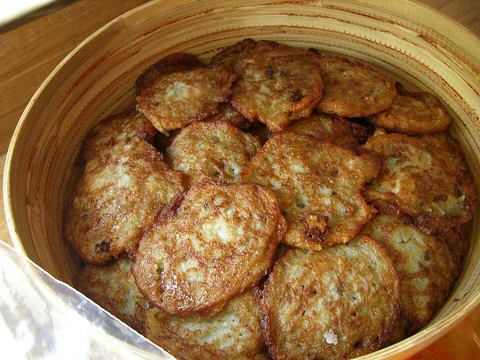
Blini
Russian leavened pancakes served with sweet or savory toppings.

EgorovaSvetlana · CC BY-SA 4.0
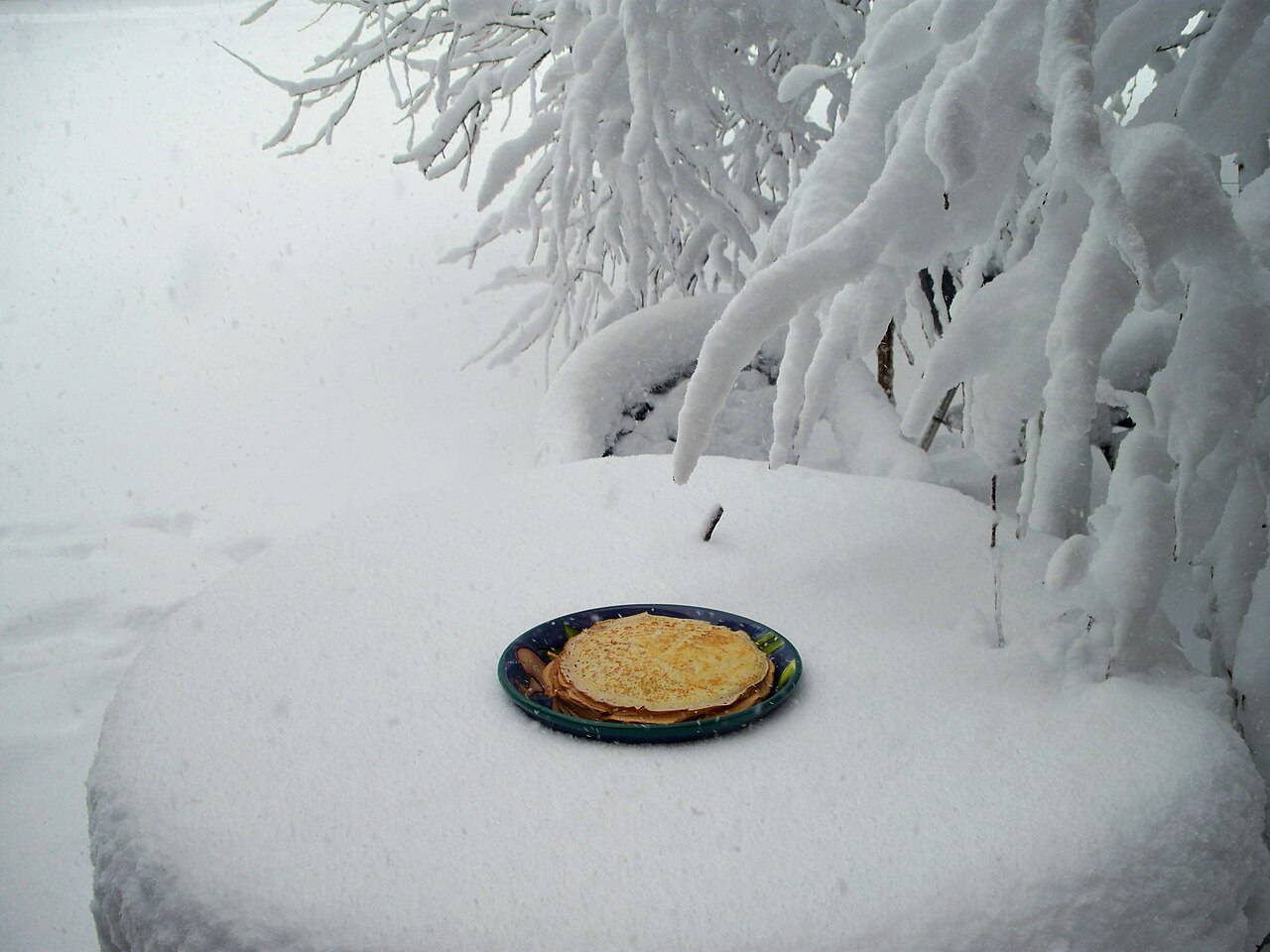
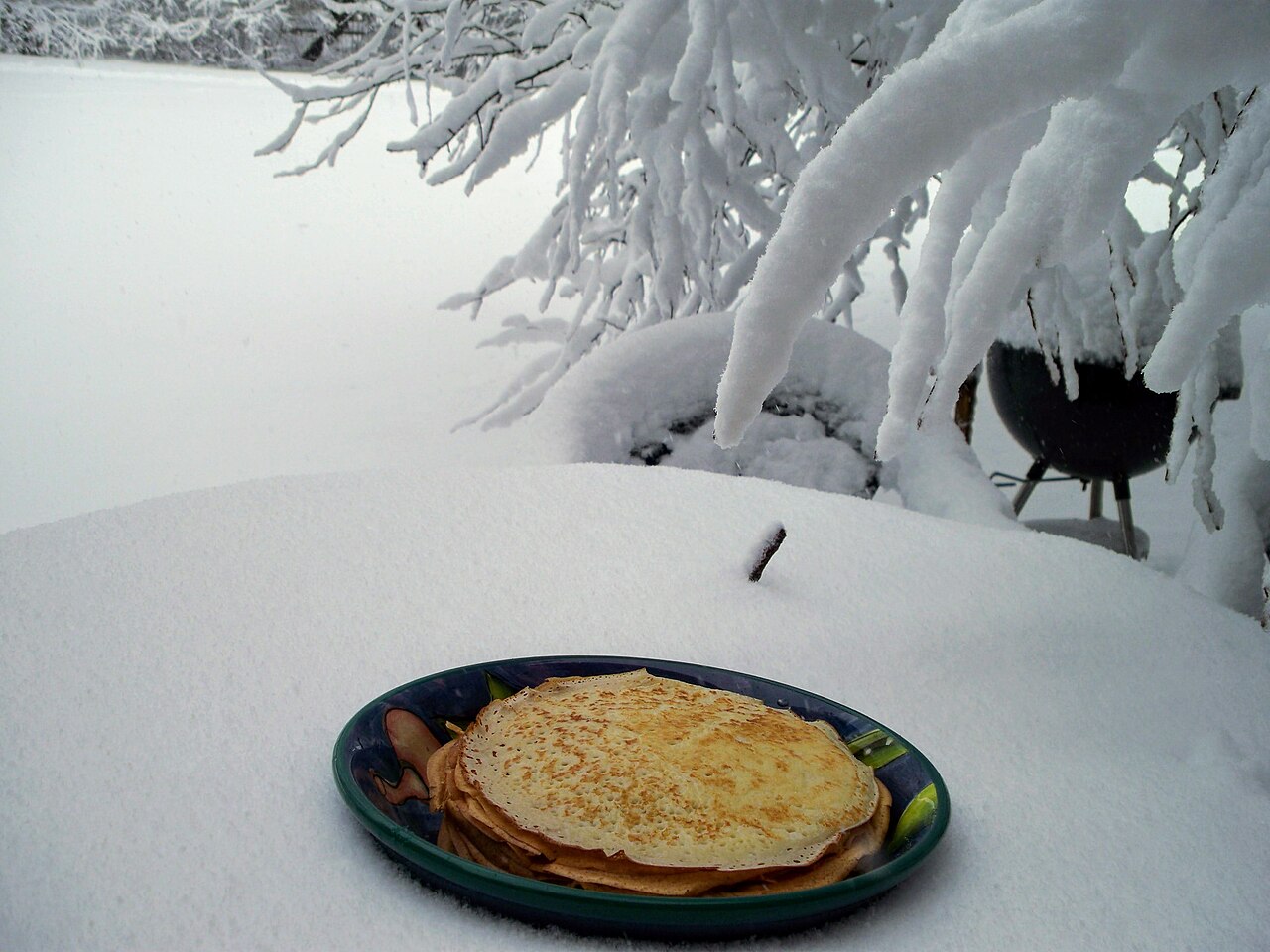
Blini (also called blinis or bliny) are Russian pancakes, traditionally made from a yeast-risen batter of buckwheat flour, wheat flour, or a mix of both, with milk. They can be topped with smetana, cottage cheese, caviar, or other garnishes, or simply spread with butter. A staple of Russian cuisine, in English the word "blini" usually refers to small, savory pancakes made with leavened batter. In modern Russian, however, the term most often describes large, thin, leavened pancakes cooked in a pan, though smaller leavened versions are also called blini. Smaller, thicker pancakes baked several at a time on one large pan are known as oladyi.
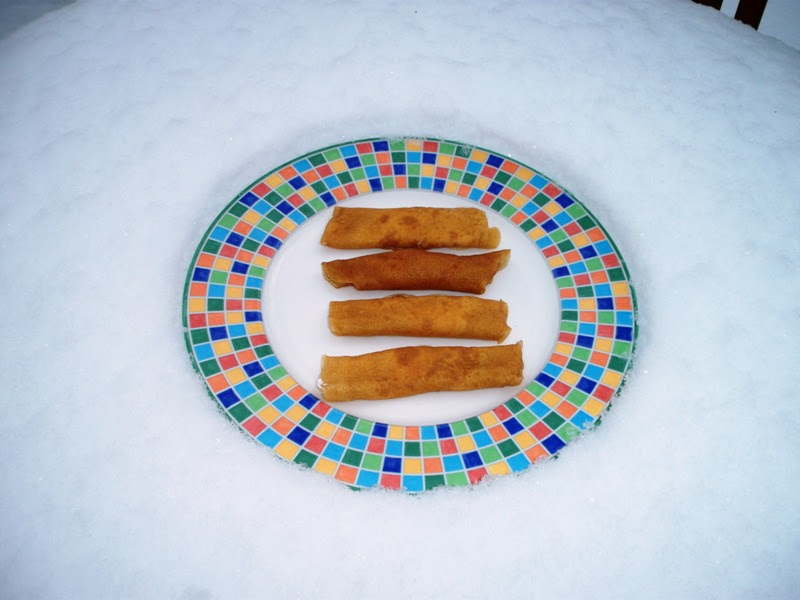
Blintzes, called blinchiki (meaning "little blinis") in Russian, are a variation of blini or crêpes. They are thin wheat-flour pancakes rolled into casings for fillings—typically cheese, fruit, or, in Russian cuisine, pre-fried minced meat—then sautéed or baked.
The Proto-Slavic word for these pancakes was likely *mlinŭ* (related to "to mill"), which evolved into Old Russian млинъ (mlinŭ) and then блинъ (blinŭ). Linguist Max Vasmer noted similar words across many Slavic languages, as well as in Latvian and Lithuanian. While the modern Russian plural блины (bliny) now covers foreign-introduced pancakes in general, the term русские блины ("Russian pancakes") is often used in Russia to distinguish them. Some English dictionaries list "blin" as singular and "blini" or "bliny" as plural, matching the original Russian, but others treat "blini" as the singular and "blinis" as the plural, reflecting common English usage.
Blini date back to the Middle Ages. In Russian culture, they were traditionally prepared at the end of winter for Maslenitsa ("butter week") and eaten twice a day. They also appeared at funerals and during prayers for the dead. Traditional Russian blini use a yeasted batter that rises and is then thinned with milk, soured milk, or cold or boiling water. When boiling water is used, they are called zavarnye bliny (the term zavarnoe testo refers to choux pastry). A lighter, thinner version made from unyeasted batter—typically flour, eggs, milk, soured milk, kefir, ryazhenka, or varenets—is also common. Any flour can be used, from wheat and buckwheat to oatmeal and millet, though wheat is now the most popular. Historically, blini were baked in a Russian oven, which was used for all kinds of food heat processing.
Quick Facts
- Country
- Russia
- Main Ingredient
- wheat, eggs (optional), milk, water
- Cookbook
- Bliny
Facts from the source article.
Lore & Background
Blini have a history dating to the Middle Ages. In Russian culture, they were traditionally prepared at the end of winter during Maslenitsa ('butter week') as a treat eaten twice a day. There were also other occasions for eating blini, such as at funerals and during prayers for the dead. Traditional Russian blini are made with yeasted batter, which is left to rise and then diluted with milk, soured milk, and cold or boiling water. When diluted with boiling water, they are referred to as zavarnye bliny. A lighter and thinner form made from unyeasted batter is also common in Russia. All kinds of flour may be used, from wheat and buckwheat to oatmeal and millet, although wheat is currently the most popular. Historically, blini have been baked in a Russian oven, and preparing blini is still referred to as 'pech bliny' ('to bake blini') in Russian.
Reader's Guide
Blini are a foundational element of Russian cuisine, with a history reaching back to the Middle Ages. They are most famously associated with Maslenitsa, the end-of-winter festival, but also appear at funerals and prayers for the dead. The dish has evolved: traditional blini use a yeast-raised batter, while modern versions often use unyeasted batter for thinner pancakes. The influence of French cuisine in the 19th century may have led to lighter blini. Blini are versatile, served with butter, sour cream, jam, honey, caviar, or folded with fillings like cheese, fruit, or meat. The term 'blini' in English has shifted from a plural-only form to a singular noun with regular plural 'blinis'. The word itself is also used in Russian as a minced oath for a swear word, and appears in proverbs such as 'The first blin is lumpy,' meaning the first attempt is often unsuccessful. Buckwheat blini are traditional in Russia and also found in Ukraine and Lithuania.
Did You Know?
- The Proto-Slavic term for blini was probably mlinŭ ('to mill'), which became блинъ in Old Russian.
- In Russian, preparing blini is still called 'pech bliny' ('to bake blini'), even though they are now pan-fried.
- The word 'blin' is used in Russian as a minced oath for the swear word 'блять' (blyat'), similar to 'damn!'.
- Buckwheat blini are known as hrechanyky in Ukraine and grikių blynai in Lithuania's Dzūkija region.
Etymology & Linguistic Identity
The word for these pancakes traces back to Proto-Slavic "mlinŭ," meaning "to mill," which evolved through Old Russian into both "mlinŭ" and "blinŭ." This root surfaces across Slavic languages as well as in Latvian and Lithuanian, underscoring the dish's deep Pan-Slavic heritage. In contemporary Russian, "bliny" (the plural of "blin") most commonly denotes pan-sized leavened thin pancakes, though smaller leavened versions also go by that name. Thicker, smaller pancakes baked several to a single pan are set apart as "oladyi." English has its own tangle: some dictionaries preserve the Russian singular "blin" with plurals "blini" or "bliny," while others regard that usage as too marginal and record only "blini" as singular and "blinis" as plural. When speakers wish to distinguish their own tradition from foreign-introduced pancakes, they specify "russkiye bliny" — "Russian pancakes" — a small but pointed act of linguistic ownership.
Historical Roots & Cultural Ritual
Blini's story reaches into the Middle Ages, when they became woven into the Russian calendar as both seasonal and spiritual markers. At the close of winter, during Maslenitsa — colloquially "butter week" — households prepared blini as a twice-daily indulgence, a way to mark the return of light. Beyond seasonal celebration, blini appeared at funerals and in prayers for the dead, embedding them in the full arc of human experience. Historically, these pancakes were baked in the Russian oven, the same hearth that handled all manner of food preparation. A linguistic fossil endures: even now, when blini are pan-fried like modern pancakes, Russians still say "pech bliny" — "to bake bliny" — and the word for the Russian oven, "pech," is a direct cognate. By the nineteenth century, French culinary influence likely nudged Russian blini toward lighter, thinner preparations, reshaping what had been a hearty yeasted tradition into something more delicate.
Culinary Craft & Varieties
The preparation of blini reveals a wide spectrum of technique. The classic Russian version uses a yeasted batter — left to rise, then thinned with milk, soured milk, or water. When that water is boiling, the result is called "zavarnye bliny," a term linked to the Russian concept of choux pastry. A lighter, thinner alternative skips the yeast entirely, relying on flour, eggs, and dairy such as kefir, ryazhenka, or varenets. While wheat flour dominates today, buckwheat, oatmeal, and millet all carry historical weight. Buckwheat blini hold particular cultural significance in Ukraine, where they go by "hrechanyky," and in Lithuania's Dzūkija region — the only part of the country that grows buckwheat — where they are called "grikių blynai," literally "buckwheat blini." Beyond the basic disc, blini can be folded or rolled around fillings ranging from tvorog and berry compote to pre-fried minced meat, salmon, or chopped mushrooms. A distinct preparation, "blini s pripyokom," involves pouring batter over vegetables, meat, or mushrooms already placed in the pan, creating a layered savory cake.
Cultural Resonance & Popular Language
Beyond the kitchen, blini have seeped into Russian speech and everyday expression in ways that far exceed food. The singular "blin" functions as a minced oath — a softened stand-in for a harsher swear word — used as an interjection to vent frustration, roughly equivalent to "damn!" or "Holy Moly!" in English. Proverbs carry the pancake's weight too: "Первый блин комом" ("The first blin is lumpy") is the go-to reassurance for anyone whose first attempt at a task has flopped, reminding them that imperfection is expected and forgivable. In the structure of a full Russian meal, blini occupy a specific place after the cold appetizers, potentially followed by consommé, pies, and the main meat course — a sequence that, as one observer noted, demands a gargantuan appetite. Even in foreign Russian-style restaurants, blini paired with caviar remain a signature party dish, carrying the flavor of home across borders.
Gallery
Frequently Asked Questions
What is Blini?
Blini is a leavened pancake dish rooted in Russian and broader Slavic culinary tradition, built from a yeast-risen batter of buckwheat or wheat flour and milk. In everyday English the word usually points to small, savory pancakes, whereas in modern Russian it more often describes larger, thinner pancakes cooked flat in a pan.
What are Blini's core ingredients?
The classic batter blends buckwheat flour, wheat flour (or a mix of both), milk, and yeast to produce a slightly tangy, risen base. Toppings range from smetana and cottage cheese to caviar, or simply a generous spread of butter.
When does Blini play a central role in tradition?
Blini is the signature dish of Maslenitsa, the week-long celebration often called 'butter week,' when they are eaten in abundance before the fasting season begins. They also appear at funerals and in prayers for the dead, serving as a symbolic offering to the departed.
Where does the name 'Blini' come from?
The word descends from the Proto-Slavic root mlinŭ, meaning 'to mill,' which passed through Old Russian forms млинъ and блинъ before settling into the modern plural blini. The etymology ties the dish directly to the grain-grinding process that produces its flour base.
What other dishes is Blini related to?
Blini is closely linked to blintzes (blinchiki), which are rolled or folded versions of the same pancake, and to oladyi, a thicker, rounder cousin made from a similar leavened batter. Together they form a family of grain-and-yeast pancakes across Slavic cooking traditions.
More in Belarusian cuisine 1-18
Spotted an error? Know more?
Reader corrections go straight into our review queue. Suggest an edit · How this site is sourced