
Cold beet soup
Cold beet soup is a shared heritage of several Eastern European cuisines.

Auctor quaerendae · CC BY-SA 4.0
Cold beet soup is a cold summer soup found in the cuisines of Belarus, Lithuania, Latvia, Poland, and Ukraine. It is historically associated with the culinary traditions of the Grand Duchy of Lithuania and the later Polish–Lithuanian Commonwealth, where cold sour soups were common across all social strata. The dish has several regional and national forms, with the beetroot-and-kefir version known as šaltibarščiai being especially prominent in modern Lithuanian cuisine.
Quick Facts
- Country
- Grand Duchy of Lithuania / Polish–Lithuanian Commonwealth
- Region
- Eastern Europe
- Associated Cuisine
- Belarusian cuisine, Latvian cuisine, Lithuanian cuisine, Polish cuisine, Ukrainian cuisine
- Main Ingredient
- Beetroot or sorrel, kefir, soured milk or kvass, cucumbers, greens, eggs
Facts from the source article.
Lore & Background
Cold beet soup developed within the shared culinary space of the former Grand Duchy of Lithuania and the Polish–Lithuanian Commonwealth. One of the earliest known recipes was recorded in Warsaw by Paul Tremo, head chef to King Stanisław August Poniatowski, at the end of the 18th century. Another early account was left by military doctor Jan Drozdowski, who described a cold soup called chołodec in Biała-Radziwiłłowska at the end of the 18th century. In the 19th century, the dish was widely represented in regional cookbooks and ethnographic descriptions, including works by Jan Szyttler and Wincenta Zawadzka.
Reader's Guide
Cold beet soup remains a recognisable summer dish in several Eastern European cuisines, with distinct modern forms in each. It is particularly prominent in modern Lithuanian cuisine, where šaltibarščiai has become a widely known national dish and an element of culinary branding. Contemporary debates about the attribution of cold beet soup often reflect modern national identities, but historically the dish is understood as part of the shared culinary heritage of the former Grand Duchy of Lithuania and the Polish–Lithuanian Commonwealth. Since 2023, an annual cold beet soup festival has been held in Vilnius, reflecting its exceptional importance in Lithuanian public food culture and culinary tourism.
Did You Know?
- The dish is mentioned in Adam Mickiewicz's epic poem Pan Tadeusz.
- A Lenten version recorded in 1878 used crayfish tails and olive oil instead of sour cream and meat.
- The German physician Johann Peter Frank was served cold soup with ice in 1805 during a visit to Nyasvizh.
Shared Roots in the Grand Duchy of Lithuania
Cold beet soup belongs to a shared culinary heritage stretching across Belarus, Lithuania, Latvia, Poland, and Ukraine. Its deepest roots lie in the Grand Duchy of Lithuania and the later Polish–Lithuanian Commonwealth, a vast territory encompassing modern Lithuania, much of Belarus, parts of Latvia, eastern Poland, and Ukraine. Within that world, cold sour soups were not a luxury reserved for the elite; they were a staple enjoyed by everyone from the highest nobility down to the peasant household. The Polish name chłodnik litewski, literally "Lithuanian cold soup," preserves that historical connection even though the dish was never exclusive to a single nation. In contemporary Lithuania, the beetroot-and-kefir version called šaltibarščiai stands as one of the country's most recognized summer dishes, while in Belarus the name chaladnik appears extensively in eighteenth- and nineteenth-century ethnographic records as a widespread traditional preparation. A related Russian cousin, svekolnik, is typically built around bread kvass or beetroot kvass, showing how the concept of a cold, sour, beet-based soup radiated outward from that common core.
Tracing the Dish Through Early Cookbooks and Memoirs
The earliest documented recipe for a dish called chłodnik was penned by Paul Tremo, head chef serving King Stanisław August Poniatowski in Warsaw, at the close of the eighteenth century. Around the same period, military physician Jan Drozdowski recorded his first encounter with the soup in Biała-Radziwiłłowska, present-day Biała Podlaska, where a local woman served him a preparation she called chołodec. He noted the dish also went by the names chłodnik and, among ordinary folk, boćwina, and that the noble-household version was enriched with crayfish tails and sour cream. The nineteenth century brought a flood of printed references. Vilnius-based cook Jan Szyttler included cold soups in his 1848 volume, and Wincenta Zawadzka's Kucharka litewska, published in Vilnius in 1854, presented the soup as a regional specialty of wealthier kitchens. Maria Marciszewska, writing from Zhytomyr in 1878 and identifying herself as a "Lithuanian living in Ukraine," published a recipe under the dual title "Lithuanian cold soup, or Ukrainian cold soup," even offering a Lenten adaptation that substituted walnut milk and olive oil for the usual dairy and crayfish. The dish crossed borders into English-language cookery as well, appearing in the 1842 edition of Mary Eliza Rundell's A New System of Domestic Cookery among a set of "Polish" recipes.
From Beetroot to Bowl: The Craft of Preparation
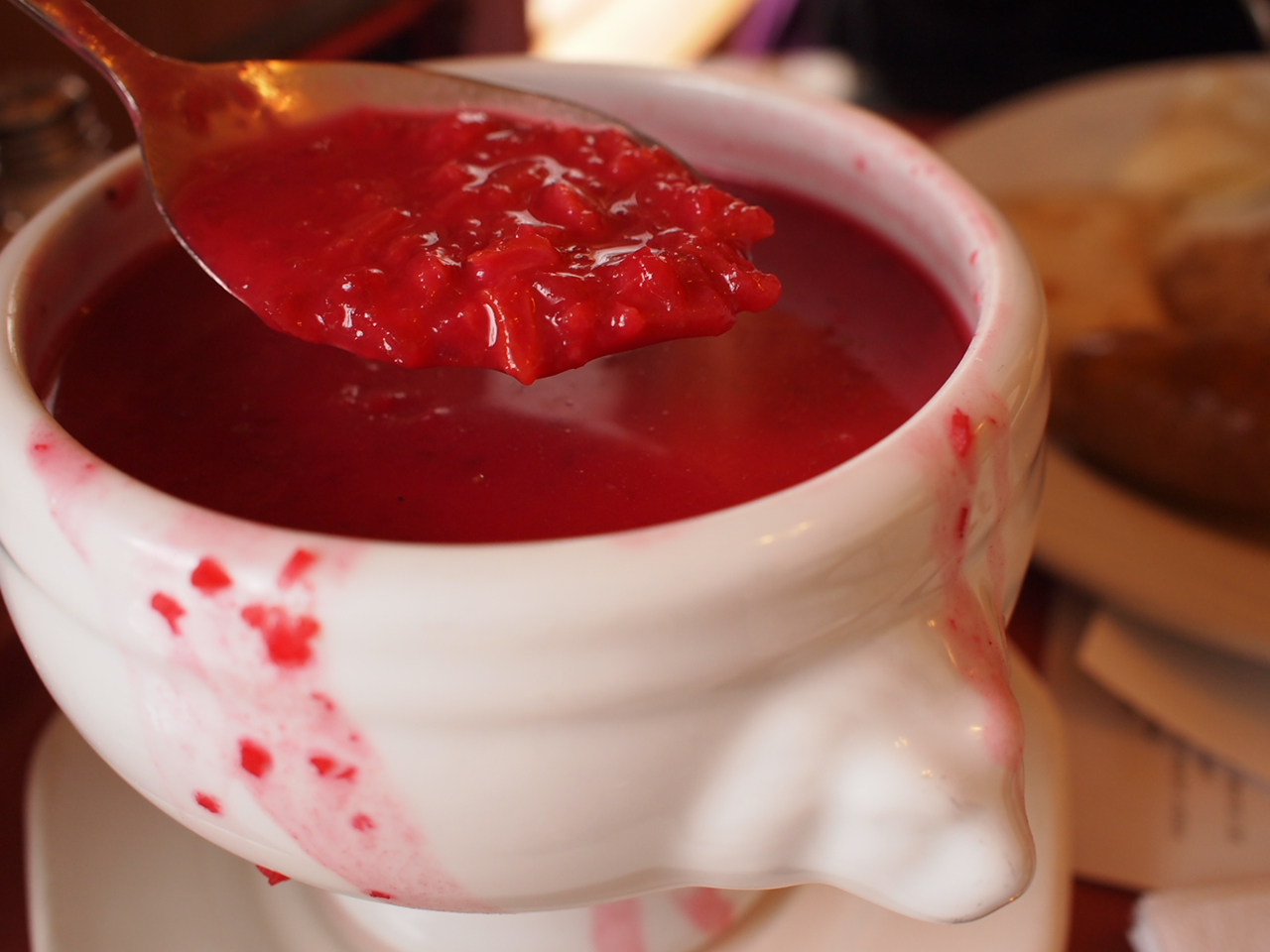
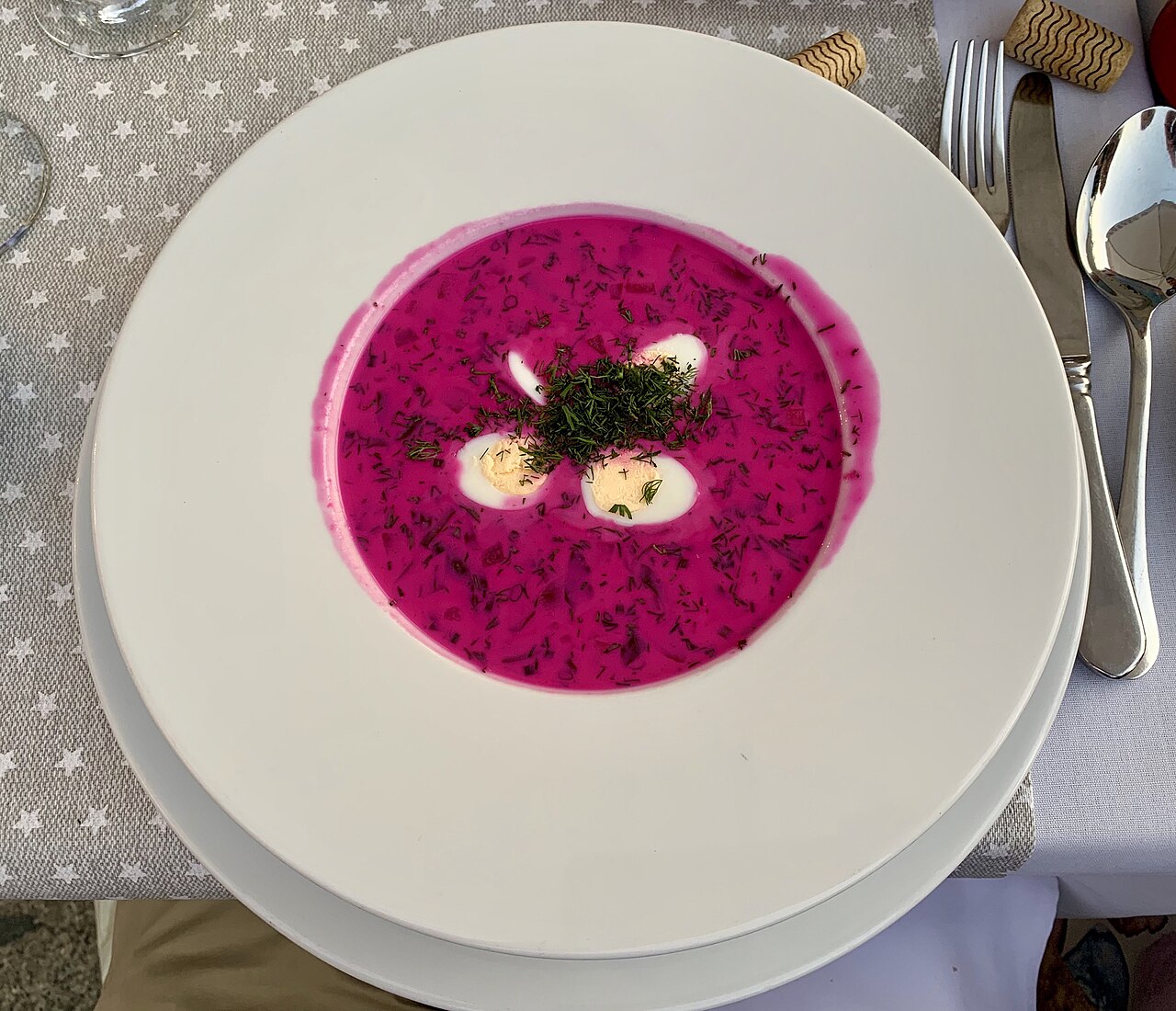
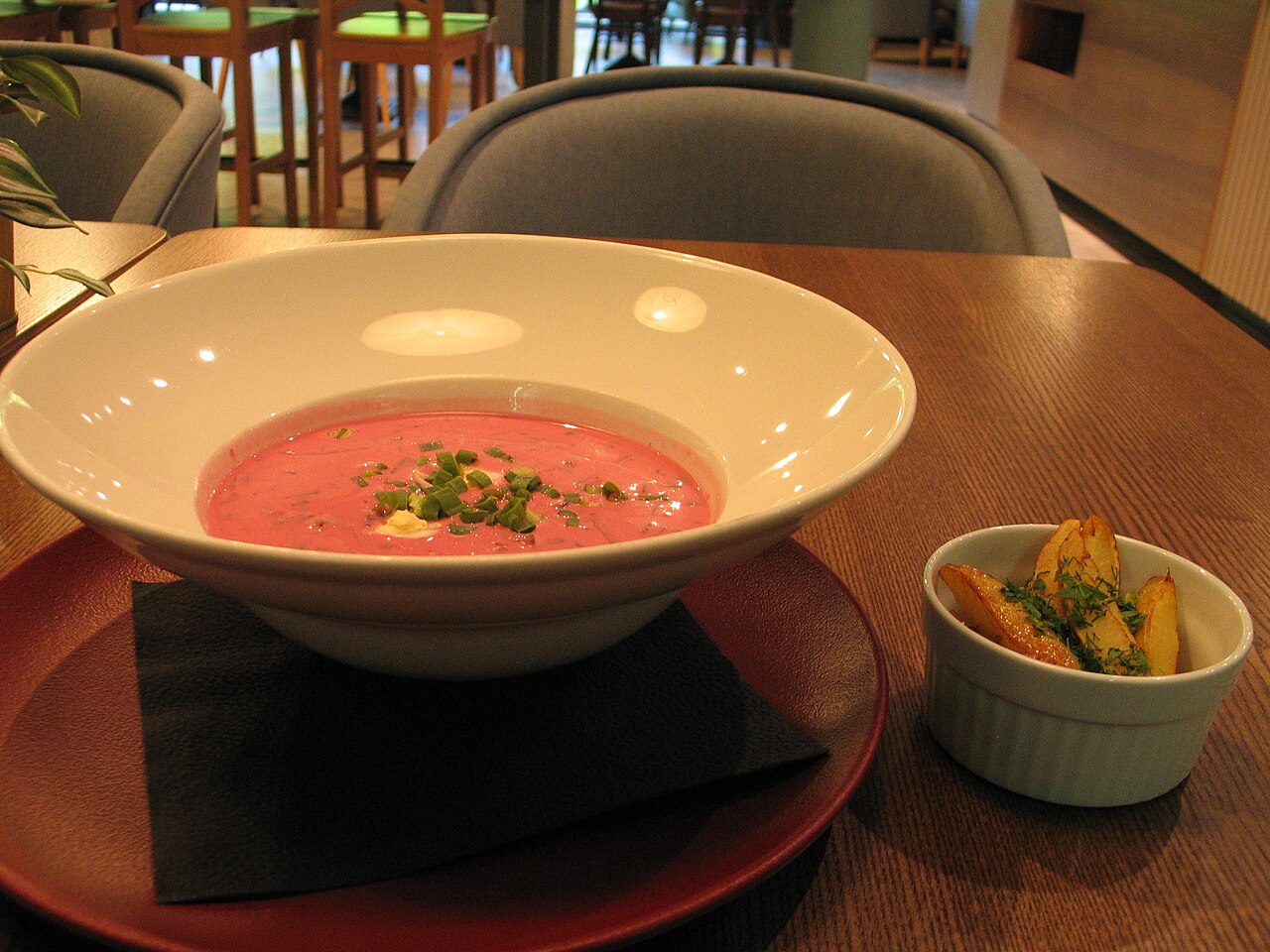
The modern preparation of cold beet soup follows a recognizable pattern across the region. Boiled beetroot is cooled, peeled, and either grated or chopped into the bowl. Fresh cucumbers are diced or sliced, and a handful of green onions, dill, or other herbs are finely minced. These vegetables are then combined with a cold liquid base—water, kefir, soured milk, buttermilk, or a blend of several. To sharpen the flavor, cooks reach for vinegar, lemon juice, beet kvass, or bread kvass. A hard-boiled egg, halved or roughly chopped, is typically added just before serving, and the finished soup is garnished with a sprig of dill or a dollop of sour cream. Boiled potatoes, a slice of rye bread, or other simple accompaniments often sit on the side. The recipe is not monolithic: a sorrel-based variant exists, and older preparations incorporated beet greens, young beetroot leaves, or different fermented liquids. Historically, the gap between noble and rural tables was significant. Aristocratic kitchens layered in more elaborate additions, while peasant versions relied on whatever seasonal produce and fermented liquids were at hand, keeping the dish simple and deeply tied to the local larder.
A Soup in Literature and Living Tradition
Cold beet soup has left a lasting imprint on the literary and cultural memory of the former Grand Duchy of Lithuania. In 1805, the German physician and Vilnius University professor Johann Peter Frank recalled being served a cold soup with ice during a visit to Nyasvizh to see Prince Michał Hieronim Radziwiłł. A decade later, Stanisław Morawski described a dinner in the Navahrudak region where hosts presented several soups, cold beet soup among them. The dish also found its way into Adam Mickiewicz's epic poem Pan Tadeusz, set in that same Navahrudak landscape, where it anchors the culinary atmosphere of the old Commonwealth. Gabriela Puzynina's memoirs reveal a more personal bond: while living in Warsaw, she associated the soup with her homeland, and in 1825 her family brought it to a picnic at Puławy as a regional speciality. The tradition has not faded. Since 2023, Vilnius has hosted an annual cold beet soup festival, a public celebration that underscores how central šaltibarščiai remains to Lithuanian food culture and to the country's growing culinary tourism.
Gallery

Frequently Asked Questions
What is Cold beet soup and where does it come from?
Cold beet soup is a chilled summer dish rooted in the culinary traditions of Belarus, Lithuania, Latvia, Poland, and Ukraine. It descends from the cold sour soups that were everyday fare for every social class during the Grand Duchy of Lithuania and the later Polish–Lithuanian Commonwealth.
What are Cold beet soup's key ingredients?
The dish is built on a base of beetroot mixed with a fermented dairy such as kefir, soured milk, or buttermilk. It is typically finished with diced cucumbers, fresh dill, and hard-boiled eggs to add crunch and brightness.
When was Cold beet soup first documented in writing?
The earliest known recipe for the soup was recorded in Warsaw by Paul Tremo at the close of the 18th century. That single entry predates the modern nation-states that today each claim a version of the dish.
What names does Cold beet soup go by across different regions?
Depending on the country, it is called chaladnik in Belarus, aukstā zupa in Latvia, šaltibarščiai in Lithuania, chłodnik litewski in Poland, or kholodnyk in Ukraine. The Lithuanian form šaltibarščiai is especially prominent in contemporary Lithuanian cooking.
Why is Cold beet soup important to Eastern European food culture?
It stands as a shared culinary heritage that binds five countries together through a single dish, making it a rare example of a recipe that belongs to no one nation exclusively. Its cultural weight is recognized today by events such as the annual cold beet soup festival in Vilnius, running since 2023.
More in Belarusian cuisine 1-18
Spotted an error? Know more?
Reader corrections go straight into our review queue. Suggest an edit · How this site is sourced