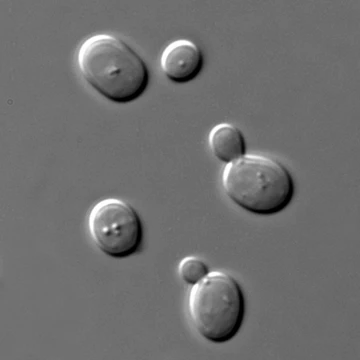
Schizosaccharomyces pombe
Fission yeast used in brewing and cell cycle research.

Schizosaccharomyces pombe, commonly known as fission yeast, is a single-celled eukaryote used both in traditional beer-making and as a laboratory model for studying molecular and cell biology. Its cells are rod-shaped, typically 3 to 4 micrometers wide and 7 to 14 micrometers long. The genome spans about 14.1 million base pairs and is thought to hold around 4,970 protein-coding genes and at least 450 non-coding RNAs. These cells grow only at their tips and reproduce by splitting down the middle, producing two equally sized daughter cells—a trait that makes them especially useful for research on the cell cycle. The species was first isolated in 1893 by Paul Lindner from an East African millet beer. Its name comes from the Swahili word for beer, *pombe*. It was turned into an experimental model in the 1950s: Urs Leupold used it for genetics, and Murdoch Mitchison for cell cycle studies. Later, researcher Paul Nurse brought together these two lines of work, and along with Lee Hartwell and Tim Hunt, won the 2001 Nobel Prize in Physiology or Medicine for discoveries about cell cycle control. In 2002, a consortium led by the Sanger Institute published the full genome sequence of *S. pombe*, making it the sixth model eukaryote to be fully sequenced. Researchers are supported by the PomBase model organism database, which has helped reveal that about 70% of *S. pombe* genes have counterparts in humans, including many linked to human disease. In 2006, the locations of nearly all its proteins within the cell were mapped using green fluorescent protein tags. The yeast is also widely used to study how cells respond to DNA damage and how DNA replication works. Around 160 natural strains of *S. pombe* have been collected from Europe, the Americas, and Asia. Most come from cultivated fruits like apples and grapes, or from alcoholic drinks such as Brazilian Cachaça. It has also been found in fermented tea, kombucha, though it is unclear whether it plays a major role in fermentation there or is just a contaminant. The natural ecology of *Schizosaccharomyces* yeasts remains poorly understood. The species was first discovered in 1893 by a group at a Brewery Association Laboratory in Germany, who examined sediment from an acidic millet beer imported from East Africa. The prefix *schizo* means "split" or "fission" and had been used for other *Schizosaccharomycetes*.
Quick Facts
- Genus
- Schizosaccharomyces
- Species
- pombe
Facts from the source article.
Lore & Background
Schizosaccharomyces pombe was first discovered in 1893 when a group working in a Brewery Association Laboratory in Germany examined sediment from millet beer imported from East Africa that gave it an acidic taste. The species name pombe is the Swahili word for beer. The standard strains were isolated by Urs Leupold in 1946 and 1947 from a culture that he obtained from the yeast collection in Delft, The Netherlands. Fission yeast belongs to the division Ascomycota. It is unique among ascomycetous yeast genera due to the deposition of α-(1,3)-glucan in the cell wall and the virtual lack of chitin. S.
Reader's Guide
Schizosaccharomyces pombe was first developed as an experimental model in the 1950s by Urs Leupold for studying genetics and by Murdoch Mitchison for studying the cell cycle. Paul Nurse, a fission yeast researcher, merged the independent schools of fission yeast genetics and cell cycle research, and together with Lee Hartwell and Tim Hunt won the 2001 Nobel Prize in Physiology or Medicine for work on cell cycle regulation. The sequence of the S. pombe genome was published in 2002 by a consortium led by the Sanger Institute, becoming the sixth model eukaryotic organism whose genome has been fully sequenced. Researchers are supported by the PomBase model organism database, which has helped identify many genes orthologous to human genes—70% to date, including many involved in human disease. In 2006, sub-cellular localization of almost all proteins in S. pombe was published using green fluorescent protein as a molecular tag. The organism has also become important in studying cellular responses to DNA damage and DNA replication. Compared to budding yeast Saccharomyces cerevisiae, S. pombe has three chromosomes, nearly 5,000 introns, large repetitive centromeres similar to mammalian centromeres, and RNAi machinery genes like those in vertebrates.
Did You Know?
- S. pombe cells divide by medial fission to produce two daughter cells of equal size.
- S. pombe has three chromosomes, while Saccharomyces cerevisiae has 16.
- Approximately 70% of S. pombe genes are orthologous to human genes.
More in Yeasts, Part 2 1-24
Spotted an error? Know more?
Reader corrections go straight into our review queue. Suggest an edit · How this site is sourced