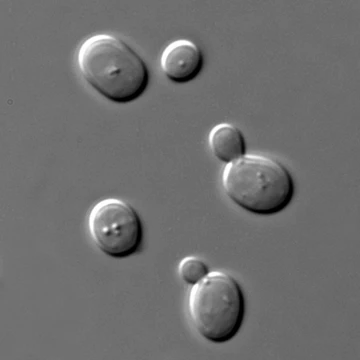
Komagataella
A methylotrophic yeast used widely in protein expression and research.

Komagataella is a type of methylotrophic yeast belonging to the order Pichiales. It was first discovered in the 1960s under the name *Pichia pastoris*, recognized for its ability to use methanol as a carbon and energy source. In 1995, it was reclassified as the sole member of the new genus *Komagataella*, becoming *Komagataella pastoris*. By 2005, researchers determined that nearly all industrial and laboratory strains actually belonged to a separate species, *K. phaffii*. Further studies have since identified additional species, bringing the total to seven recognized ones. Despite this, the older name *Pichia pastoris* is still commonly used in protein production contexts as of 2023, and in informal settings the yeast may be confusingly called simply "pichia."
Over years of study, *Komagataella* has become widely used in biochemical research and biotechnology. *Komagataella phaffii*, in particular, is valued as a strong expression system for protein production and as a model organism for genetic research.
**Taxonomy** According to GBIF, the seven recognized species are: *Komagataella kurtzmanii*, *K. mondaviorum*, *K. pastoris*, *K. phaffii* (responsible for most, if not all, industrial and research use), *K. populi*, *K. pseudopastoris*, and *K. ulmi*.
**Natural habitat** In nature, *Komagataella* is found on trees, such as chestnut trees. It is a heterotroph that can use several carbon sources, including glucose, glycerol, and methanol, but it cannot use lactose.
**Reproduction** *Komagataella* reproduces both asexually (by budding) and sexually (by forming ascospores). It exists as haploid and diploid cells. In the asexual cycle, haploid cells reproduce via mitosis. In the sexual cycle, diploid cells undergo sporulation and meiosis. Colony growth rates vary widely, from nearly zero to a doubling time of about one hour, which suits industrial processes.
**As a model organism** *Komagataella* has been identified as a good model organism for several reasons. It is easy to grow and handle in the lab, has a short life span and fast regeneration time like other yeast models, and can grow quickly to high cell density on inexpensive culture media. The genome of *K.
- Discovery year
- 1960s
- Original name
- Pichia pastoris
- Reassignment year
- 1995
- Reassigned to
- Komagataella pastoris
- Species separated year
- 2005
- Separated species
- Komagataella phaffii
- Total recognized species
- 7
Lore & Background
Komagataella was originally found in the 1960s as Pichia pastoris, noted for its ability to use methanol as a carbon and energy source. In 1995, it was reassigned into the sole representative of the genus Komagataella, becoming Komagataella pastoris. In 2005, it was discovered that almost all strains used industrially and in labs are a separate species, K. phaffii. Later studies distinguished new species, resulting in a total of 7 recognized species. The old name is still used in the context of protein production as of 2023, and in less formal use the yeast may confusingly be referred to as pichia.
In nature, Komagataella is found on trees such as chestnut trees. It is a heterotroph that can use glucose, glycerol, and methanol as carbon sources, but cannot use lactose. It reproduces both asexually (by budding) and sexually (by ascospore), with haploid and diploid cells. The growth rate of its colonies can vary widely, from near zero to a doubling time of one hour, which is suitable for industrial processes.
Reader's Guide
Komagataella is significant as a model organism and expression system platform. It can be grown easily in the lab with inexpensive culture media, achieving high cell density. Its whole genome has been sequenced, with the K. phaffii GS115 genome published in Nature Biotechnology, and all seven species were sequenced by 2022. Komagataella shares similar growth conditions with Saccharomyces cerevisiae, but unlike S. cerevisiae, it can functionally process large proteins. As a genetic model, it is used for genetic analysis and large-scale crossing, with complete genome data enabling study of functional genes such as those for peroxisome assembly. As an experimental model, it serves as a host for transformation, with abilities for recombination with foreign DNA and processing large proteins. Its expression system advantages include growth on simple medium, strongly inducible AOX promoters (especially Aox1), high cell density, and a well-developed secretory pathway for proper folding and post-translational modification of heterologous proteins. Disadvantages include inability to produce some proteins requiring specific chaperonins. Compared to Escherichia coli, Komagataella is slower but capable of forming disulfide bonds and glycosylations, which E. coli cannot.
Did You Know?
- Komagataella was originally known as Pichia pastoris and was reassigned to its current genus in 1995.
- Almost all industrial and laboratory strains belong to the species Komagataella phaffii, separated in 2005.
- Komagataella can grow with a doubling time as short as one hour, making it suitable for industrial processes.
- The K. phaffii GS115 genome was sequenced by the Flanders Institute for Biotechnology and Ghent University and published in Nature Biotechnology.
More in Yeasts, Part 2 1-24
Spotted an error? Know more?
Reader corrections go straight into our review queue. Suggest an edit · How this site is sourced